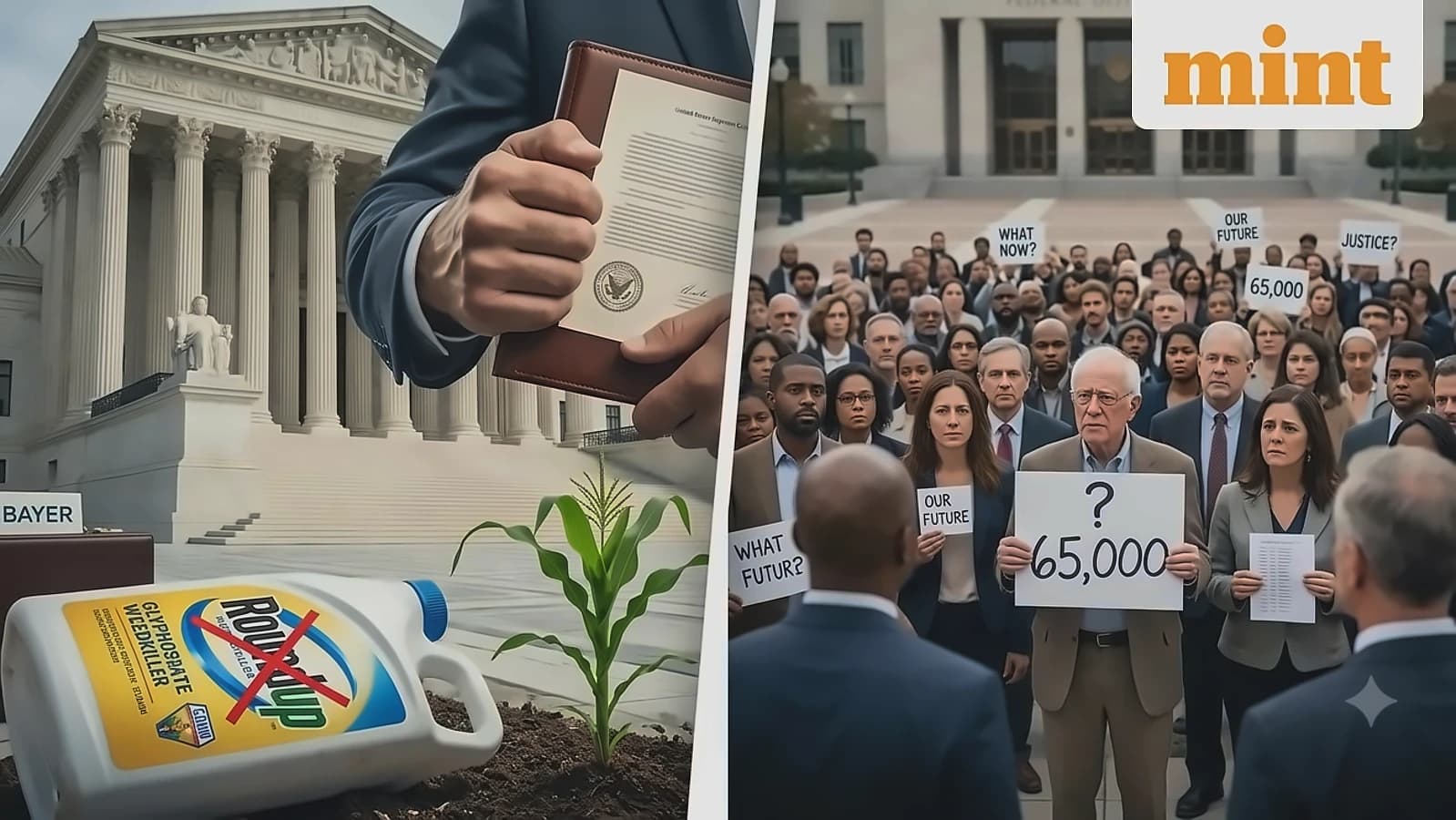
Bayer secured its first trial victory over Roundup cancer claims since the US Supreme Court issued a ruling that significantly limited plaintiffs' legal arguments. According to reports from Reuters, a St. Louis jury unanimously ruled in favor of Bayer-owned Monsanto on Thursday in a case brought by three women who alleged that regular use of Roundup caused them to develop non-Hodgkin lymphoma. The verdict represents the first test of Roundup lawsuit viability following the Supreme Court's June ruling that restricted plaintiffs' legal strategies. Plaintiffs Theresa Aretino, Cynthia Fernandez and Betty Larkin sued Bayer unit Monsanto in 2020 in St. Louis, saying they used Roundup regularly and later developed non-Hodgkin lymphoma. Their attorneys argued that Roundup was defectively designed and unreasonably dangerous, and that Bayer was negligent in selling it. Fernandez died before the trial began, while the three women are not participating in Bayer's proposed settlement.
The Supreme Court's June ruling fundamentally changed the legal landscape for Roundup litigation by blocking most claims that alleged the product's label failed to warn consumers about cancer risks. As reported by Reuters, the court ruled that federal law requires herbicide manufacturers to use the exact label approved by the US Environmental Protection Agency (EPA), with the regulator having concluded that Roundup's label does not require a cancer warning. Bayer has argued that other claims, including design defects and negligence, are also barred by this Supreme Court ruling, though plaintiffs' lawyers maintain these legal arguments remain valid. The EPA has previously concluded that glyphosate is probably not carcinogenic, but it is currently in the middle of a new safety review.
The verdict comes as Bayer pursues a $7.25 billion settlement proposal currently under review by a Missouri state court judge in St. Louis. According to Reuters, the outcome could have implications for around 65,000 claims Bayer faces in US state and federal courts from people who say they developed cancer after using the weedkiller. The three women involved in Thursday's trial were not participating in the proposed settlement, which Bayer seeks to resolve tens of thousands of other Roundup lawsuits through. Before the Supreme Court ruling this year, most lawsuits had alleged that Roundup's label failed to warn consumers about cancer risks, but the court blocked those legal arguments in June. Bayer's US general counsel Bill Dodero stated that the verdict should send a strong signal that plaintiffs pursuing claims following the Supreme Court ruling will face significant challenges in demonstrating viable claims and providing necessary evidence in court.
Bayer has maintained that decades of studies show glyphosate, Roundup's active ingredient, is safe and does not cause cancer. As reported by Reuters, the scientific debate continues with the EPA conducting a fresh safety review while previously concluding that glyphosate is probably not carcinogenic. Meanwhile, the International Agency for Research on Cancer classified glyphosate as 'probably carcinogenic' to humans in 2015, a conclusion Bayer has disputed, calling it an outlier opinion based on flawed methodology. Bayer faces around 65,000 claims in US state and federal courts from plaintiffs who say they developed cancer after using Roundup at home or on the job.
The litigation has significantly impacted Bayer since its 2018 acquisition of Monsanto, costing the company billions of dollars and dragging down its share price. According to Reuters, Bayer's US general counsel Bill Dodero stated that the verdict should send a strong signal that plaintiffs pursuing claims following the Supreme Court ruling will face significant challenges in demonstrating viable claims and providing necessary evidence in court. "This verdict should send a strong signal that plaintiffs who wish to pursue claims in the court system following the Durnell ruling will face significant challenges both in demonstrating they have viable claims and putting forth the necessary evidence to prove them in court," Dodero said in a statement. The litigation has weighed on Bayer since its 2018 acquisition of Monsanto.