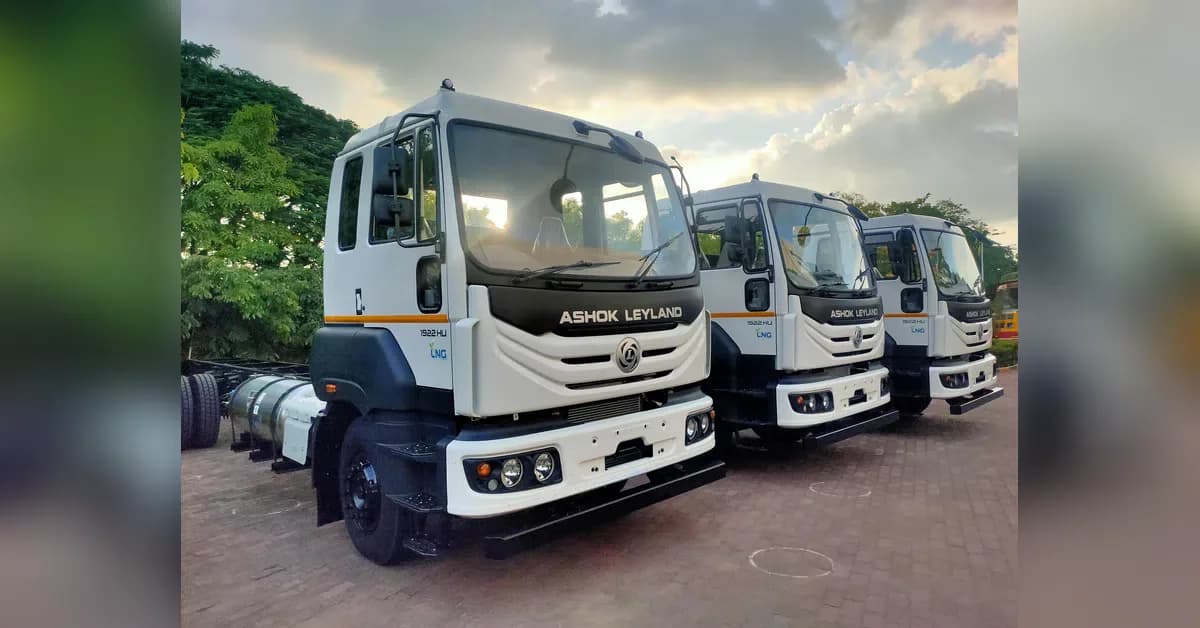
Ashok Leyland remains cautiously optimistic for the commercial vehicle industry in FY27, with growth expected across key segments driven by infrastructure activity and replacement demand. According to the company's latest annual report, Ashok Leyland is confident of sustaining momentum in both trucks and buses, while progressing towards its medium-term goal of achieving around 35 per cent market share in medium and high commercial vehicles. This represents an increase from the 30.7 per cent market share achieved in FY25. The demand outlook for FY27 is expected to be shaped by continuing infrastructure and road-building activity, replacement demand supported by an ageing fleet and higher utilisation in select corridors, and improving operating economics driven by better payload and fuel-efficiency choices.
The company believes it is positioned to benefit from the India-EU trade agreement and the anticipated trade pact with the US, which open important doors for Indian exporters. As per the annual report, Ashok Leyland anticipates growth in FY27 driven by infrastructure, replacement demand, and favorable trade agreements with the EU and US. The structural demand drivers for CVs in India remain intact, with infrastructure investment continuing at scale, the formalisation of logistics networks deepening, and the shift toward higher-payload, more productive vehicle configurations playing directly to the premiumised product and solutions portfolio the company has been building.
On rising input costs, Kumar said they are seeing how to manage the current situation, but are hopeful that those costs will start coming down at some point. In FY26, material cost increased by 14 per cent to ₹31,417 crores as against ₹27,623 crores in FY25, as a percentage of sales revenue remained largely stable year-on-year. The company flagged demand volatility linked to macro conditions, abnormal increase in fuel prices, interest rates and freight availability, commodity and foreign exchange fluctuations, supply chain disruptions, among key factors to watch for. Kumar noted that passing on costs will be a real challenge, as it will disrupt the overall industry, with the company seeking to mitigate these through diversified business levers, a strong new product pipeline, proactive cost and working capital actions, and continued emphasis on customer experience.
Diesel price hikes have had an impact on demand initially but have now stabilised, Kumar told PTI and The Economic Times. As reported by Business Standard, Kumar explained that customers and the Indian market look for certainty rather than volatility of diesel prices. In the first two months of the fiscal, there were challenges, followed by improved market sentiment in June, Kumar added. According to Business Standard and The Economic Times, Kumar noted that now they are again seeing some challenges, but overall they are optimistic about the market outlook. The overall expectation is that the market continues to be good, with hopes that the second quarter should be better than last year's second quarter.
Chairman Dheeraj G Hinduja highlighted the company's transformation, stating that three years ago, Ashok Leyland was operating with net debt and navigating a market that had not yet returned to its pre-pandemic volumes. Today, the company is strongly cash positive, with an all-time high sales volume and a set of adjacent businesses that contribute both earnings and resilience. As the company enters FY27, Hinduja believes they do so from a position of strength, with structural demand drivers for CVs in India remaining intact. The company continues to focus on diversified business levers including aftermarket, exports, defence and power solutions, while maintaining a strong new product pipeline and emphasis on customer experience through stronger uptime and service reach.