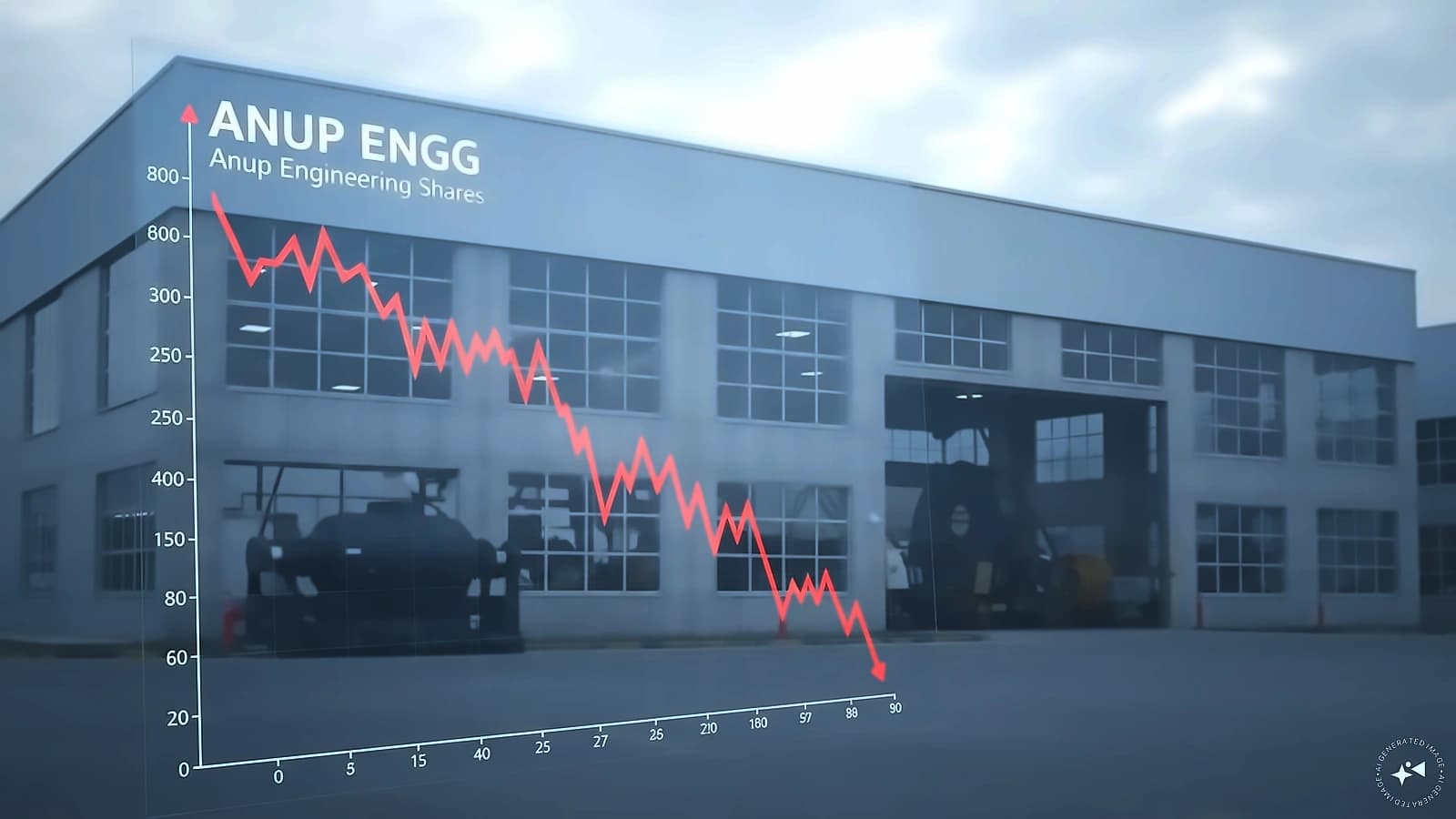
Shares of Anup Engineering Ltd. have shown significant recovery, trading at ₹2,028.3 as of August 6, 2026, representing a 14% increase from the previous session's close of ₹1,800. According to latest market data, the stock opened at ₹2,225 and moved between a high of ₹2,296.40 and low of ₹1,901.00 during the trading session. The recovery comes after the company's disappointing June quarter results had initially triggered a 14% decline to ₹1,901 in earlier sessions. The stock has demonstrated resilience with a 6.7% gain over the past six months, though it remains 18.55% down over the last year. The 52-week high of ₹2,700 and low of ₹1,422.30 indicate significant volatility, with the company's market capitalization standing at ₹4,434.97 crore as of August 6, 2026. The stock's PE ratio of 41.19 and PB ratio of 6.46 reflect current market valuations, while mutual fund shareholding stands at 10.07% as of the latest reporting period.
The company reported a 29% year-on-year decline in revenue from operations to ₹125.25 crore from ₹175.23 crore in the corresponding quarter of the previous year. According to CNBC TV18 and Business Standard, this significant revenue contraction was primarily driven by a 28.5% drop in revenue from operations to ₹125.2 crore in Q1FY27, reflecting a planned lower execution pace due to low order bookings in the prior period and ongoing global supply chain disruptions. The latest data shows revenue from operations slumped 29% to ₹125.25 crore from ₹175.23 crore, with the company attributing the moderation in execution to low order booking in the previous year, elevated freight and energy costs, and raw material pricing pressures. The decline reflects slower execution of orders on the ground during the quarter, despite a healthy order pipeline, suggesting a temporary execution bottleneck rather than structural demand issues.
The most concerning aspect of the results was the dramatic deterioration in profitability metrics. According to CNBC TV18 and Business Standard, Anup Engineering reported a 98% year-on-year drop in net profit to ₹57 lakh from ₹26.26 crore in the year-ago quarter. The latest Q1FY27 results show consolidated net profit (PAT) falling 97.8% year-on-year to ₹0.6 crore from ₹26.3 crore in Q1FY26, with profit before tax (PBT) falling 97.4% to ₹0.9 crore from ₹35.3 crore. This substantial profit decline indicates severe operational challenges that impacted the company's bottom-line performance during the reporting period. The 98% YoY drop in net profit shows intense bottom-line pressure, likely due to a combination of under-absorption of fixed overheads and execution delays, with EBITDA margins pressured by the under-absorption of fixed costs resulting from lower revenue volumes.
The company experienced significant margin pressure across all key profitability metrics. According to CNBC TV18, Anup Engineering reported a 97.8% year-on-year drop in net profit to ₹0.6 crore from ₹26.7 crore in the year-ago quarter. The latest Q1FY27 results confirm this dramatic profitability decline, with EBITDA declining 76.5% to ₹9.5 crore from ₹40.4 crore in Q1FY26, resulting in an EBITDA margin of 7.6% compared to 23.0% in Q1FY26. The margin down 1,540 basis points indicates raw material volatility or under-absorption of capacity during the early part of the fiscal year played a major role. While gross margins remained intact, EBITDA margins were pressured by the under-absorption of fixed costs resulting from lower revenue volumes, with the company citing raw material pricing pressures and elevated freight and energy costs as key factors.
Despite the challenging quarterly performance, Anup Engineering entered the fiscal year with an all-time high opening order book of ₹769 crore and has now secured a record-high pending order book of ₹985 crore, providing significant visibility for future quarters. The company recently commissioned its Phase-2 expansion at the Kheda facility in late January 2026, which enhanced the plant's revenue potential to ₹400-₹450 crore per annum. Management views FY27 as a year of stabilization, consolidation, and risk management amidst a volatile global environment influenced by geopolitical tensions. The company's strategic focus areas include diversification into Nuclear, Thermal energy, and clean energy storage segments, alongside growth in the technical services business. With expanded capacities at its Kheda facility and an encouraging inquiry pipeline of ₹1,100 crore, the company remains optimistic about achieving annual objectives despite current operational challenges.