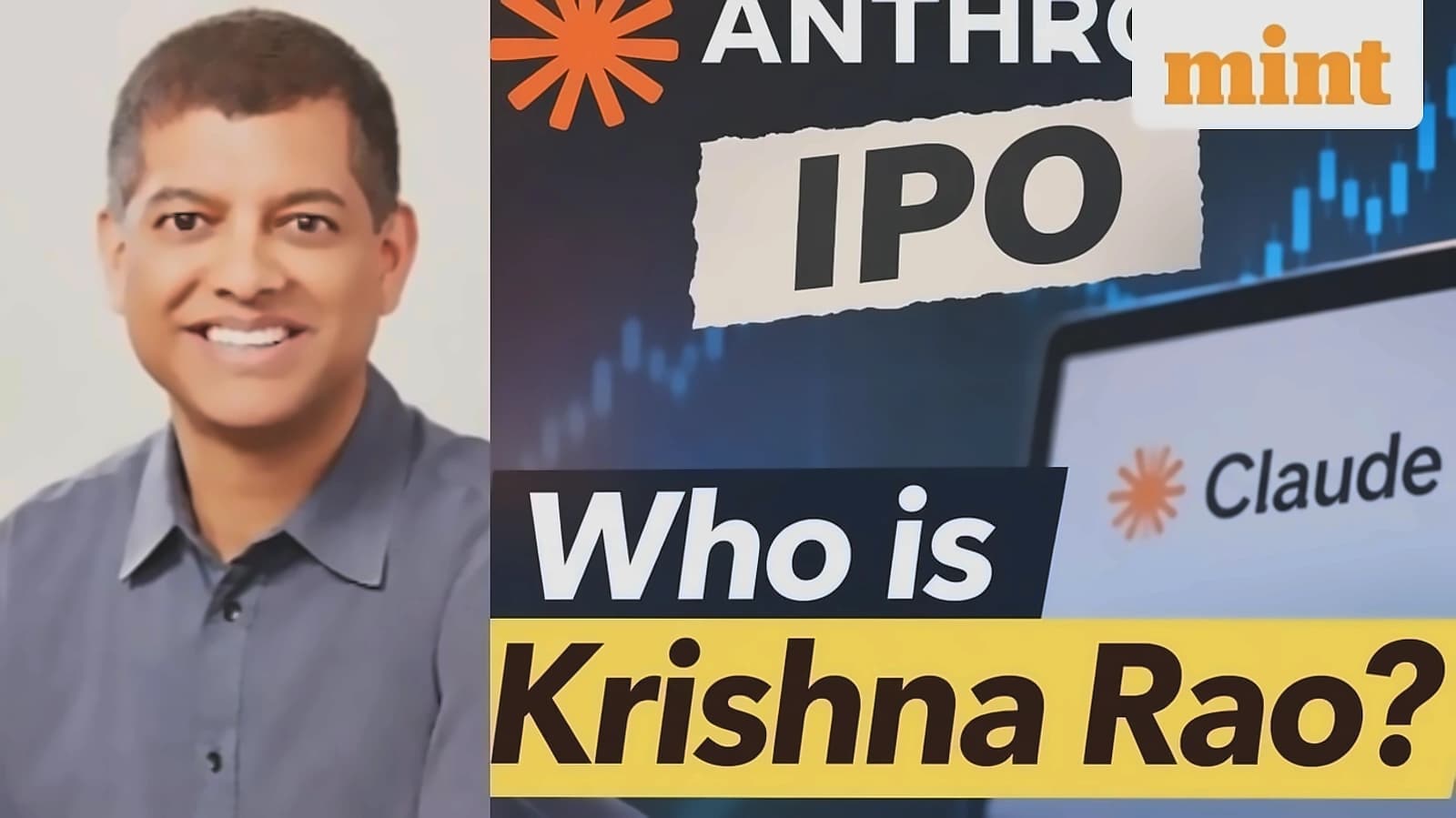
Anthropic shares experienced a dramatic reversal on Friday, crashing 13% to $85 by 12:20 pm ET after opening at $112 on Thursday, according to The Times of India. The stock had closed at $97 on Thursday, representing a significant decline from its opening price of $111.5 per share on debut day. This sharp decline came after the company's historic IPO, which achieved what was reported as the largest public share sale globally and surpassed Elon Musk's SpaceX listing. The opening price valued the company at approximately $2 trillion, with the stock quickly climbing the ranks to become one of the highest-traded stocks on specialised investment platforms that allow Indians to trade in global stocks.
Retail investors who rushed to buy Anthropic shares following the record IPO faced significant losses on Friday, with the stock plunging 13% and reversing much of its gains from the first day. According to The Times of India, retail investors recorded more than $750 million in Anthropic share transactions on Thursday, marking the highest turnover for a stock debut in Vanda Research's records. This figure surpassed the $670 million recorded for SpaceX during its IPO in June. The strong retail interest also resulted in the third-largest day of net retail buying for a stock on its debut in records dating back to 2012, according to Vanda Research. However, net buying remained below the records set by SpaceX at $118 million and Coinbase at $92 million.
Indian investors demonstrated unprecedented enthusiasm for Anthropic's record IPO, with the company accounting for 40% of INDmoney's international investments and 11% of Vested's trading value on debut day. According to The Times of India, Indian investors continued to trade shares of Claude maker Anthropic after its Nasdaq debut, with trading volume on Vested rising about 46% on Friday from the first session on Thursday. On Groww, Anthropic has been among the most traded US stocks since the night of November 19, the first day of trading. The listing attracted investors across professions, including engineering, finance and media, many of whom were already users of the company's Claude AI products. An Indian-origin investor based in the US, who applied for shares worth over $130,000 but received an allocation of less than 5% of what he applied for, explained his investment decision: "I bought Anthropic because I use it in my day-to-day life, and it's pretty useful for automating work and saving time. It enables me to generate more output than I ever could in a short span."
Anthropic has reportedly excluded investors from China and Hong Kong ahead of its public listing, following a similar pattern set by other major US technology companies. Three people familiar with the decision confirmed to The New York Times that Anthropic had excluded investors from the two regions. This move aligns with a broader trend among American technology companies, as SpaceX and its bankers had taken a similar step ahead of the company's blockbuster IPO in July, shutting Chinese investors out of the offering. OpenAI, another leading AI company, is also expected to bar Chinese investors from its eventual public listing, having already prevented investors from China from participating in its private fund-raising rounds. The exclusion comes amid growing US efforts to restrict China's access to advanced artificial intelligence technology, with all three companies - Anthropic, SpaceX and OpenAI - having counted the US government among their clients.
Anthropic raised $81.31 billion through its initial public offering, setting a new record for the largest IPO at initial pricing and surpassing SpaceX's initial $75 billion offering. The offering comprises 980 million Class A common shares, with Anthropic selling 956.35 million shares while existing shareholders offered the remaining 23.65 million. The company will not receive proceeds from the sale of shares by existing shareholders. Indian residents cannot subscribe to the IPO because the company didn't include India in its international retail offering, restricting it to Australia, Canada, Japan, Switzerland, the UK and specified European countries. However, Indian investors can still invest in Anthropic shares after listing through international brokerage platforms that facilitate overseas investments under RBI's Liberalised Remittance Scheme (LRS). Platforms such as Interactive Brokers, Vested Finance, INDmoney, Zerodha, Groww and HDFC Securities offer access to international markets, with investors required to open accounts, complete KYC formalities and remit money from Indian bank accounts to overseas brokerage accounts.
Anthropic experienced a period of explosive growth in 2026, driven largely by the popularity of its AI coding tool, Claude. For the nine months ended September 30, the company generated $33.24 billion in revenue, representing a roughly 1,200% increase from the same period last year. The company reported a $104 billion net loss during the nine-month period, though most of that was due to the change in fair value of convertible notes and derivative liabilities. This compares to a $25.1 billion loss over the same stretch in 2025. Anthropic's run-rate revenue was roughly $81 billion at the end of October, up $10 billion from the previous month, as reported in the company's amended filing. The company's third quarter 2026 performance showed continued momentum with revenue increasing to $16.96 billion from $11.56 billion in the previous quarter, while the net loss narrowed to $23.29 billion from $66.3 billion in Q2. However, the company reported an operating loss of $567 million in Q3, compared with operating income of $974 million in the previous quarter. The IPO delivered outsize returns to its backers and pushing up the combined wealth of its seven founders to $166 billion, with Goldman Sachs Group Inc., Morgan Stanley and 20 other banks earning a record $550 million in fees for their work on Anthropic's IPO.
The listing comes as domestic brokerage firms, including Groww, Upstox, Zerodha and Angel One, expand their international investing offerings through the Gujarat International Finance Tec-City (GIFT City) route, widening access to US-listed stocks for Indian investors. Commenting on the trading activity, Naresh Biyani, founder and CEO of Capwise Financial Services, noted that the first session should be viewed as an indication of demand rather than a measure of the company's underlying value. "The first day measures demand, not value. The real test will come over the next few quarters: whether margins improve as compute costs fall, whether growth holds up against competition, and how the stock behaves when lock-ins expire," Biyani said. Speaking on the implications for other AI companies, he added that the listing could reopen the window for large technology offerings, including OpenAI, although valuations may remain volatile. Under the RBI's LRS framework, resident individuals can remit up to $250,000 per financial year for permitted overseas transactions, including investments in foreign stocks and overseas-listed exchange-traded funds. The Cboe Volatility Index spiked to more than 29 on Friday morning, well above the level where companies typically consider the market welcoming to IPOs, with stocks roiled by a selloff that spread from Asia to the US, with the Nasdaq 100 Index falling 5.6% and the S&P 500 Index sinking 3.7%.