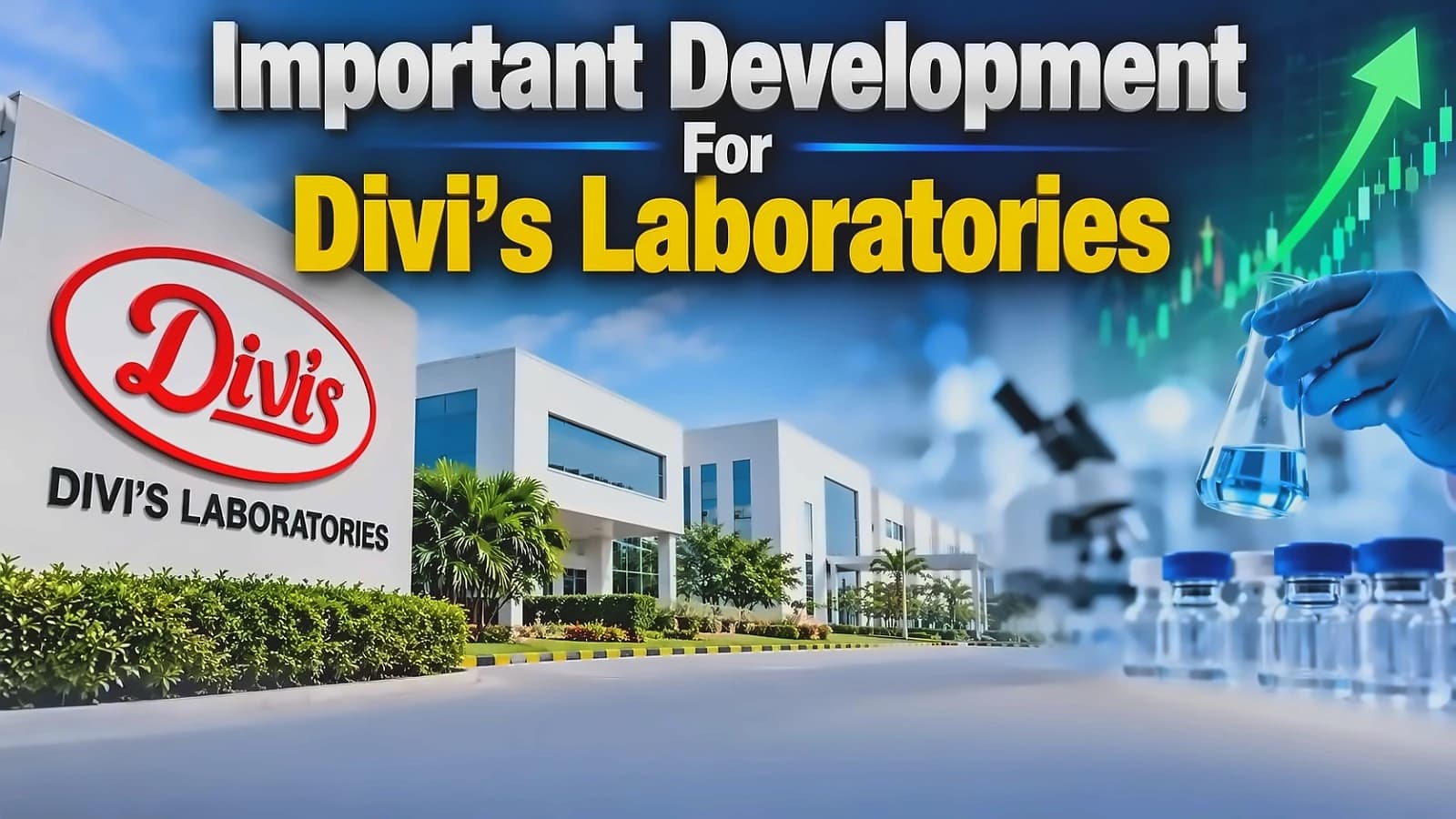
Let's get straight to the headline. Divi's Laboratories just reported a September quarter (Q2 FY27) that made the market sit up and take notice.
Revenue climbed 35% to ₹3,676 crore. But here's the real story: the EBITDA margin expanded by a staggering 989 basis points to 42.6%, the highest since the Covid era.
The stock, already on a tear, hit a 52-week high of ₹11,824 before settling around 4% higher on the day. It has gained roughly 75-84% year-to-date, and the company has now joined the elite ₹3 trillion market cap club. This wasn't just a good quarter. It was a statement.
Why Profit Grew 64%: The Custom Synthesis Engine
The profit growth didn't come from magic. It came from the custom synthesis (CS) business firing on all cylinders. Goldman Sachs reports CS revenue grew 54% year-on-year, blowing past its own estimate of 34%. This segment has grown from about 40% of revenue in FY23 to 62% in the first half of FY27, driven by 60-70 active projects.
What fueled this surge? Validation batches. The company shipped significant quantities of product to customers for validation across three major capex programs. These aren't recurring commercial sales yet, but they carry higher margins and boosted the top line significantly. Brokerages like Jefferies noted that several programs are now nearing commercial production, which is the next phase of this story.
Generics, often the laggard, also chipped in. Goldman Sachs reported 12% growth against its estimate of just 4%, supported by healthy volumes despite persistent pricing pressure in certain categories. Other sources like Jefferies put generics growth at 18%, a multi-year high. Either way, generics contributed more than expected.
How EBITDA Margins Hit 42.6%
A 989 basis point margin expansion doesn't happen by accident. Three factors drove this:
First, the product mix shifted decisively toward higher-margin custom synthesis. When CS grows 54% and becomes 62% of your revenue, margins naturally expand.
Second, backward integration at Unit 3 started paying off. The company has been investing heavily in making its own raw materials and intermediates. Net material consumption fell to about 32% of sales in H1 FY27 from 40% a year earlier, a direct benefit of this integration. Brokerages like ICICI Securities and Goldman Sachs specifically cite Unit 3's backward integration as a key margin driver.
Third, operating leverage kicked in. When revenue grows 35% and you've already built the capacity, fixed costs get spread over a larger base. Goldman Sachs attributes part of the margin beat to this operating leverage.
The result? Gross margins improved by 739 basis points to 67.9%, and EBITDA margins hit 42.6%. This is well above the company's historical run rate, and management has guided for full-year margins closer to FY26 levels, suggesting some lumpiness in the quarterly numbers.
Why Brokerages Were Caught Off Guard
Consensus estimates were nowhere near this performance. JPMorgan notes that revenue beat consensus by 15% and EBITDA by a massive 33%. Why the big miss?
Analysts underestimated the scale of validation batch shipments. Goldman Sachs had modeled 34% growth in custom synthesis; the actual came in at 54%. They also underestimated generics, which grew 12% against a 4% forecast. The margin beat was equally dramatic—actual EBITDA margin of 42.6% exceeded Goldman's estimate by 535 basis points.
This wasn't just a small beat. It was a wholesale reassessment of the company's earnings power. Both JPMorgan and Goldman Sachs raised their FY27-29 EPS estimates significantly—JPMorgan by 18-30% and Goldman by up to 17%.
The Peptide Ambition: Chasing the Top Three
Beyond the current quarter, Divi's is laying the groundwork for its next growth leg: peptides. The company plans to add multi-tonne capacity by installing multiple 3,000-litre solid-phase peptide synthesis (SPPS) reactors. This is serious scale.
JPMorgan puts this ambition in context by pointing to WuXi AppTec, the largest peptide player globally. WuXi has capacity exceeding 100 kilolitres and is targeting $2.5 billion in TIDES revenue in CY26. Divi's wants to be among the top three integrated global players in peptides, leveraging its backward integration from raw materials to peptide building blocks.
The strategic advantage is clear. By making its own protected amino acids, resins, and starting materials, Divi's can control costs and ensure supply security—critical in a complex chemistry space like peptides. However, this is a long-term bet. There's no disclosed peptide revenue or order book yet, and the commercialization timeline remains uncertain. Transcript +3
The Validation-to-Commercial Transition
The immediate growth driver is the conversion of validation batches into commercial supplies across three dedicated programs. One program is nearing commercialization, while the other two are expected to progress over the next few quarters, subject to customer qualification and regulatory clearances.
This transition is critical. Validation shipments are lumpy and one-off. Commercial supplies, once they start, provide recurring revenue. The capex for these three programs—roughly ₹2,000 crore each, according to some reports—is already largely spent. The question is timing. Transcript
Management has been cautious. In the Q1 call, they declined to predict regulatory timelines, noting that commercial supply starts only after validation, customer qualification in their formulations, and regulatory approval. For new sites like Kakinada (Unit 3), US FDA qualification can take 1-2 years. One analysis suggests first commercial revenue may only come in CY2027. Transcript +2
Brokerage Views: Bullish but Cautious
The street has responded with upgrades and target hikes, but not everyone is convinced at current valuations.
JPMorgan maintained its 'Overweight' rating and raised its target price to ₹12,500, implying about 12.65% upside. The brokerage sees the conversion of validation projects to commercial production as the key growth driver and highlighted the peptide expansion as a long-term opportunity.
Goldman Sachs kept its 'Buy' rating with a target of ₹11,700, raising EPS estimates by up to 17% to factor in the Q2 beat. The brokerage attributes the outperformance to better mix, backward integration, and operating leverage.
Motilal Oswal, however, stayed 'Neutral' with a target of ₹11,110. The brokerage raised its earnings estimates but noted that at 65 times forward earnings, the stock offers limited upside from current levels. Of 32 analysts covering the stock, 20 rate it a 'Buy', 4 a 'Hold', and 8 a 'Sell'.
Market Reaction: A Sector Mover
Divi's results didn't just move its own stock. They lifted the entire Nifty Pharma index, which rose about 1.5% on the day. With a weight of around 13.7% in the index, Divi's was a significant contributor to the sector's gains.
The stock itself surged 6.56% to hit ₹11,824 before paring gains to close 4.22% higher at ₹11,565.50. The initial spike reflected the earnings beat, but profit booking at higher levels trimmed the advance—a common pattern after sharp rallies.
Technically, the stock is in strong territory. Analysts describe it as a "strong continuation breakout" at all-time highs, with immediate resistance at ₹11,800 and support near ₹11,200. However, after a 15% two-day rally and an 80%+ year-to-date gain, some consolidation would be normal.
The Road Ahead: Sustainability Questions
The big question now is sustainability. Can Divi's maintain these margins as validation batches normalize and commercial supplies ramp up? Management has guided for double-digit revenue growth with EBITDA margins similar to FY26, suggesting they expect some moderation from Q2 levels.
Risks remain. Solvent costs have nearly doubled or tripled due to Middle East tensions, and inventory levels are elevated at ₹5,325 crore. Regulatory timelines for the three dedicated programs are uncertain, and customer qualification adds another layer of dependency. Transcript
Yet the structural story remains compelling. Custom synthesis is now the dominant, higher-margin business. Backward integration is delivering real cost benefits. And the peptide expansion, while long-term, positions Divi's in a high-growth niche with significant barriers to entry.
For now, the market is buying the story. The stock has joined the ₹3 trillion market cap club, and brokerages are scrambling to revise their models upward. The next few quarters will be crucial—not just for maintaining momentum, but for proving that this wasn't just a great quarter, but the start of a new era.