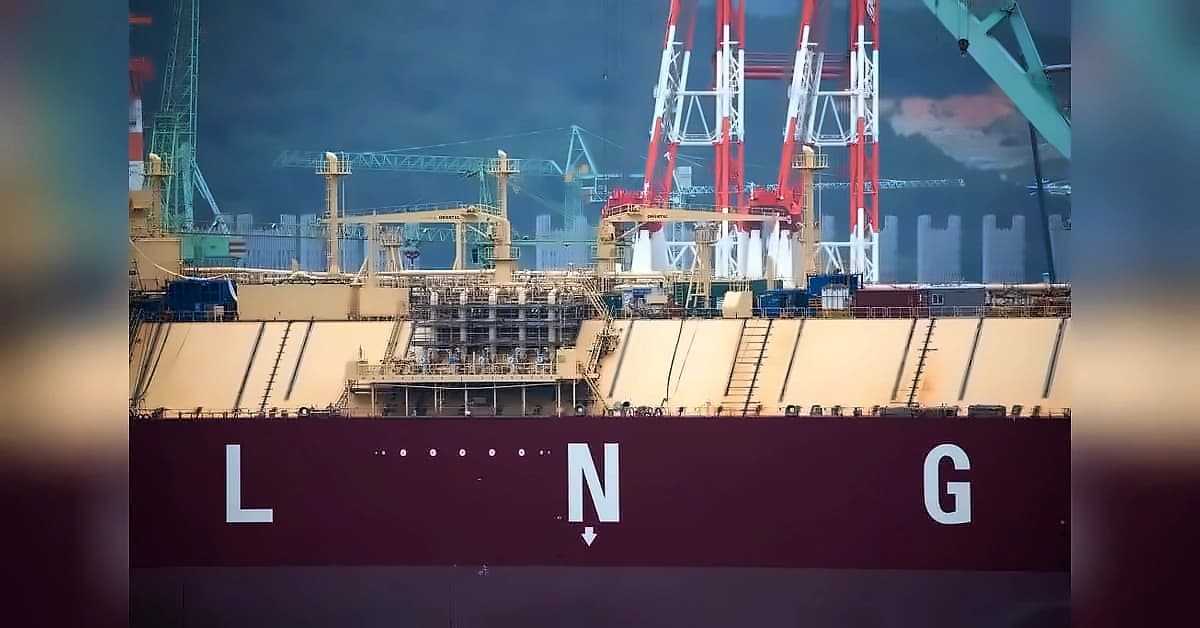
The United States became India's largest supplier of both liquefied natural gas (LNG) and liquefied petroleum gas (LPG) in May as disruptions in the Strait of Hormuz forced a strategic shift in gas procurement amid the ongoing Iran war. US LNG exports to India reached 900,000 tonnes over the same month, covering more than 40% of total demand and tripling April's level. The US also shipped 630,000 tonnes of LPG to India in May, which stood roughly 60% above the 380,000 tonnes India received from all Gulf countries combined, as reported by CNBC. Nomura noted that total U.S. gas exports to India have expanded eightfold from pre-conflict baselines, highlighting the dramatic scale of this shift. President Trump has threatened further military action against Iran if Tehran fails to reach an agreement with Washington, while Iran's military command said vessels attempting to transit the Strait of Hormuz would be targeted.
The conflict accelerated a shift that was already underway, with analysts noting that high freight costs had long kept American cargoes uncompetitive with Middle Eastern supply on a landed-cost basis. According to Rystad Energy's Manish Sejwal, the conflict provided the catalyst for this change. Sumit Ritolia, lead research analyst at Kpler, expects the realignment to last, stating that "the India–US energy trade will increasingly focus on gas." India depended on the Strait of Hormuz for about 60% of its LNG imports and nearly all of its LPG supplies before the current disruptions began. The constriction of shipping lanes through the Strait of Hormuz since late February has forced state-run oil marketing companies to aggressively re-route procurement, as highlighted by Kpler data showing an unprecedented drop in standard short-haul volumes and a corresponding surge in Atlantic basin deliveries. For Washington, the shift fits a broader energy trade strategy, with U.S. producers having abundant shale output and expanding export capacity, while India needs to reduce its exposure to a single maritime chokepoint.
The reliance on high-cost spot cargoes coincided with a sharp spike in domestic power consumption, with heatwave conditions pushing India's peak electricity demand to a record 270 GW in May. The Ministry of Power placed all gas-fired generation plants on active standby to sustain crude and gas processing baselines. To bypass the volatile maritime chokepoint entirely, Indian refiners are deploying logistical workarounds, with IOC and HPCL drawing Abu Dhabi National Oil Company (ADNOC) grades directly from terminals outside the Persian Gulf at Fujairah (Gulf of Oman) and Sohar (Oman). HPCL recently secured 4 million barrels of UAE Murban crude for August delivery via international trading desks at a premium of approximately 40 cents per barrel over the July Dated Brent benchmark, while 2 million barrels have been contracted from Brazil and West Africa to feedstock newly expanded inland refining infrastructure. India remains highly exposed to changes in global energy markets, being the world's third-largest crude oil importer, fourth-largest LNG importer and second-largest LPG importer.
Gas-linked companies traded higher on Tuesday following a Bloomberg report indicating that Qatar is preparing to rapidly ramp up liquefied natural gas (LNG) production once the Strait of Hormuz reopens. According to Bloomberg, QatarEnergy has told buyers it expects LNG output to recover to about 50% of capacity within one month of safe passage through the strait being restored and to roughly 80% within two months. The report added that the remaining capacity, equivalent to two production trains, could take years to fully recover after being damaged during Iranian missile strikes in March. Qatar shut down operations at its Ras Laffan complex, the world's largest LNG export facility, in the first week of the conflict following an Iranian attack, with the facility remaining largely idle for more than three months as disruptions made large-scale exports difficult. Bloomberg reported that QatarEnergy has been carrying out equipment testing and maintenance since April to prepare for a restart, with some production trains continuing to operate at reduced capacity to supply neighbouring countries while retaining the ability to ramp up output quickly when conditions improve.
The energy import surge has created significant economic pressures, with spot LNG prices in Asia jumping after the conflict began, with the Platts JKM benchmark rising to about $25 per million British thermal units on March 3, before averaging above $18 per million British thermal units in late May. ORF analysis noted that longer U.S. voyages and high LNG carrier rates, above $200,000 a day in the Atlantic Basin, were eroding gas's cost advantage over other fuels. The pressure is particularly acute because India is highly price sensitive, with LNG feeding fertilizer plants, city gas networks, industrial users, and power demand, while LPG is used mainly as household cooking fuel. Any sustained increase in import costs can move quickly into subsidies, company margins, or consumer prices. The Indian rupee has weakened against the U.S. dollar amid concerns over rising energy import costs and supply disruptions, while the energy import surge has directly influenced trade policy, with U.S. tariffs on Indian goods being negotiated down to 18 per cent in early 2026. The anticipated return of Qatari LNG supplies is expected to ease pressure on global gas markets, with Bloomberg noting that LNG prices in Europe and Asia remain above pre-conflict levels despite progress in negotiations between the US and Iran.