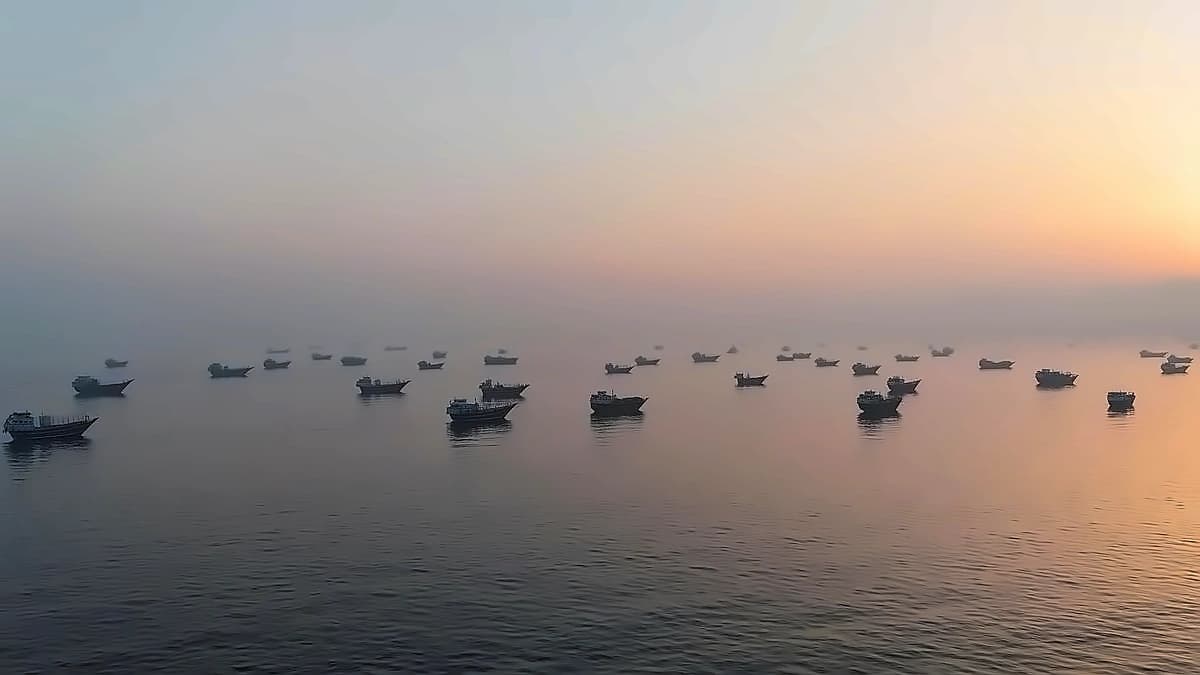
Two India-bound LPG tankers have successfully crossed the Strait of Hormuz between Wednesday and Thursday, marking the fifteenth India-bound vessel to transit the critical maritime chokepoint since early March. The Marshall Islands-flagged Symi and Vietnam-flagged NV Sunshine are the first India-bound energy tankers to make the crossing in nearly two weeks, according to ship-tracking data reported by The Indian Express. The Symi was spotted in the Gulf of Oman on Thursday after switching off its tracking transponder, while the NV Sunshine stopped transmitting its location post midnight (India time) before beginning transmissions again on Thursday afternoon. This brings the total number of large ships that have made it through Hormuz since Sunday to nine vessels, demonstrating continued maritime activity despite ongoing US and Iran restrictions and a deadlock in negotiations to end the war. However, latest developments show that an Indian vessel 'Haji Ali' sank after a fire following an attack in Omani waters, though all crew members were safely rescued by the Omani Coast Guard and are reported safe.
The NV Sunshine, which loaded LPG at the United Arab Emirates' Ruwais refinery, appeared in the Gulf of Oman late Thursday morning after last transmitting its location east of Iran's Larak Island, as reported by The Indian Express. It was initially broadcasting India's Mangalore as a destination but is now indicating New Mangalore port in Karnataka. The Symi is transporting fuel from Qatar's Ras Laffan to Kandla, Gujarat. According to the Shipping Ministry, Symi is carrying 19,965 tonnes of LPG and is expected to arrive at Kandla on May 16, while NV Sunshine is carrying 46,427 tonnes of LPG and is expected to arrive at New Mangalore on May 18. The cargo on both vessels belongs to the country's largest refiner and fuel retailer Indian Oil Corporation. The other seven vessels that have recently made it through the strait include three more LPG carriers, four very large crude carriers and one liquefied natural gas tanker, with some vessels reportedly still within what has been described as a U.S.-controlled maritime cordon.

Iran's Foreign Minister Seyed Abbas Araghchi has explicitly stated that "We have created no obstruction in the Strait of Hormuz. It is the United States that has imposed a blockade," according to reports from WANA. Speaking on the sidelines of the BRICS foreign ministers' meeting, Araghchi emphasized that the Islamic Republic of Iran has consistently maintained its sovereignty and full control over the strategic waterway. Iran has repeatedly warned that it will respond to any threat or hostile action in the region, while maintaining close oversight of maritime traffic and designating specific routes for oil tankers transiting the strait following the recent conflict. The latest developments show Iran's continued adherence to international maritime law while the US maintains its blockade operations.
The US Central Command (CENTCOM) has stated that it has so far redirected 65 commercial vessels and stopped four others from continuing their voyages, as reported by Reuters. The supertanker Agios Fanourios I, carrying Iraqi crude oil to Vietnam, is currently anchored in the Gulf of Oman after being reportedly forced to turn back by the U.S. Navy. Vietnam's state oil company PVOIL warned the U.S. Navy in a letter that feedstock reserves at the Nghi Son refinery had fallen sharply, cautioning that any further delay could halt refinery operations and affect millions of Vietnamese consumers and businesses. Iranian officials had previously announced that Iraqi cargoes would be exempt from restrictions imposed after the recent conflict involving the United States, Israel, and Iran. The Chinese tanker Yuan Hua Hu crossed the American blockade line, while Japan's Eneos Endeavor was sailing close to the line, demonstrating the growing use of evasion tactics among commercial shipping.
Ever since the West Asia war began—leading to the effective closure of the Strait of Hormuz—India has been engaging with Iran at the diplomatic level to facilitate safe passage of Indian vessels. While a few Indian ships made their way through the strait over a weeks-long period starting mid-March, transits of Indian and India-bound vessels were badly hit after the April 18 incident in which a couple of Indian ships were fired upon by Iranian forces as they attempted to cross the waterway. This incident, and subsequent similar ones with Iran and the US running their own blockades in the region, further hit the already constrained vessel movements through the strait. Currently, there are 14 Indian vessels stranded in the Persian Gulf, and a number of others that are foreign ships but carrying cargo for India. Around 40% of India's crude oil imports, 60% of its LNG imports, and a whopping 90% of its LPG imports came from West Asia through the strait, making the chokepoint particularly critical for India's energy supplies. That's primarily the reason why India has prioritised the movement of LPG tankers over its other vessels through the Strait. Latest reports indicate that over 3,158 seafarers have been repatriated so far, while port operations across India remain normal.