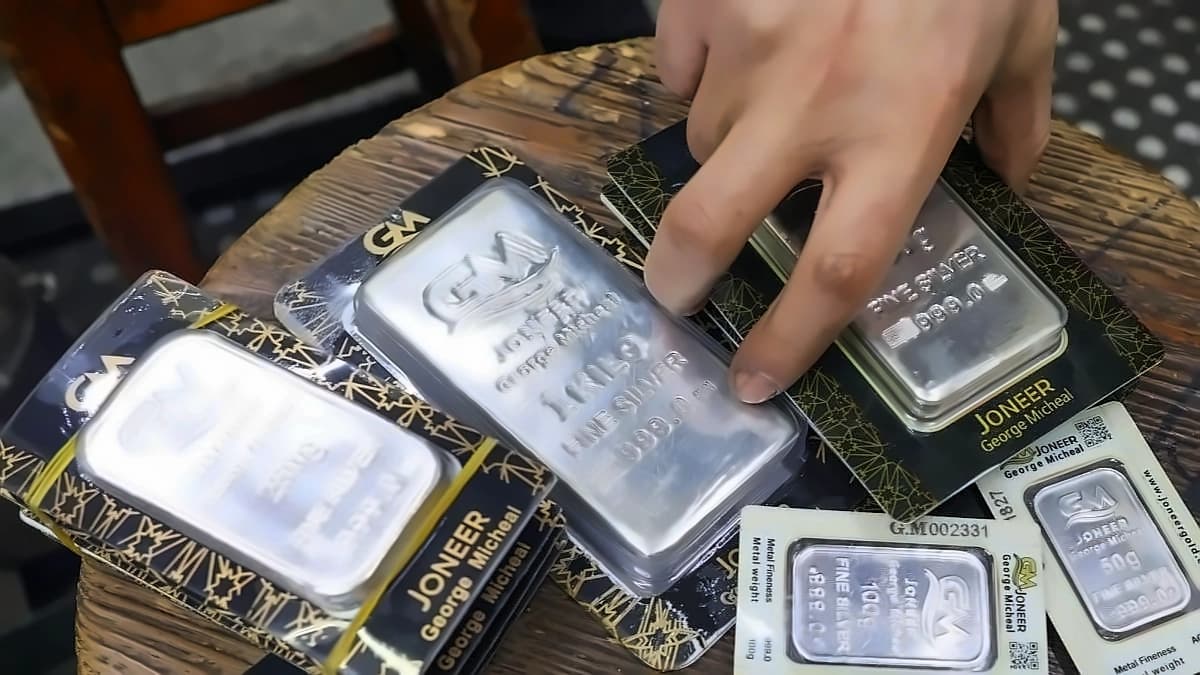
Silver prices have plunged to an 11-month low of ₹1.95 lakh per kg in Mumbai's spot market, marking the first time silver has broken below ₹2 lakh per kg since December 2025. According to The Hindu BusinessLine, silver (Dec) futures breached the psychological ₹2,00,000-mark and made a ten-month low of ₹1,92,149 on Friday before ending the session at ₹1,95,719. On the Multi Commodity Exchange (MCX), silver futures fell ₹6,800 per kg, or 3.4%, to ₹1,92,800 per kg on Friday, with prices having plunged ₹32,955, or more than 14%, over the past 10 sessions. The correction has been steep, with silver dropping 22.5% from its August 2026 peak of ₹2,48,800 per kg and more than 50% from its January record high of ₹4,20,048 per kg. Silver is also down 6.38% in October alone, putting it on track for a fifth consecutive weekly loss. Gold has also witnessed a sharp slide, with spot prices declining 0.29% on Friday while hovering near a three-month low of ₹1.40 lakh per 10 grams, having fallen around ₹23,000 per 10 grams from its August peak of ₹1,64,773.
Silver has experienced a dramatic selloff, falling to an all-time low of $53.83 per ounce in international spot markets, with the crash from $121.74 to $53.83 now bringing MCX rates in India from ₹4.2 lakh per kg to ₹1.9 lakh per kg. According to NDTV Profit, the Devil's metal fell to an all-time low of $53.83 an ounce, with no recovery seen despite some rebounding in other precious metals. Gold futures hit a low near $3,989 but rebounded slightly, remaining bearish after spot futures for Gold fell to a fresh international low of $3,989.10 to $3,993.96 per ounce last week. Kaynat Chainwala, AVP Commodity Research at Kotak Neo, noted that the pullback in treasury yields have aided the safe haven assets, but periods of market stress has mounted selling pressure on the bullion. From a long-term point of view, Gold may be better off than silver given the white metal's larger industrial demand component, as Chainwala outlined that given its larger industrial demand, silver remains more exposed to a deeper correction should risk sentiment deteriorate further.
Rising bond yields, driven by elevated crude oil prices, have emerged as a key challenge for precious metals, fueling concerns that the US Federal Reserve could tighten monetary policy further. As per LiveMint, Brent crude approached $115 per barrel on Friday, nearing its four-year high of $115.25 reached on May 4, with Houthi attacks on Saudi targets and reports of possible renewed US strikes against Iran heightening concerns over disruptions to Middle Eastern oil supplies. US consumer and producer inflation data released last week came in hotter than expected, largely because of rising energy costs. Although traders broadly expect the US Federal Reserve to keep interest rates unchanged at its October 27-28 meeting, expectations of a later hike have strengthened. According to CME's FedWatch Tool, the probability of a rate hike at the October meeting stood at 9%, while the likelihood of a December hike was 81%. Investors are also awaiting US Personal Consumption Expenditures (PCE) inflation data, scheduled for October 29, with the PCE index being the Fed's preferred inflation gauge as it works towards its 2% target.
Silver's three-month put-call skew has climbed 10 points in four weeks to minus 3, its highest reading since early July, according to The Kobeissi Letter, indicating that more traders are buying protection against silver falling further. Hedge funds and commodity trading advisers have also sold $2.2 billion in silver futures in the three weeks to October 13, showing that large investors are reducing their exposure to silver as confidence in a recovery weakens. Technical analyst Kev_Capital_TA identifies $52–$55 as critical support, with a potential rebound toward $63–$72, noting that if that support holds, all those crowded shorts become fuel for a bounce. Michaël van de Poppe sees $40–$45 as a possible trading entry and $22–$26 longer term, while Peter Schiff considers silver attractive below $54. If silver loses $52, it could expose $39–$45, with traders now eyeing $52 for a squeeze or a deeper drop.
Silver rates vary across major Indian cities, with Chennai, Hyderabad and Kerala commanding ₹2.25 lakh per kg, while Delhi, Mumbai, Kolkata, Bangalore, Pune, Ahmedabad, Vadodara and other cities offer ₹2.20 lakh per kg. As per Goodreturns, 100 grams silver rates stand at ₹22,000 and 10 grams at ₹2,200, registering a decline of ₹500 and ₹50 respectively. 8 grams silver dipped by ₹40 to ₹1,760 and 1 gram silver is lower by ₹5 to ₹220. In Mumbai's spot market, silver was trading at ₹1.95 lakh per kg, down from ₹2 lakh per kg on Thursday, while gold was trading at ₹1.41 lakh per gm, down from ₹1.43 lakh per 10 gm on Thursday. The rupee's 0.4% decline on Thursday to around 94.82 against the US dollar is providing only limited relief against the decline in international prices, as per Ponmudi R, CEO of Enrich Money. Meanwhile, MCX gold is outperforming domestic silver and declining less than COMEX gold, as silver faces greater pressure from concerns over industrial demand and global growth.
The Indian government's decision to permit 6,500 metric tons of silver imports over six months has significantly impacted domestic markets, with silver futures with December, March and May expiries falling around 3% each to trade at ₹1,93,940 per kilogram, ₹1,99,985 per kg and ₹2,04,513 per kg respectively. As per The Economic Times, bullion dealers who received the permits told Reuters that the approvals would help India meet demand during the anticipated surge in the upcoming sale season. Chirag Thakkar, chief executive of leading silver importer Amrapali Group Gujarat, told Reuters that the permitted volume appeared substantially higher than India's likely requirements over the next six months, with expectations that the additional supply would help lower domestic premiums. India relies on international purchases to meet more than 80% of its silver demand, and the government had previously restricted imports in mid-May before tightening rules further in June. Buyers remain hesitant after recent losses, with local premiums falling from $2.50 to just 45 cents an ounce, suggesting that supply shortages are easing even as demand remains weak. The scale of the import allocation surprised market participants given the weakness in demand for silver jewellery and investment amid falling prices.