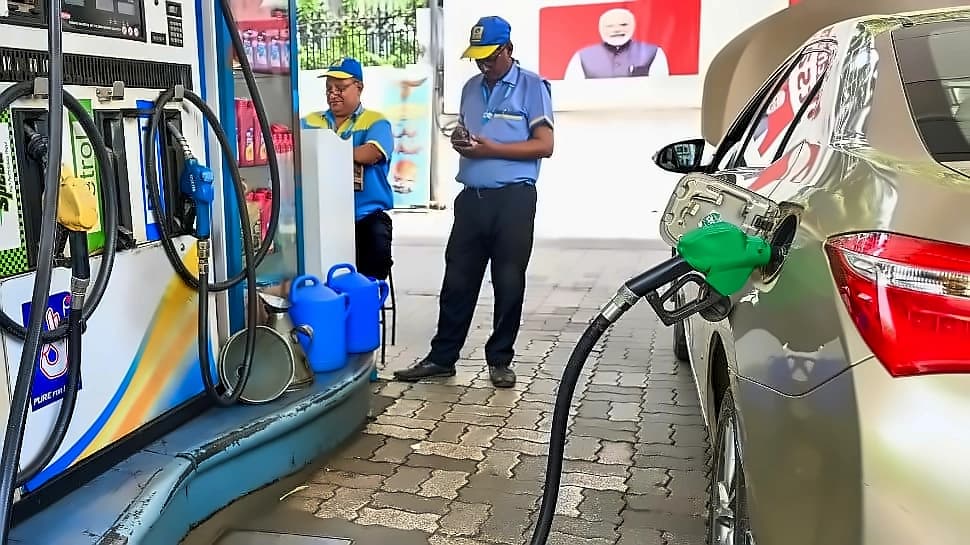
India's fuel prices have experienced a dramatic surge, with petrol and diesel prices rising by nearly ₹4 per litre in just five days - the most significant increase since the pricing freeze was lifted. The latest 90 paise per litre hike on May 19 marks the second increase in less than a week, following a ₹3 per litre hike on May 15 - the first increase in more than four years. As per Kotak Neo, retail fuel prices had been frozen since April 2022, with the only exception being a one-time ₹2 per litre cut in March 2024 ahead of the Lok Sabha elections. The cumulative increase has pushed petrol prices to ₹104.49 per litre in Chennai and ₹111.84 per litre in Hyderabad, while diesel ranges from ₹86.09 per litre in Chandigarh to ₹99.95 per litre in Hyderabad. According to Reuters, the recent fuel price hikes were aimed at partially offsetting losses suffered by public-sector fuel retailers due to elevated crude oil prices, though the ₹3-per-litre increase was still lower than the level required for oil marketing companies to fully recover losses on fuel sales.
Despite the recent price increases, oil companies continue to face severe financial stress with petrol and diesel marketing losses estimated at ₹6 per litre and ₹12.5 per litre respectively, according to Harshraj Aggarwal, Energy Lead Analyst at YES Securities. As reported by Kotak Neo, public sector oil marketing companies like Indian Oil Corporation, Bharat Petroleum Corporation Limited and Hindustan Petroleum Corporation Limited had suspended daily price revisions in 2022 to protect consumers from global crude price shocks following Russia's invasion of Ukraine. However, the West Asia conflict has changed the financial equation entirely, with global crude prices surging more than 50% since US-Israeli strikes on Iran on February 28. According to Reuters, the rise in domestic fuel prices has been linked to volatility in global crude oil markets amid geopolitical tensions in West Asia, with previous reports from Emkay Global Financial Services suggesting petrol and diesel prices could rise by another ₹18-20 per litre over the next three to six months if crude oil prices remain elevated. Mint reports that government estimates show these three firms have been collectively losing ₹750 crore a day due to price under-recovery, with at least two independent analysts from Kotak Institutional Equities and Bernstein suggesting further price hikes of ₹11-14 per litre are necessary to curb oil marketing companies' losses.
India's crude basket averaged $69 per barrel in February before climbing to nearly $113 to $114 per barrel in recent months, as reported by Kotak Neo. Brent crude prices have surged over 50% since US and Israel launched strikes on Iran at the end of February, with Tehran's retaliation disrupting flows through the Strait of Hormuz. India imports nearly 90% of its crude requirements, leaving domestic fuel pricing highly exposed to international market movements. According to Reuters, Brent crude prices slipped 2.4% to $109.43 per barrel after US President Donald Trump paused a planned military strike against Iran, easing concerns over an immediate escalation in the region. However, crude oil prices remain significantly higher than levels seen earlier this year, with Reuters reporting that Brent crude climbed to two-week highs amid fears of supply disruptions linked to the Iran conflict and uncertainty around shipping movements through the Strait of Hormuz. Crisil expects Brent crude prices to average $90-95 per barrel in fiscal 2027 from $70.3 last fiscal, with rising crude prices expected to further widen India's oil trade deficit this fiscal.
As reported by Kotak Neo, fuel prices in India depend on several factors, with global crude oil prices being the most significant as crude is the primary raw material used to produce petrol and diesel. The rupee-dollar exchange rate also influences fuel prices since India imports a large portion of its crude oil requirements. Central excise duty and state-level VAT significantly affect the final retail price of petrol and diesel, which is why rates differ across cities. In Delhi, petrol is now priced at ₹98.64 per litre (up ₹0.87), while diesel costs ₹91.58 per litre (up ₹0.91). Mumbai saw petrol prices rise by 91 paise to ₹107.59 per litre, with diesel up 94 paise at ₹94.08 per litre. Latest price updates from Indian Oil Corporation, Bharat Petroleum Corporation Limited and Hindustan Petroleum Corporation Limited showed limited movement in fuel prices across major cities, with variations driven by local value-added tax rates and freight costs. The latest revisions are expected to add pressure on inflation through transportation, freight and logistics costs, with estimates suggesting the cumulative ₹4-per-litre increase could add nearly 20 basis points to retail inflation over the coming months.
The automobile sector is among the first to be affected by rising fuel costs, with Bajaj Auto stating earlier this month that anticipation of fuel price hikes is already dampening consumer sentiment and delaying purchases. Commercial vehicle manufacturers also expect a slowdown as fleet operators defer purchases until prices stabilize. According to current industry estimates, sales growth in two-wheelers, commercial vehicles, and tractors is expected to moderate this financial year, driven in part by increasing fuel costs. With oil prices averaging $100 per barrel this fiscal year, inflation is expected to touch 5% levels (it was 3.48% in April). Mint reports that fuel price hikes threaten to negate the benefits of last year's GST cuts as the total cost of owning a vehicle will increase significantly. However, there are signs of EV adoption acceleration, with two-wheeler EV penetration at 9.6% in March and 7.8% in April compared to 6.5% in February before the war broke out, while car penetration rose to 5.1% in March and 5.7% in April from 3.4% in February. Analysts at Nomura suggest that higher oil prices could accelerate the shift toward electric vehicles, with the total cost of owning a petrol or diesel vehicle rising significantly.