Agriculture Minister Shivraj Singh Chouhan expressed optimism about bridging the kharif sowing deficit, stating that there is possibility to compensate shortfall in acreage as sowing operations continue till August 15. Speaking at the 98th ICAR Foundation Day, Chouhan noted that there is still time for sowing of Kharif crops and emphasized that the government is keeping a close watch on the rainfall situation and ongoing sowing operations. As per the agriculture ministry data, the total acreage under Kharif crops declined 16% to 531.25 lakh hectares till July 10 in the ongoing season due to weak monsoon conditions, but the minister expressed hope for improvement with good rainfall expected after July 20. Addressing the ICAR event, Chouhan said contingency plans had been prepared for all districts experiencing rainfall deficiency to help minimise the impact on agricultural activity.
According to the latest data from the Ministry of Agriculture, paddy acreage was around 9% lower than last year as of July 10, 2026, with paddy coverage down 8.63% to 114.69 lakh hectares compared to 125.53 lakh hectares a year earlier. The most concerning developments are in oilseeds and pulses sectors, where pulses acreage fell 23.31% to 56.63 lakh hectares from 73.85 lakh hectares, with arhar down 30.26%, urad down 29.71%, and moong down 10.62%. Coarse cereals acreage was 22.47% lower to 98.69 lakh hectares, led by declines in bajra (26.58%), jowar (23.66%), maize (19.54%), and ragi (16.55%). Oilseeds acreage stood at 117.83 lakh hectares, 21% lower than the same period last year, with soybean acreage down 16% to 90.51 lakh hectares from 107.72 lakh hectares, and groundnut down to 23.40 lakh hectares from 35.45 lakh hectares. However, sunflower, nigerseed and other oilseeds have registered an increase in acreage, while sugarcane acreage was marginally higher at 57.58 lakh hectares against 56.72 lakh hectares, and jute/mesta area rose to 6.28 lakh hectares from 6.16 lakh hectares.
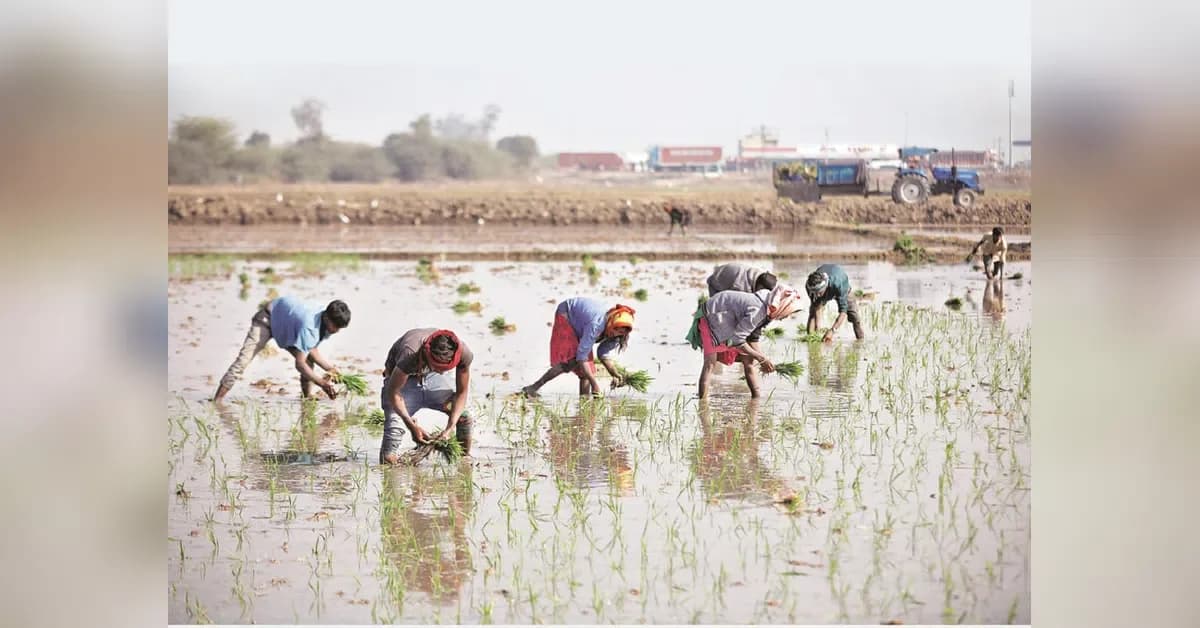
As reported by The Hindu BusinessLine, the India Meteorological Department forecasts subdued rainfall activity over the next few days across major agricultural states. The pan-India rainfall deficit during July 11-13 was 42%, with the gap expected to widen further as there is no prediction of rainfall in major agricultural states over the next few days. However, rainfall conditions improved across the rain-fed core zone of central India between July 1 and July 10, with the rainfall deficit in the region narrowing to 8% by Monday from more than 50% at the end of June, according to the Financial Express report. According to the IMD, cumulative rainfall between June 1 and July 16 stood at 231.3 mm, which was 23.9% below the long-period average (LPA). While June recorded a rainfall deficit of around 40%, precipitation during July so far has been 4% above the seasonal benchmark, though rainfall distribution has remained uneven across the country. The IMD said northwest India has recorded a rainfall deficit of 22%, while east and northeast India have received 36% less rainfall than normal, and central India has reported a deficit of 14%, while the south peninsula has recorded rainfall that is 27% below the long-period average.
As of July 10, the total kharif area sown stands at 531.25 lakh hectares, representing 48% of the season's normal area of 1104.46 lakh hectares, compared with 632.69 lakh hectares during the same period last year, representing a shortfall of 16%. However, expansion of the area might not see a similar level of rise next week, even as over 180 lakh hectares got planted last week against nearly 190 lakh hectares in the year-ago period, as the monsoon rainfall in key states has slowed down. Among cash crops, cotton sowing continued to trail, with coverage down 15.33% at 79.54 lakh hectares so far this kharif season against 93.95 lakh hectares in the year-ago period. Rice, the country's key kharif crop, has recorded a relatively smaller decline of 8.63%, while among the few crops showing positive growth, sugarcane sowing is up 1.51% and jute and mesta have registered a combined increase of 2.02%. The delay in sowing is attributed to a weak monsoon linked to the El Niño effect, which has disrupted the typical planting schedule that begins with the onset of the southwest monsoon in June.
At the 98th ICAR Foundation Day, Agriculture Minister Shivraj Singh Chouhan urged ICAR scientists to intensify efforts to raise productivity in pulses and oilseeds, sectors where India continues to rely heavily on imports. "If countries without access to genetically modified seeds can get better yields in pulses, why can't India?" Chouhan asked, pointing out that farmers with access to irrigation tend to shift toward rice and wheat cultivation, pushing the country to depend on pulse imports. The minister highlighted the productivity gap, noting that an acre under maize can produce over 100 quintals, against roughly 30-35 quintals for rice and just about 5 quintals for pulses such as gram or moong. India currently imports about 6-7 million tonnes of pulses and 15-16 million tonnes of edible oils annually, with Chouhan noting that India imports around 20% of its pulse requirement and about 58% of its edible oil consumption. Chouhan also flagged fertiliser self-sufficiency as a priority and asked how long the country could continue depending on imports. He commended ICAR for developing contingency plans for regions vulnerable to climate shocks and proposed concrete commitments including development of at least 100 climate-smart villages by the centenary and deployment of 100 young scientists to work on frontier areas such as artificial intelligence, robotics, gene editing and climate-smart agriculture. During the event, Chouhan released 43 improved crop varieties and 17 agricultural technologies developed by ICAR, including new Basmati and climate-resilient rice varieties, technology for export-oriented mango cultivation, India's first indigenous African Swine Fever vaccine, and an affordable cassava harvester designed for small farmers.