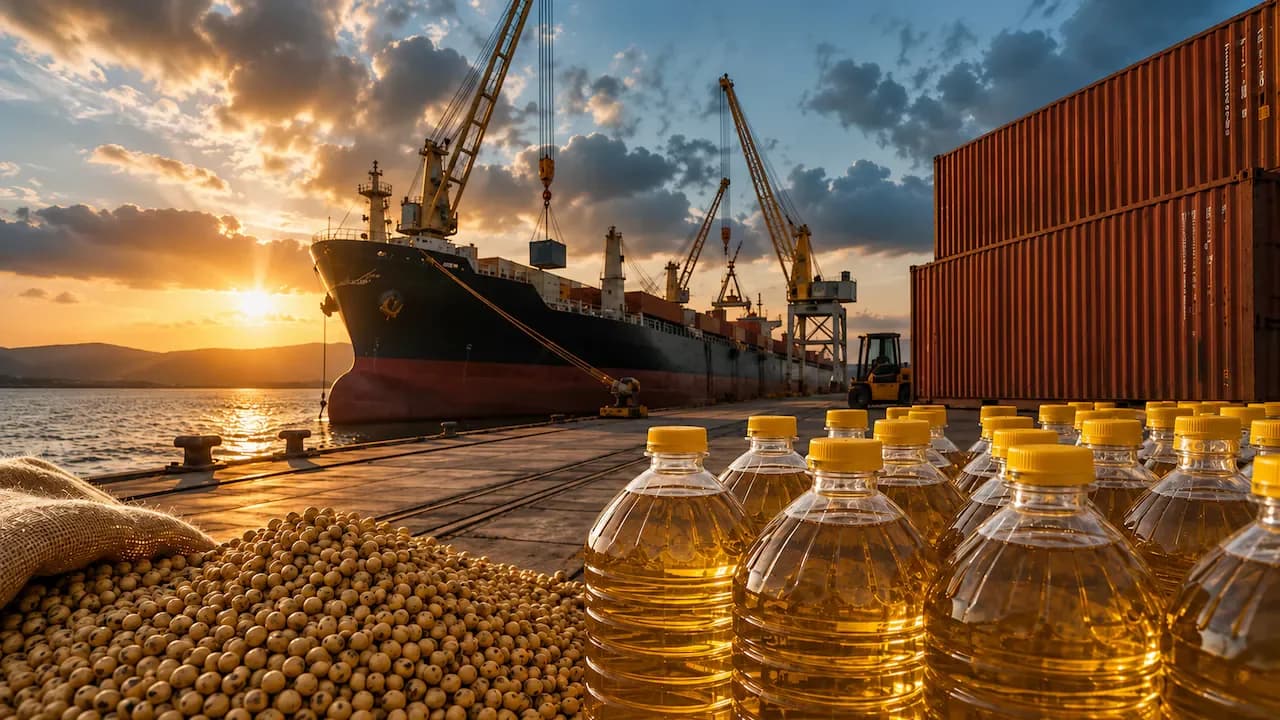
India's soyoil imports are set to reach a record 620,000 metric tons in August, representing a 46% increase from the average monthly imports of 424,549 tons recorded in the current marketing year that began in November, according to four traders directly involved in trade deals. As reported by Reuters, this surge is driven by competitive soyoil prices and disruptions to sunflower oil shipments caused by the Russia-Ukraine conflict. The traders did not wish to be named in line with their companies' policies. Trade-source import estimates of this kind are the standard precursor to official Indian customs data and have historically been directionally reliable, with the main revision risk sitting in vessel timing and month-end arrivals rolling into the following month. According to Sanjeev Asthana, President of Solvent Extractors' Association of India (SEA), India's soybean oil import story is turning red-hot just ahead of the festive season, with competitive international prices, strong domestic demand, and disruptions in sunflower oil shipments prompting Indian refiners to step up purchases.
Russia and Ukraine account for most of India's sunflower oil imports, which are likely to fall to 180,000 metric tons in August, the lowest since February 2026 and down 28% from a month earlier, according to dealers. According to Reuters, around 150,000 tons of sunflower oil originating from the Black Sea and scheduled for shipment in August and September have been delayed due to the conflict. The Black Sea has become increasingly difficult for vegetable oil shipments as Russia and Ukraine target each other's port and maritime infrastructure. The disruption is particularly important for Indian refiners in the south, where sunflower oil is traditionally popular, forcing buyers to turn to soyoil instead. With sunflower supplies facing disruption and palm oil competing for market share, soybean oil is emerging as the preferred alternative. As per SEA, with sunflower supplies facing disruption and palm oil competing for market share, soybean oil is emerging as the preferred alternative.
The premium for soyoil over palm oil has narrowed to around $50 per metric ton from more than $100 in April, said a New Delhi-based dealer, as reported by Reuters. This narrower premium is making soyoil more attractive to price-sensitive Indian buyers. Palm oil has become relatively expensive after concerns over unfavourable weather and Indonesia's decision to increase palm oil use for biofuels, creating a more competitive landscape for soyoil. The narrower price gap has made soyoil more competitive for India's price-sensitive buyers. A second distinction is between demand-led and price-led import surges: episodes where a record reflects cheap landed costs against domestic prices tend to reverse once the arbitrage closes, whereas festival-season stocking has proven stickier.
Argentina and Brazil usually account for the bulk of India's soyoil imports, but India is now sourcing the oil from destinations such as China, Egypt, Thailand and Turkey for prompt shipments, according to Reuters. India is buying soyoil even for shipments several months out, as the landed cost of palm oil and soyoil is nearly the same for October-December shipments, while sunflower oil is trading at a premium of nearly $200 per ton. Shipments are now arriving at southern ports such as Krishnapatnam and Kakinada, in addition to major western ports including Kandla and JNPT. On the supply side, the channels that matter are Argentine and Brazilian crush margins and fob basis, since India's appetite is price-taking rather than structural, and demand of this scale has historically tightened basis in the exporting origins. Concerns over a possible El Niño effect on India's domestic oilseed production are adding to the urgency.
According to Reuters, India's edible oil buying is rising ahead of the festive season, with total edible oil imports climbing to a 10-month high of 1.48 million tons in July, while soyoil imports jumped 31% to 498,881 tons. India has already booked nearly 1.4 million tons of soyoil for September-December delivery, with one dealer expecting monthly imports to remain above 600,000 tons in September. The combination of Black Sea supply disruptions, strong festive demand and a smaller price premium is reshaping India's edible oil buying strategy. Soyoil, once a competing option, is increasingly becoming the preferred substitute for delayed sunflower oil cargoes. However, Sanjeev Asthana from SEA highlighted concerns about domestic production, noting that India's total kharif oilseed acreage stood at 184.46 lakh hectares as of August 14, marginally below 185.36 lakh hectares last year. Soybean acreage has slipped to 120.84 lakh hectares from 122.61 lakh hectares, while groundnut, sesame and sunflower have shown encouraging gains. He wondered whether India could convert its oilseed acreage into a stronger domestic balance of oilseeds and edible oils in 2026-27.