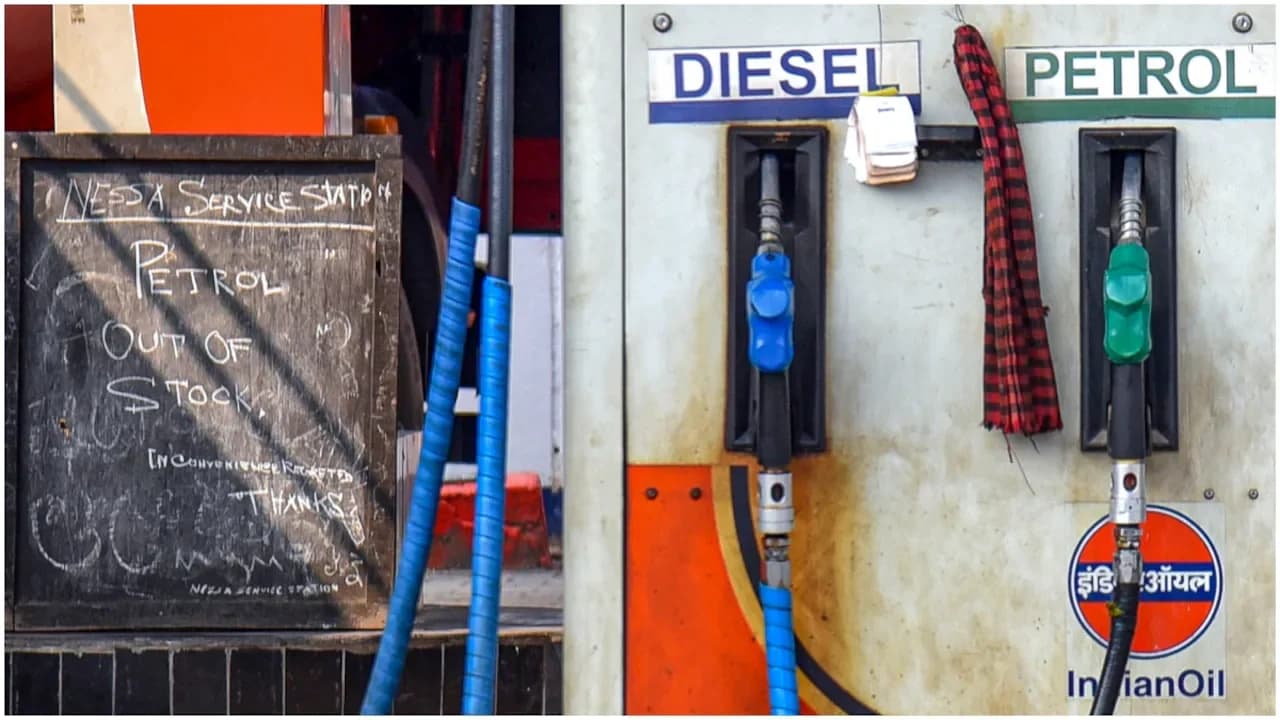
The government has defended its fuel pricing strategy following four rounds of OMC price revisions in May, asserting that India absorbed the Hormuz disruption for 78 days before passing on a cumulative hike of just over ₹7 per litre. According to government sources, this represents the smallest material upward movement of any major non-subsidising economy in the world. The four phased revisions on May 15, 19, 23 and 25 took Delhi petrol from ₹94.77 to ₹102.12 and diesel from ₹87.67 to ₹95.20. As per latest reports, the cumulative Indian revision at just over ₹7 per litre takes the headline movement on the retail price to roughly seven and a half per cent - equivalent to ₹7.35 per litre on petrol and ₹7.53 per litre on diesel.
Government sources pointed out that every major importing economy raised pump prices far more sharply over the same period, with Myanmar hiking 90%, Pakistan 55%, the UAE 52% and the United States 45%. India's cumulative revision of approximately 7.5% compares with a global weighted average increase of over 22% on petrol and 27% on diesel. At peak Brent of around $126 per barrel during the Hormuz disruption, India was absorbing approximately ₹24 per litre on petrol and ₹30 per litre on diesel. The latest data shows that every major developed economy now retails petrol above ₹150 per litre and most above ₹180, with the EU 27 weighted average sitting at ₹179 on petrol and ₹184 on diesel. India's two large neighbours - Pakistan and Nepal - have moved well past ₹135 per litre on petrol despite lower nominal incomes, while Sri Lanka, Myanmar, and the Philippines have crossed ₹130 per litre.
The latest price hike averaging around ₹2.7 per litre will help oil marketing companies cut their overall losses by at least 44%. According to government data, daily OMC under-recoveries had reached approximately ₹1,000 crore at the height of the disruption before the four phased revisions progressively reduced the losses. Refinery-gate under-recoveries were even sharper at ₹26 per litre on petrol and ₹81.90 per litre on diesel. The government highlighted that India is the only major economy to have cut retail fuel prices through both the Russia-Ukraine crisis and the Hormuz disruption, reducing central excise duties four times since 2021 and absorbing approximately ₹30,000 crore at the exchequer through the March 27, 2026 SAED cut alone. Over ₹1.3 lakh crore of UPA-era oil bond liabilities have been redeemed since 2021, sources added.
The government highlighted that India is the only major economy to have cut retail fuel prices through both the Russia-Ukraine crisis and the Hormuz disruption, reducing central excise duties four times since 2021 and absorbing approximately ₹30,000 crore at the exchequer through the March 27, 2026 SAED cut alone. Over ₹1.3 lakh crore of UPA-era oil bond liabilities have been redeemed since 2021, sources added. Through the 78 days from the closure of the Strait of Hormuz on February 28, to the oil marketing companies' revisions of May 15, 19, 23, and May 25, India held petrol and diesel prices essentially unchanged, while the rest of the world raised prices by 10, 20, 50, and, in some cases, 90 per cent. Every other major importing economy has passed on the cost to its consumers and in several cases, doubling pump prices over 48 months. India has not.
On state-level pricing, the government drew a sharp contrast between BJP-ruled states, where petrol is at or below ₹102 per litre in six states, and opposition-governed states, where Telangana and Kerala retain the highest VAT rates in the country, pushing petrol above ₹114 and ₹118 per litre respectively. This pricing differential reflects varying state tax policies on fuel products. The pricing comparison shows that India prices petrol and diesel at or below most of the developing world and at roughly half the European pump price, while still raising less than any non-subsidising peer through the present disruption.