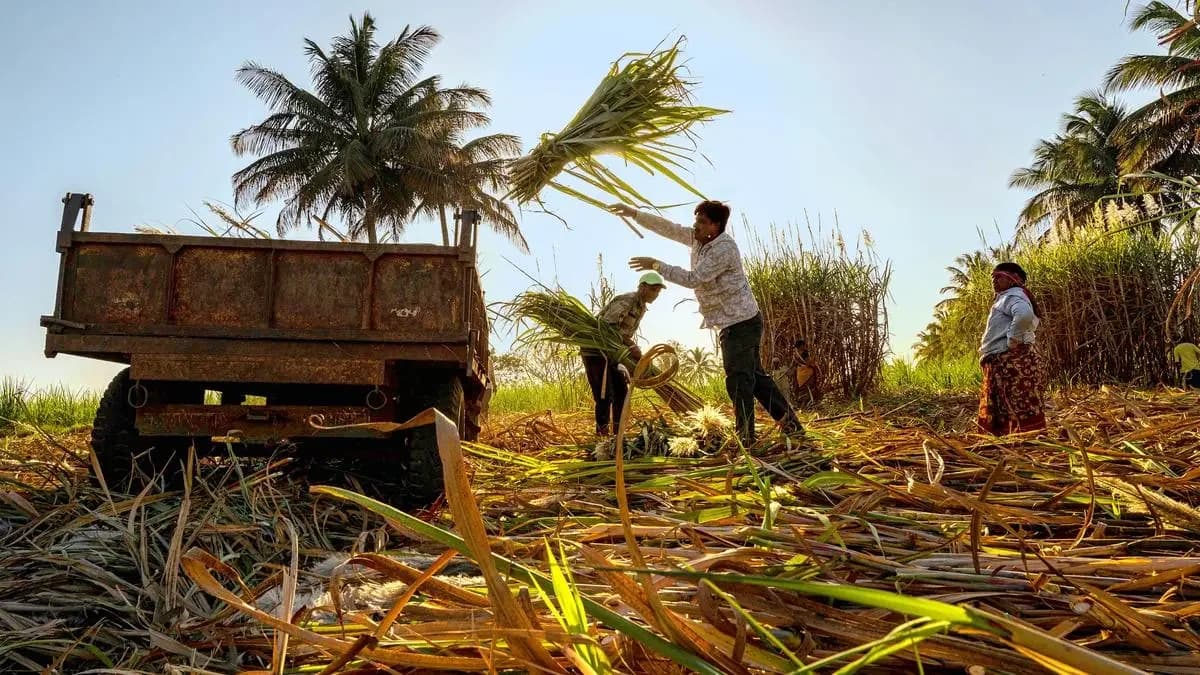
India's sugar production during the current season (October-September) has been estimated at 306 lakh tonnes, representing an 11% decline from the initial projection of 343 lakh tonnes by sugarcane-growing states, as announced by the government on Friday. The lower output is expected to reduce opening stock of sugar on October 1 to around 33-34 lakh tonnes, down from 50 lakh tonnes a year earlier - approximately two-thirds of last year's level. However, officials indicated that the carry-over stock would be sufficient to meet demand until fresh sugar from the new crushing season starts reaching the market. Retail sugar prices rose sharply to ₹58.2 per kg on Friday, marking a 20% increase over the past month and nearly 26% higher than a year ago, according to The Times of India. Latest data from the Department of Consumer Affairs shows retail prices have climbed to ₹55.7 per kg as of August 20, compared to ₹46.3 per kg a year earlier, with prices standing at ₹48.2 per kg just a month ago and ₹50.9 per kg a week ago, pointing to a sharp acceleration rather than gradual climb.
Sugar prices have experienced a dramatic surge in West Bengal, with retail prices reaching ₹70 per kg in Kolkata markets ahead of the festive season, according to PTI. Prices have surged by ₹20 per kg in the past month alone, while the last four to five days have seen a sudden 10% jump, with sugar-associated products such as jaggery, batasa (sugar drop), and nakuldana witnessing similar spikes. A neighbourhood kirana store owner reported selling loose sugar at ₹65 just three days ago, but today can't sell below ₹70 per kg. Wholesale prices have already touched ₹65 per kg, with retail prices expected to reach about ₹70 per kg, as reported by PTI. In Kolhapur, one of the country's key sugar trading hubs, spot prices jumped 30% in a single month, rising from ₹4,400 to ₹5,750 per quintal between July 22 and August 20, per NCDEX data. Confederation of West Bengal Trade Association (CWBTA) president Sushil Poddar said there was no control over sugar mills, with wholesale prices already touching ₹65 a kg, and retail prices will reach about ₹70 a kg. West Bengal minister Dilip Ghosh blamed the sugar price spike on hoarding and not on ethanol blending, though industry executives attribute the crisis to multiple factors including diversion to ethanol production.
Bihar Minister Shravan Kumar has drawn sharp criticism for attributing the limited impact of rising sugar prices to increasing diabetes cases, claiming that people have already cut down on their sugar consumption. As reported by NDTV, Kumar told reporters while defending the price increase, "People are eating less sugar anyway. Everyone is suffering from diabetes. Who eats sweets these days?" He said the rise in sugar prices would not make much difference and there was no need for concern. Sugar prices in Bihar have climbed to more than ₹65 per kg, compared with around ₹48-50 earlier, raising concerns among consumers. Another Bihar minister, Vijay Kumar Sinha, also defended the increase, but said the reasons behind the sharp rise should be examined, adding that he was happy when farmers received better prices for their produce and the government would seek information from the minister responsible for sugar production.
India has officially permitted duty-free import of 1 million metric tonnes of raw sugar as part of its efforts to combat soaring domestic prices and control food inflation. As per The Times of India, the Commerce Ministry issued a notification stating that the imports will be allowed under a tariff rate quota regime, with the import window extended until October 31, 2026. The Directorate General of Foreign Trade announced that the import policy for raw sugar is amended to allow 10 lakh MT of duty-free imports under Tariff Rate Quota (TRQ) till October 31, 2026, marking the first raw sugar import since the 2016-17 season. The Centre on Thursday evening allowed sugar mills to import one million tonne of raw sugar, a measure last resorted to a decade ago, but its impact is yet to trickle down to retail markets, according to PTI. The government has also imposed a stockholding limit on bulk customers who consume more than 10 tonne of sugar a month, capping their stock at 15 days' consumption. The imports were permitted just ahead of the crucial festival season to curb a sharp surge in domestic prices, which touched record levels on Thursday.
The tighter norms come amid concerns over sugar availability for the 2026-27 sugar season, beginning October 1, with industry estimates pegging opening stocks at 40-42 lakh tonnes, while some estimates are lower at 32-35 lakh tonnes, against domestic requirements of around 50 lakh tonnes. According to a report by rating agency ICRA in May, gross sugar production for sugar year 2026 (SY2026) is projected to rise 5.03% to 31.10 million tonnes, against 29.6 million tonnes in the previous year. Net sugar production, after an estimated diversion of 3.1 million tonne towards ethanol, is likely to remain at 28 million tonne. Considering domestic consumption of 28.3 million tonne and exports of 0.7 million tonne already undertaken, closing sugar stock is expected to be around 4.3 million tonne by September 2026, against 5.3 million tonne in the previous year, as reported by PTI. India's sugar stocks, the buffer that protects consumers from supply shocks, have been declining steadily over the past five years. Closing stocks stood at 95-96 lakh metric tonnes in 2021-22 and 2022-23, before falling to 84 lakh metric tonnes in 2023-24 and 60 lakh metric tonnes in 2024-25. Stocks are now projected to drop further to 43 lakh metric tonnes by the end of September this year, the lowest level in five years, according to data from the US Department of Agriculture's Foreign Agriculture Service and ratings agency ICRA.
Sugar prices in India have climbed to record levels, with domestic wholesale prices crossing ₹6,000 per quintal in cities like Kanpur and Kolkata, while prices in the Muzzafarpur and Kolhapur belts have averaged above ₹5,000 per quintal. The all-India average ex-mill sugar price rose to ₹5,400 to ₹5,560 per quintal on August 18, up from ₹3,900 a year earlier. Data furnished by NCDEX showed that spot sugar prices in major markets across India touched a 16-year high of ₹5,530 per quintal on August 19, 2026. The average retail price rose 13% year-on-year to ₹52.30 per kg on August 18, up from ₹46.34 per kg, with the all-India average ex-mill price reaching ₹5,400-5,560 per quintal, compared with ₹3,900 a year ago. However, sources suggest that the proposed import of 1 mt of sugar will lead to a significant decline in ex-mill and wholesale prices by around ₹500 per quintal at best, though this may not be substantial enough to significantly impact current price levels. The government has also tightened stock disclosure and reporting norms, with sugar consumption determined with reference to Goods and Services Tax (GST) returns filed by sellers or buyers using relevant Harmonised System of Nomenclature (HSN) code for sugar.

Sunny Agrawal, head of fundamental research at SBI Securities, said that tightness in demand supply situation has led to firming up of sugar prices and this augurs well for all the sugar mills. He noted that sugar millers will benefit on account of the recent surge in sugar prices as they are sitting on sugar stock at significantly lower cost (around ₹37/Kg vs current ex-factory realisation of ₹54-55/kg in UP & ₹46/Kg in Maharashtra). The surge in sugar prices will help them mitigate margin pressure in the ethanol division, where there has been no price hike for the last 3 years. Our preferred bets in the sugar segment will be Balrampur Chini, Triveni and EID Parry. However, Agrawal attributed the current correction in the sugar stocks to government intervention, stating "any government intervention can lead to a correction in sugar prices and hence pursuant correction in the stock prices of sugar companies." Notably, the imports will be permitted till October 31, 2026, for a period of more than two months, with India presently imposing a duty of 100% on raw sugar imports. For sugar companies, higher imports could increase domestic availability and weigh on sugar prices and mill realisations, though the impact may be partly cushioned as the duty-free import window is capped at 1 million tonnes. India has also kept sugar exports prohibited until September 30, 2026, to prioritise domestic supplies.