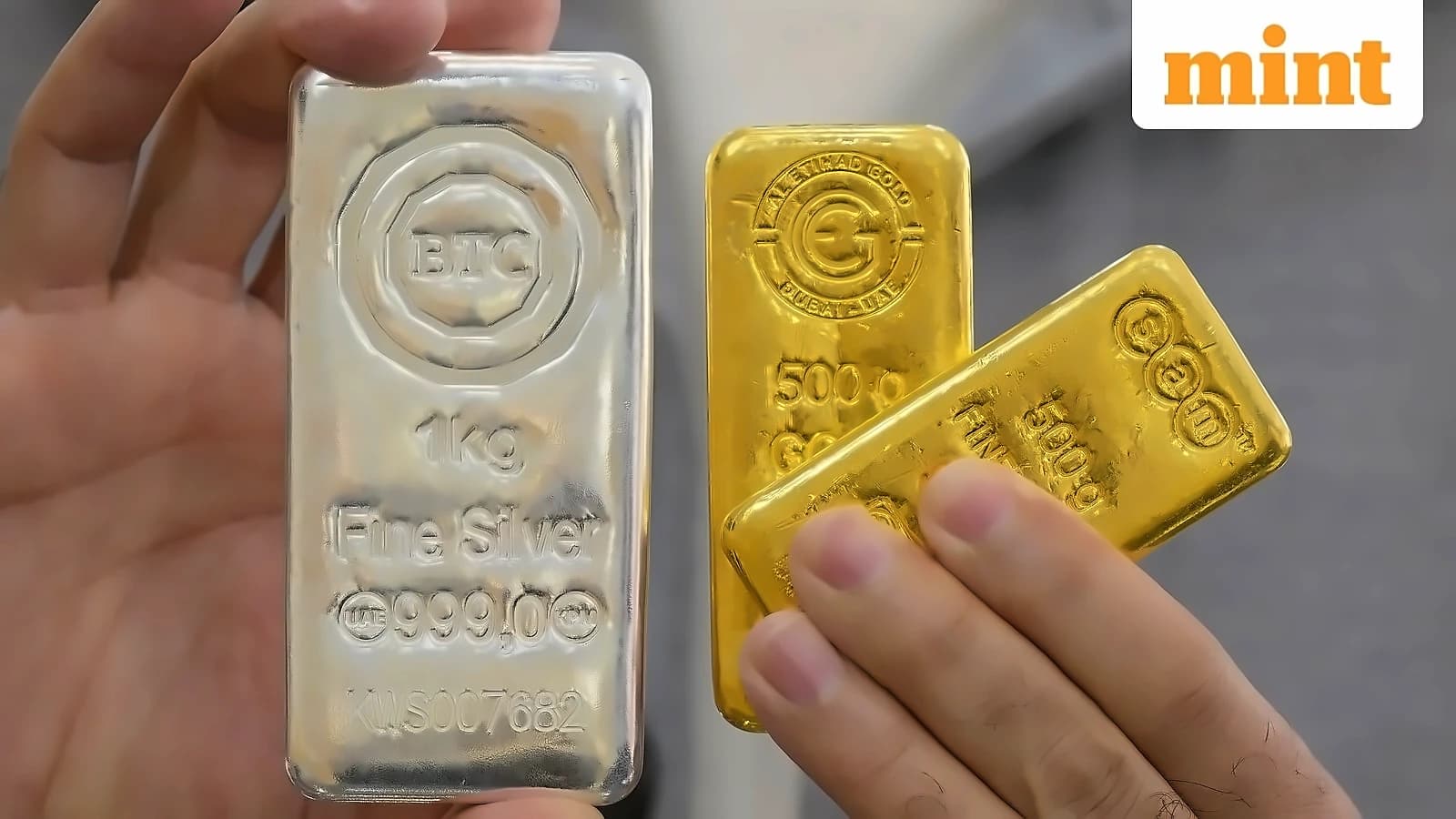
Gold prices are expected to remain range-bound in the coming week as traders await clarity on evolving US-Iran negotiations, while silver is anticipated to retain a positive bias amid persistent geopolitical uncertainty and elevated energy rates, according to analysts. As reported by The Hindu BusinessLine, Business Standard, Devdiscourse, and The Times of India, "Gold price momentum next week looks sideways, while silver still looks positive as focus will again be on the peace negotiations between the US and Iran to end the war." Domestic futures markets will remain closed during the morning session on Thursday for Bakri Id. Investors will also track US housing data, GDP numbers, consumer confidence readings and Personal Consumption Expenditure (PCE) inflation data for further clues on the Federal Reserve's policy outlook.
Gold futures rose marginally to close the previous week at ₹1.58 lakh per 10 grams, while silver edged lower to settle at ₹2.71 lakh per kilogram on the Multi Commodity Exchange (MCX), according to The Hindu BusinessLine, Business Standard, Devdiscourse, and The Times of India. Jateen Trivedi, VP Research Analyst at LKP Securities, noted that gold traded in a range-bound manner last week, posting marginal gains of around 0.40% to close near ₹1,58,670 per 10 grams. The week witnessed sharp profit booking in crude oil, with prices correcting nearly 7% from higher levels, easing some inflation concerns globally. Pranav Mer, Vice President at EBG - Commodity & Currency Research at JM Financial Services Ltd, noted that gold prices moved in a consolidative range over the past few sessions, but ended the week with a marginal loss amid lack of fresh direction.
The rupee recovered from weaker levels of 97 against the US dollar to strengthen near 95.70, which limited upside momentum in domestic gold prices despite stable international bullion trends, as reported by The Hindu BusinessLine, Business Standard, Devdiscourse, and The Times of India. In international markets, Comex gold futures closed the week 1% lower at $4,523.2 per ounce, while silver fell nearly 2% to close at $76.20 per ounce. According to analysts, uncertainty surrounding the geopolitical situation has continued to keep markets on edge, particularly as statements from both Washington and Tehran have frequently shifted. The volatility in crude oil prices persisted due to contradictory and frequently changing statements from American and Iranian officials.
President Donald Trump has sharply contrasted the current negotiations with the 2015 Joint Comprehensive Plan of Action (JCPOA), calling it "one of the worst deals ever made" and a "direct path to Iran developing a nuclear weapon." Under the Obama-era JCPOA, the US along with China, France, Germany, Russia, and the United Kingdom lifted economic sanctions against Iran in exchange for limits to its nuclear programme. Trump pulled the US out of that deal in 2018, arguing it only delayed rather than prevented Iran from acquiring nuclear weapons. Israeli Prime Minister Benjamin Netanyahu has spoken with Trump about the memorandum of understanding to reopen the Strait of Hormuz and upcoming nuclear negotiations with Iran, stressing that any final agreement must dismantle Iran's enrichment sites and remove all enriched material from Iranian territory. Netanyahu said Trump reaffirmed Israel's right to defend itself on every front, including Lebanon, and that the two leaders were aligned on a core red line, Iran will not have nuclear weapons.
Despite growing expectations of a breakthrough, key disagreements persist in the negotiations. Iranian media indicated differences remained over "one or two clauses" in the proposed memorandum, with Tehran warning there would be no final understanding if Washington continued to create obstacles. Iran's Foreign Ministry spokesperson said the overall trend had been toward reducing disputes, though "issues still need to be discussed through mediators." Iranian military adviser Mohsen Rezaei, a military adviser to Iran's Supreme Leader, said Iran's management of the Strait of Hormuz was Tehran's legal right to ensure national security, adding that it would end 50 years of insecurity in the Persian Gulf. The proposed memorandum outlines a framework to end months of fighting, reopen the waterway, and potentially ease restrictions on Iranian shipping, with the future of Iran's stockpile of highly enriched uranium to be negotiated separately within 30 to 60 days. On Sunday, US President Donald Trump claimed on Truth Social that Washington and Tehran were nearing a broad agreement aimed at easing tensions in the Gulf region and reopening the Strait of Hormuz, stating the agreement had been "largely negotiated" and that only final details remained before a formal announcement. However, Iranian media rejected Trump's claim that the Strait of Hormuz would fully reopen under the proposed agreement, insisting that control over the strategic waterway would remain with Tehran. Analysts said the conflicting narratives from both sides have kept investors cautious, with bullion prices likely to remain highly sensitive to headlines emerging from the region.