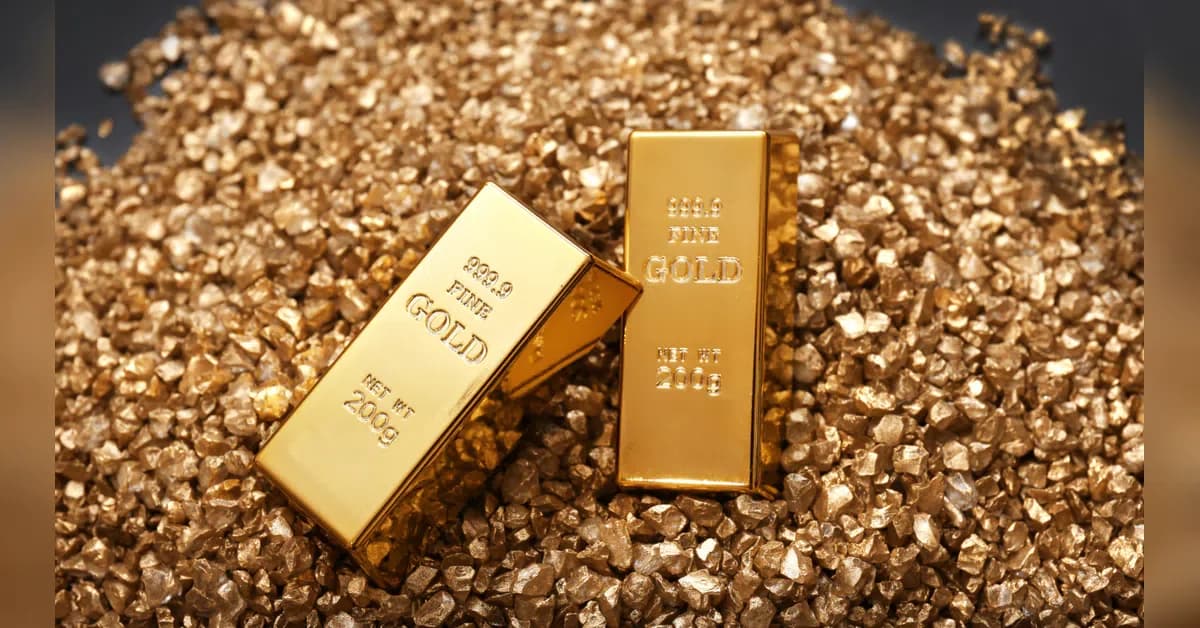
Gold experienced its worst monthly performance since 2013, falling 12% in March to $4,668 per ounce, according to the World Gold Council (WGC). The precious metal lost value across all major currencies but maintained a positive position for the year. As reported by the World Gold Council, the decline was attributed to momentum factors rather than fundamental shifts in gold's appeal. The council used its monthly Gold Return Attribution Model (GRAM) to identify that much of the decline stemmed from momentum factors, including global gold ETF outflows, a COMEX net long unwind, and a price trend reversal. The sell-off occurred despite what should have been supportive conditions, including elevated geopolitical tensions from the Iran war and renewed inflation concerns.
The Australian gold sector faced severe pressure during March, with the S&P/ASX All Ordinaries Gold Index (ASX: XGD) declining 23.9% while the broader ASX 200 slumped 7.8%. Major gold stocks experienced significant losses, with Northern Star Resources Ltd (ASX: NST) shares falling 32.8%, Newmont Corp (ASX: NEM) dropping 14.5%, and Evolution Mining Ltd (ASX: EVN) declining 23.9%. This marked a sharp reversal for gold stocks that had been among the top performers on the ASX 200 over the year to March. The decline was particularly notable given that gold typically serves as a haven asset during geopolitical uncertainty, but investors sold the yellow metal first when seeking liquidity amid broader market declines.
Global gold ETFs experienced significant outflows during March, with $12 billion (84 tonnes) in net sales led by North America at $14 billion (-87 tonnes) and Europe contributing $0.1 billion (-7 tonnes). However, Asia provided some support with $1.9 billion (10 tonnes) in inflows, highlighting how dip-buying in Asia translated into substantial fund flows despite lower equivalent tonnage. According to the World Gold Council, this pattern demonstrates how regional investor behavior can influence global gold markets. The report noted that "While real yields and the dollar undoubtedly contributed to net sales, other factors were also likely at play," with a portion of ETF sales likely originating from retail hands, with the US accounting for the bulk of the 80 tonnes lost globally between the start of the month and March 24.
Technical factors played a significant role in the decline, with COMEX Non-Reportable positions, associated with retail exposure, experiencing a cumulative 18-tonne net drop during the first three weeks of March. This aligned with a 22-tonne drop in Managed Money, reflecting more institutional activity. As reported by the World Gold Council, commodity trading advisors (CTAs) were very long heading into mid-March and unwound positions sharply when gold broke through its 50/55-day moving average on March 16 for the first time in seven months. The council observed that "CTA-driven selling likely amplified downside momentum," with estimated and anecdotally reported CTAs unwinding positions sharply when gold broke through this technical level. Gold's performance during this period was particularly counter-intuitive given that it typically outperforms during periods of geopolitical uncertainty.
Broader cross-asset deleveraging contributed to gold's decline, with elevated margin debt relative to market capitalization causing widespread equity selling. The World Gold Council noted that gold faced liquidation pressure as multi-asset investors, including CTAs with equity exposure, reduced positions to meet liquidity needs and reduce portfolio risk. Bond market dynamics reinforced this pressure as US bonds were sold on a near-term inflation shock, causing 2-year nominal yields to shoot higher. Central bank intervention added downward pressure following The Central Bank of the Republic of Turkiye's decision to use approximately 50 tonnes of gold as collateral, predominantly via swaps, which may have fuelled rumours of selling. However, looking ahead, the World Gold Council found that fundamentals began to reassert themselves as the dollar struggled to sustain gains and early April ETF flows turned positive. The analysis suggests that while momentum factors drove March's decline, underlying gold demand remains resilient despite temporary volatility.
Despite the challenging March performance, early signs of stabilization are emerging in the gold market. The World Gold Council noted that early April exchange traded fund (ETF) flows into gold have been positive across regions, indicating potential recovery momentum. For the Iran war's impact on interest rates in critical economies like the US, the WGC expects policy tightening to be rhetorical with expectations of hikes getting unwound quickly. Any energy-driven CPI impulse is likely to result in demand destruction, limiting pass-through to core inflation and reinforcing the case for an eventual dovish pivot. However, risks remain regarding oil prices and potential cross-asset deleveraging, with the WGC warning that should the conflict keep oil prices well in excess of $100/bbl for an extended period, this could risk further cross-asset deleveraging, yield blow-outs, or gold mobilization by the official sector.