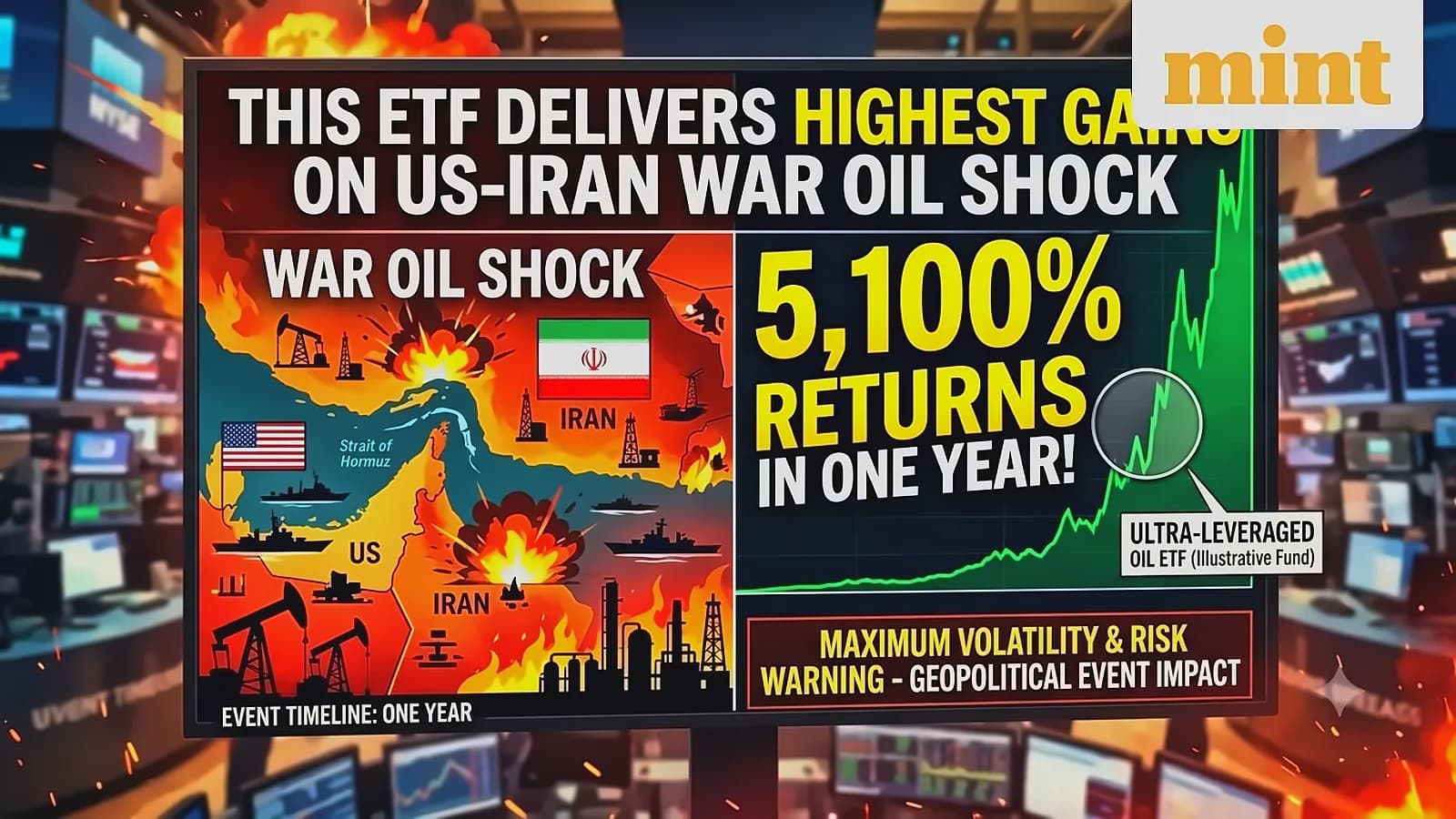
Global shipping stocks surged on Monday as rising oil transportation costs and escalating geopolitical tensions in the Middle East boosted investor interest in tanker operators. The SonicShares Global Shipping ETF climbed 2.2% to $54.69, while key tanker stocks Torm, Hafnia and Teekay Tankers opened at new 52-week highs. The Breakwave Tanker Shipping ETF (BWET) has emerged as the best-performing ETF of 2026, closing at a record $1,012.75 on October 8 with gains of 5,157% year-to-date. According to market data firm Barchart, the fund's chart has become parabolic, with analysts issuing warnings about the steep rally. The ETF's weekly performance shows gains of approximately 5,639% from its December 2025 low near $17.65, with the fund stalling between $125 and $200 from April to June before turning vertical in July. $10,000 invested at the start of the year would now be worth about $526,000, with the fund's 12-month performance reaching 6,988% according to recent data.

Freight markets have experienced unprecedented growth, with the Baltic Exchange Dirty Tanker Index standing at 7,444 last Tuesday, more than six times higher than a year ago and the highest reading in Bloomberg data going back to 2010. As reported by Bloomberg Intelligence, the benchmark rate for very large crude carriers (VLCCs) hit a record $907,635 per day on October 6 and could cross $1 million before the month is out. Recent developments show a supertanker loading crude in the Gulf of Oman was fixed at $1.01 million per day for a voyage to Asia, with another deal reportedly agreed at $1.16 million. The surge in tanker rates was initially triggered by US and Israeli strikes on Iran on February 28, which effectively closed the Strait of Hormuz, with the benchmark supertanker route from the Middle East Gulf to China (TD3C) setting a record near $424,000 per day by late March.
The disruption has forced tankers to take longer routes and pushed up insurance costs, effectively tightening the supply of available vessels even as global trade continues. Both of the Middle East's key checkpoints, the Strait of Hormuz and the Bab el-Mandeb, remain under active threat. Much of the crude leaving the Persian Gulf is now shuttled out in smaller tankers under the protection of US naval forces, then transferred onto supertankers in the Gulf of Oman. Many vessels are still sailing the long way around Africa, with these detours keeping ships at sea for days or weeks longer than normal trips. C.H. Robinson estimates that roughly 12% of global container ship capacity is currently tied up by port congestion alone. The current rates are particularly significant because they're backed by ships actually making the voyage, unlike earlier periods when some questioned whether the rates were inflated since so few tankers were crossing the strait.
Despite disruption concerns, demand remains robust with the JPMorgan Global Manufacturing PMI rising to 53.0 last month, its highest level since February 2022. S&P Global credits spending on AI infrastructure and defense equipment, along with companies building inventory out of fear of further supply disruptions. Across the broader economy, new export business grew at the fastest pace in more than five years. Trade data tell the same story, with global goods trade growing faster in the first half of 2026 than in any half-year in the past 15 years apart from the post-Covid rebound. AI-related goods such as semiconductors accounted for 76% of that growth in the first quarter. The Port of Los Angeles just wrapped up the busiest three-month stretch in its history, and import volume headed for Long Beach over the next three weeks is running roughly 50% above year-ago levels.
Elevated rates are delivering extraordinary results across the shipping industry. Hapag-Lloyd started the year forecasting anything from a $1.3 billion loss to a $400 million profit but has since raised its outlook twice and now expects 2026 operating earnings (EBIT) of $1.25 billion to $1.75 billion. Teekay Tankers reported record second-quarter adjusted net income of $193.6 million, or $5.56 per share, and ended June with more than $1.2 billion in cash and short-term investments. However, the boom is creating its own challenges as shipowners flush with cash are ordering new vessels. According to Hellenic Shipping News, 198 VLCCs have been ordered so far this year, compared with 89 in all of 2025. The tanker orderbook now equals 37% of the existing fleet, with tanker supply growth expected to outpace demand starting in 2027. Wall Street appears to see this coming, with consensus estimates for tanker owners showing quarterly earnings peaking this quarter and drifting lower through mid-2027.