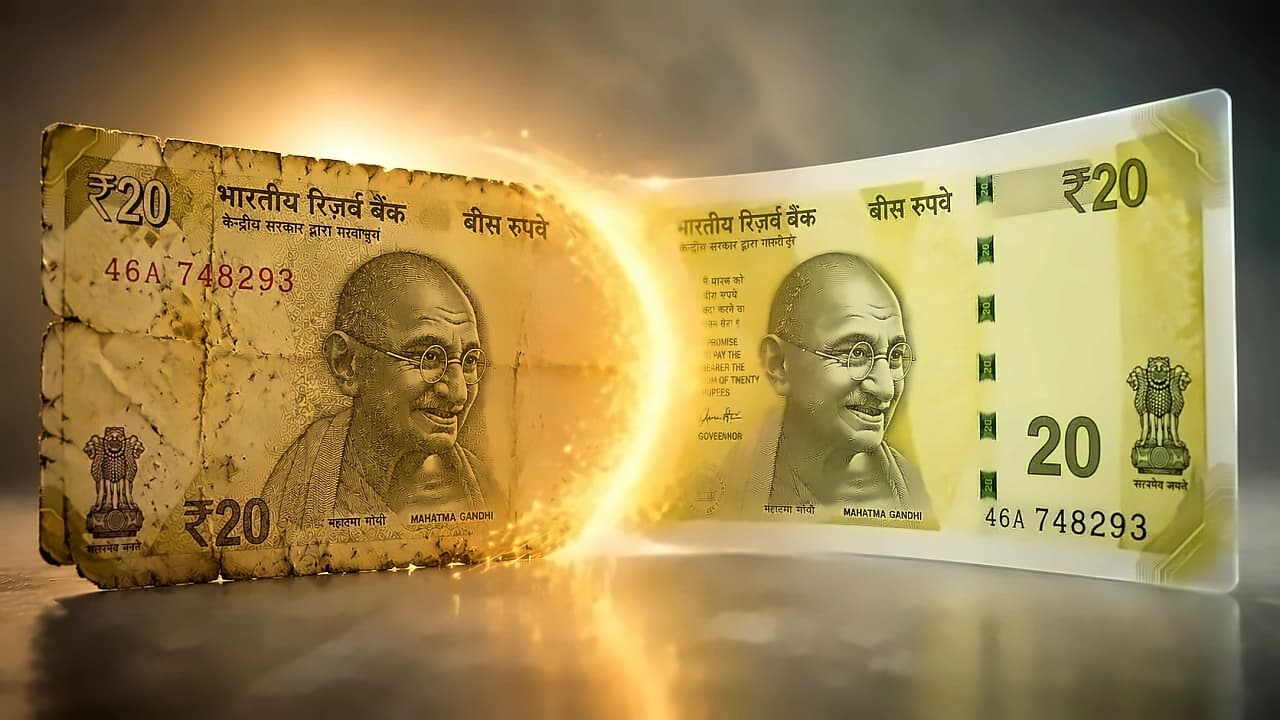
The government has officially approved the introduction of one billion polymer banknotes of ₹10 and ₹20 for field trials, with RBI Governor Sanjay Malhotra announcing during last week's Monetary Policy Committee (MPC) meeting that polymer currency would start circulating from the next financial year. As confirmed by Finance Minister Nirmala Sitharaman in her latest response to the Rajya Sabha, the RBI, with the recommendation of its central board, had sent a proposal to the government in terms of Section 25 of the Reserve Bank of India Act, 1934, seeking approval for these denominations. The RBI has informed that these polymer banknotes are proposed to be issued alongside paper substrate-based banknotes, with the government authorising the RBI to print up to 2 billion polymer banknotes for the field trials, 1 billion each in ₹10 and ₹20 denominations. However, as per the government, at this point of time, it would not be possible to practicably determine the exact timeframe for introduction of polymer banknotes or the expenditure likely to be incurred thereon. The proposal also provides for regular issuance of polymer banknotes in the two denominations if the field trials are completed successfully. This marks a significant step towards testing an alternative to India's current paper-based currency system, with if everything goes as planned, the polymer banknotes may roll out from the next financial year, though no specific date or month has been allocated for the launch.
Existing paper ₹10 and ₹20 notes will continue to remain legal tender during and after the polymer note field trials, as confirmed by the government. The proposed polymer notes will initially be tested alongside the paper-based currency already in circulation, with people able to use both versions once the polymer notes enter circulation. The government has not announced any plan to withdraw the existing paper currency in these denominations, and the field trial is instead intended to help the RBI understand how polymer notes perform under India's demanding cash-use conditions before deciding whether to expand their use. The scale of the proposed trial will allow the RBI to assess how the notes perform across actual circulation rather than relying only on laboratory testing, with the central bank needing to procure the notes before the field exercise begins.
The Reserve Bank of India's plan to introduce polymer notes will require significant infrastructure upgrades, with banks facing substantial costs for ATM modernization. According to a senior official at a large state-owned bank, polymer notes cannot be dispensed in current automated teller machines without replacing the cassettes, which store different denominations of currency notes. The banker, who spoke on condition of anonymity, indicated that the cost of replacing an ATM is about ₹2 lakh and the cassette replacement will be lower, though lenders are yet to assess the complete expenditure. The RBI is currently conducting pilot testing of polymer banknotes in Indian conditions to assess their performance before widespread adoption. As per the latest reports, polymer banknotes are typically made from a thin, flexible plastic film rather than the cotton-based paper used for conventional currency, and are widely regarded as more durable, harder to counterfeit, and more resistant to dirt and moisture compared to paper notes. According to RBI Governor Sanjay Malhotra, polymer notes have been in circulation for more than 30 years in various countries, and one finds that the life is much more - two to four times the life of the paper substrate. The plan is not to replace paper currency completely, rather polymer and paper-based notes will continue to circulate together as legal tender.
A critical challenge facing the implementation is the lack of domestic manufacturing capabilities for the specialized equipment. As reported by the banker, there are no companies in India that produce these cassettes, necessitating discussions on sourcing arrangements. The cassettes are essential components that store different denominations of currency notes in ATMs, with each ATM requiring separate cassettes for each denomination. The banker noted that when currency sizes changed in the past, banks took about a year to replace cassettes at ATMs to enable dispensing of new notes. Despite the approval, several details remain undecided, with the RBI indicating that procurement for the project is still at an early stage. This suggests that while the policy decision has been made, the practical rollout, including sourcing the polymer substrate, finalising printing arrangements, and identifying trial locations, is still some way off. As per the latest reports, the RBI is targeting circulation of the notes from the beginning of the next financial year if the project proceeds as planned.
The RBI's currency management arm, Bharatiya Reserve Bank Note Mudran, has initiated the procurement process for polymer substrate sheets with security features. On 17 July, the RBI issued a global expression of interest inviting bids from manufacturers to supply polymer substrate sheets embedded with security features for printing Indian banknotes. The bidding window remains open until 18 August, representing a crucial step in the implementation timeline as the central bank prepares for potential large-scale production requirements. The government has indicated that the procurement process is presently at an initial stage, with the RBI continuing to work on the necessary arrangements for large-scale production. According to Minister Sitharaman, the introduction of polymer banknotes is currently in a preliminary phase and the impact on digital payments could be ascertained only after regular issuance of these notes. RBI Governor Sanjay Malhotra has confirmed that the pilot programme for polymer banknotes is still in progress, stating that "We will test the currency before bringing it to the market" and "There is still a pilot going on for polymer notes". The central bank will evaluate the results of the field trials before taking a final decision on wider circulation.