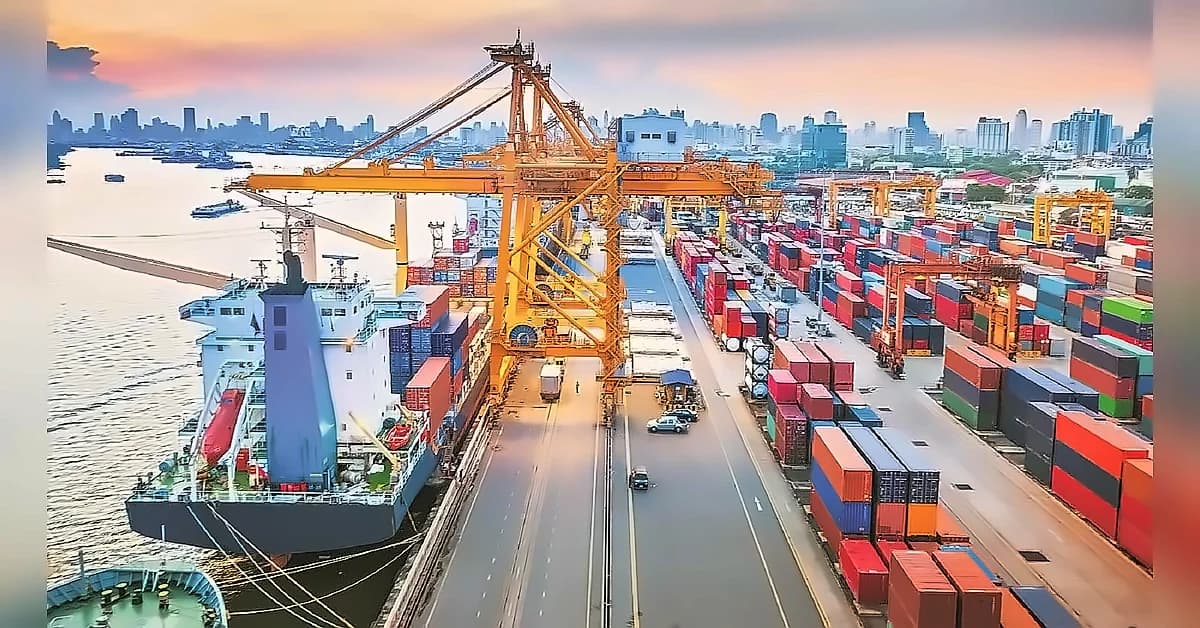
India's merchandise exports achieved a historic milestone, jumping 45% year-on-year to a record $49.5 billion in October 2026, marking the strongest annual growth in five years according to the Finance Ministry's November 2026 Monthly Economic Review. Petroleum products emerged as the biggest contributor, surging 140.2% to $8.9 billion due to higher crude oil prices, with the Indian crude basket reaching $119.9 per barrel in October compared to $65.1 per barrel a year earlier. However, non-petroleum, non-gems and jewellery exports also grew 36.5% year-on-year, led by engineering exports reaching $12.7 billion (36% growth) and electronics exports rising 62.7% to $6.6 billion. The export expansion extended across multiple sectors, with organic and inorganic chemical exports increasing 36.2%, plastics and linoleum products growing 36.3%, meat, dairy and poultry exports rising 34.9%, and gems and jewellery shipments advancing 40.1%. Employment-intensive sectors also contributed significantly, with handicraft exports surging 55.2%, cotton yarn and fabrics growing 30%, and leather exports advancing 12.7%.
India's retail inflation has risen to 6.09% in October, an increase of 55 basis points from the previous month, breaching the Reserve Bank of India's tolerance band of 2-6% and reaching a two-year high. According to the RBI's November State of the Economy report, inflation above 4% and 6% spread across more CPI items and regions, with urban inflation at 5.4% and rural at 6.6%. The Finance Ministry's November Monthly Economic Review flags near-term upside pressures from the persistence of unfavorable base effect and weather-related uncertainties, including the possibility of a strong El Nino. The retail inflation print for November is also expected to reflect the impact of an unfavorable base effect, as India's Consumer Price Index for November last year was 104.01 as per the 2024 base year, but only 0.71 per cent as per the 2012 base year. With the festive season persisting into November and the onset of the wedding/nuptial season, upcoming inflation prints may face upside risks due to increased demand across food and non-food items. Food inflation remained elevated at 8.2% for urban areas and 8.7% for rural areas, with 11 states and Union territories recording inflation between 6% and 8%. Core inflation, which excludes food and fuel, increased to 4.5% in October from 4.3% in September, while core inflation excluding precious metals rose by 60 basis points to 3.8%.
Indian companies are expected to face significant margin compression in Q3 FY27, with operating profit margins declining 50-75 basis points year-on-year despite maintaining healthy revenue growth of 18-20%, according to rating agency ICRA. As reported by Business Standard, this marks a moderation from the 24.2% year-on-year revenue growth recorded in the September quarter, as companies increasingly rely on price increases to support sales while demand growth shows signs of slowing. Rising raw material, energy and logistics costs, higher borrowing rates and weakening rural demand are weighing on profitability, with the assessment covering 3,103 listed companies excluding those in the financial sector. Despite expected margin compression, interest coverage ratios are projected at 5-5.2 times during the quarter, compared with 5.7 times in Q2. Aviation, automobiles, fast-moving consumer goods (FMCG), cement and other energy-intensive industries are likely to face margin pressure from higher crude oil prices, palm oil, coal and other key inputs, with the resulting increase in freight, packaging and logistics costs expected to weigh on profitability.

Despite merchandise imports increasing 16.5% to $89.4 billion in October, the export surge helped narrow the merchandise trade deficit to $39.9 billion from $42.6 billion a year earlier. Total exports, including services, rose 29.9% to $90 billion, while total imports increased 16.6% to $110.1 billion. Services exports provided additional support, rising 15.2% to an estimated $40.5 billion, with the services trade surplus reaching $19.8 billion, which offset 49.6% of the merchandise trade deficit. Forex reserves stood at $705.3 billion as of November 13, providing 10 months' import cover and 90.6% of external debt. The rupee appreciated 2% in FY27 till November 23, rising 1.7% in November alone. Gross tax revenue reached ₹19.8 lakh crore (+6.1%) and capital expenditure stood at ₹6.5 lakh crore (+12.7%) in the April-September period, while the fiscal deficit was ₹7.1 lakh crore (+24.7%).
Despite inflationary pressures and rising import costs, the Finance Ministry expects economic momentum to sustain in the December quarter with domestic economic activity remaining resilient. The ministry noted that business activity is likely to remain firm, with new orders gaining pace and input cost pressures easing. High-frequency indicators showed continued strength in October, with robust growth in e-way bill generation, GDP collections, electricity consumption and freight movement. Comfortable fertiliser availability bodes well for the rabi season, although sowing is at an early stage and reservoir storage remains below last year's level. However, potential supply-side shocks arising from the West Asia conflict are likely to remain a key risk to wholesale and retail prices in India. The Q3 momentum is expected to persist, supported by consumption, new orders, and rural demand, though evolving geopolitical situations and uncertainty surrounding global trade policies could weigh on the outlook. India's GDP grew 7.8% in the June quarter, while the October edition of the MER estimated growth at 7.35% in the September quarter, with GDP estimates for the September quarter to be released on November 30, 2026.