During the 18th Brics Summit in New Delhi, the grouping urged the New Development Bank to expand local-currency financing as a key economic theme. According to reports from Business Standard, the Brics grouping encouraged the NDB to strengthen its ability to mobilise resources, describing the bank as a crucial BRICS institution for promoting sustainable development, reducing inequalities and supporting resilience in emerging economies. The focus on de-dollarisation was among the key economic themes at the summit, though the grouping stopped short of backing a common Brics currency. As per Albanian Daily News, the summit represented more than just an annual diplomatic meeting, reflecting the growing demand from emerging economic powers to play a greater role in shaping the rules of the international system. The question is not simply how much money is available. It is also who provides the money, in which currency, and under what conditions. The more developing countries can borrow, trade and invest without first obtaining dollars, the less vulnerable they become to changes in American monetary policy and the dollar exchange rate.
The New Development Bank is a multilateral development bank established in 2015 by the original Brics countries: Brazil, Russia, India, China and South Africa. As reported by Business Standard, the bank is headquartered in Shanghai and has established on-the-ground presence in all five founding members. The NDB was established with an authorised capital of $100 billion and initially structured around equal shareholdings among its five founding members, with each country subscribing $10 billion of the bank's initial $50 billion subscribed capital. Following expansion, the five founding members continue to hold 18.72% each of the total subscribed capital, while Egypt holds 2.24%, Bangladesh 1.76%, Algeria 1.15%, the UAE 1.04%, and Uzbekistan 0.23%. According to Albanian Daily News, BRICS now comprises 11 member states including the five founding members, four nations that joined in 2024—Egypt, Ethiopia, Iran, and the UAE, Indonesia admitted in 2025, and Saudi Arabia, though its formal status remains unclear. The enlarged grouping now includes 11 full members and has become a platform through which countries of the Global South seek greater influence over international economic and political institutions.
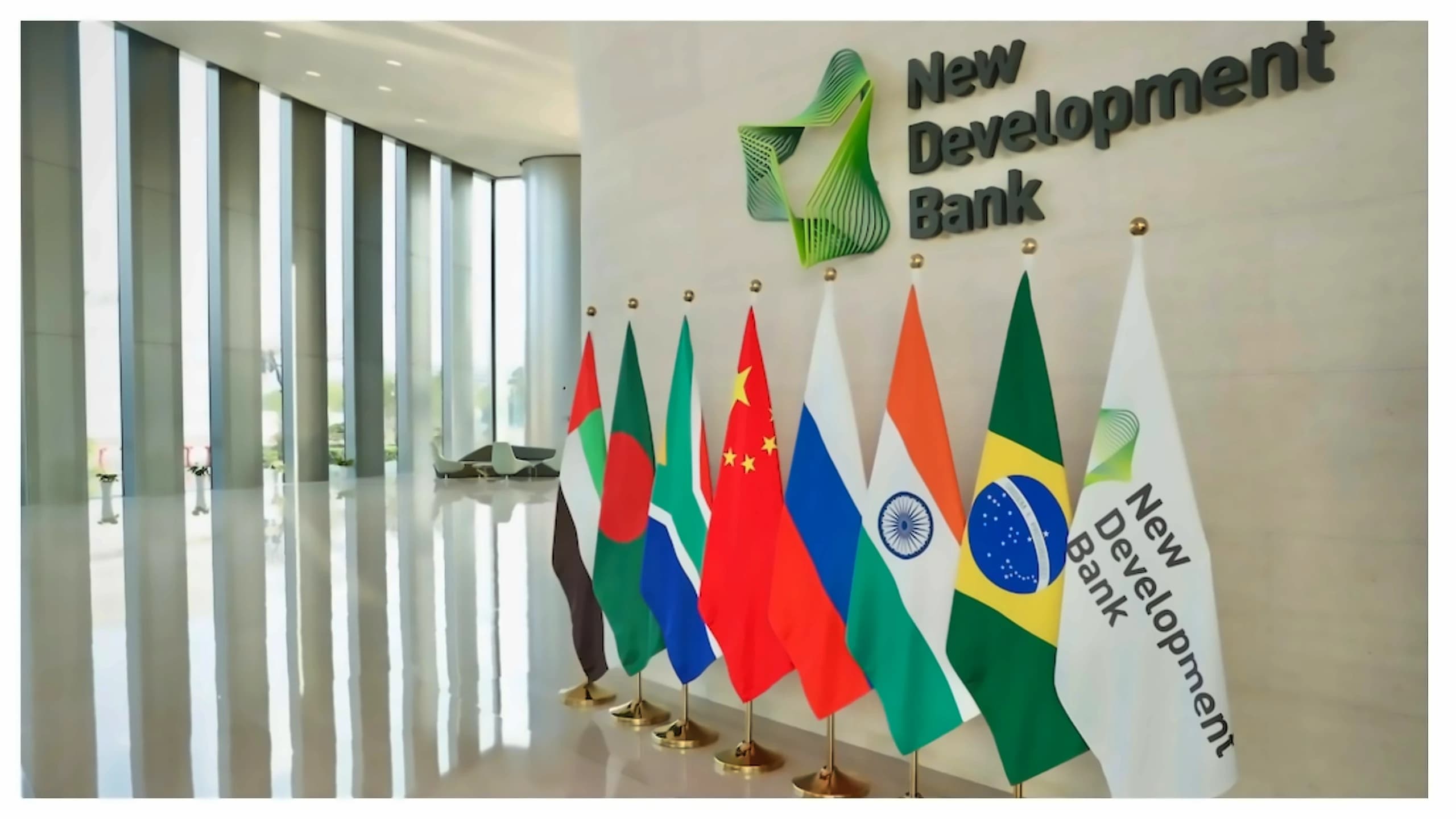
According to Business Standard, the NDB raises money through capital provided by its members and borrowing in domestic and international capital markets. The bank issues different types of bonds, including benchmark bonds, thematic bonds and bonds denominated in member countries' currencies. To promote local-currency financing, the NDB registers bond programmes with national regulators in member countries and issues local bonds to domestic institutional investors such as pension funds, insurance companies and commercial banks. The bank aims to increase local-currency financing to 30% of its overall lending portfolio, with neither the bank nor borrowers facing foreign exchange volatility or currency mismatch risks. As per Albanian Daily News, the more realistic objective is to foster trade and investment in national currencies and to gradually enhance interoperability between cross-border payment systems, with calls for more resilient supply chains alongside criticism of unilateral tariffs and sanctions. China and Russia have dramatically increased the share of their bilateral trade conducted in their national currencies to more than 90 percent, while BRICS countries are exploring closer links between their payment systems and greater financing in local currencies, with China's Cross-Border Interbank Payment System (CIPS) being one element of this emerging architecture.
As reported by Business Standard, the NDB has approved 141 projects with cumulative financing of about $44 billion as of June 30, with disbursements reaching $25 billion. The bank's portfolio spans roads and bridges, metro systems, water supply and sanitation, renewable energy, environmental protection, housing and digital infrastructure. In India specifically, the NDB has approved $9.5 billion for 32 initiatives covering clean energy, transport infrastructure, water and sanitation, and social development sectors since 2016. According to Albanian Daily News, the NDB data shows it has approved approximately $42.9 billion in financing for 139 projects, with the New Delhi Declaration calling on the bank to expand financing in local currencies and strengthen its role in sustainable infrastructure and long-term development. The objective is not to abolish the dollar overnight. It is to reduce the dependence of the Global South on a financial system dominated by the United States, with the process already visible through increased use of national currencies in bilateral trade and development of alternative payment mechanisms.
According to Business Standard, the NDB is moving into what it describes as its second golden decade, with local-currency financing expected to remain a major part of this expansion. In August 2026, the NDB announced it was advancing its first onshore Indian rupee-denominated 'Maharaja Bond', with support from the Indian government and the Reserve Bank of India (RBI). The proposed bond is intended to strengthen the bank's local-currency financing operations in India, supporting the grouping's focus on reducing dependence on US dollar financing. The declaration therefore called for reform of international financial institutions and greater representation of developing countries in their governance. It also opposed unilateral trade measures and sanctions and emphasized diplomacy and multilateralism as instruments for resolving international conflicts. The strength of BRICS therefore does not lie in the creation of a new bloc or in the immediate replacement of the dollar. Instead, the grouping is gradually assuming some of the role once played by the Non-Aligned Movement, with BRICS countries accounting for about 40.7% of global GDP versus 28.4% for the G7, and representing approximately 48.5% of the global population compared to less than 10% for the G7. The joint declaration expressed "deep concern" regarding the escalating conflict in the Middle East and involving Iran, calling for "maximum restraint" and emphasizing dialogue, consultation, and diplomacy.