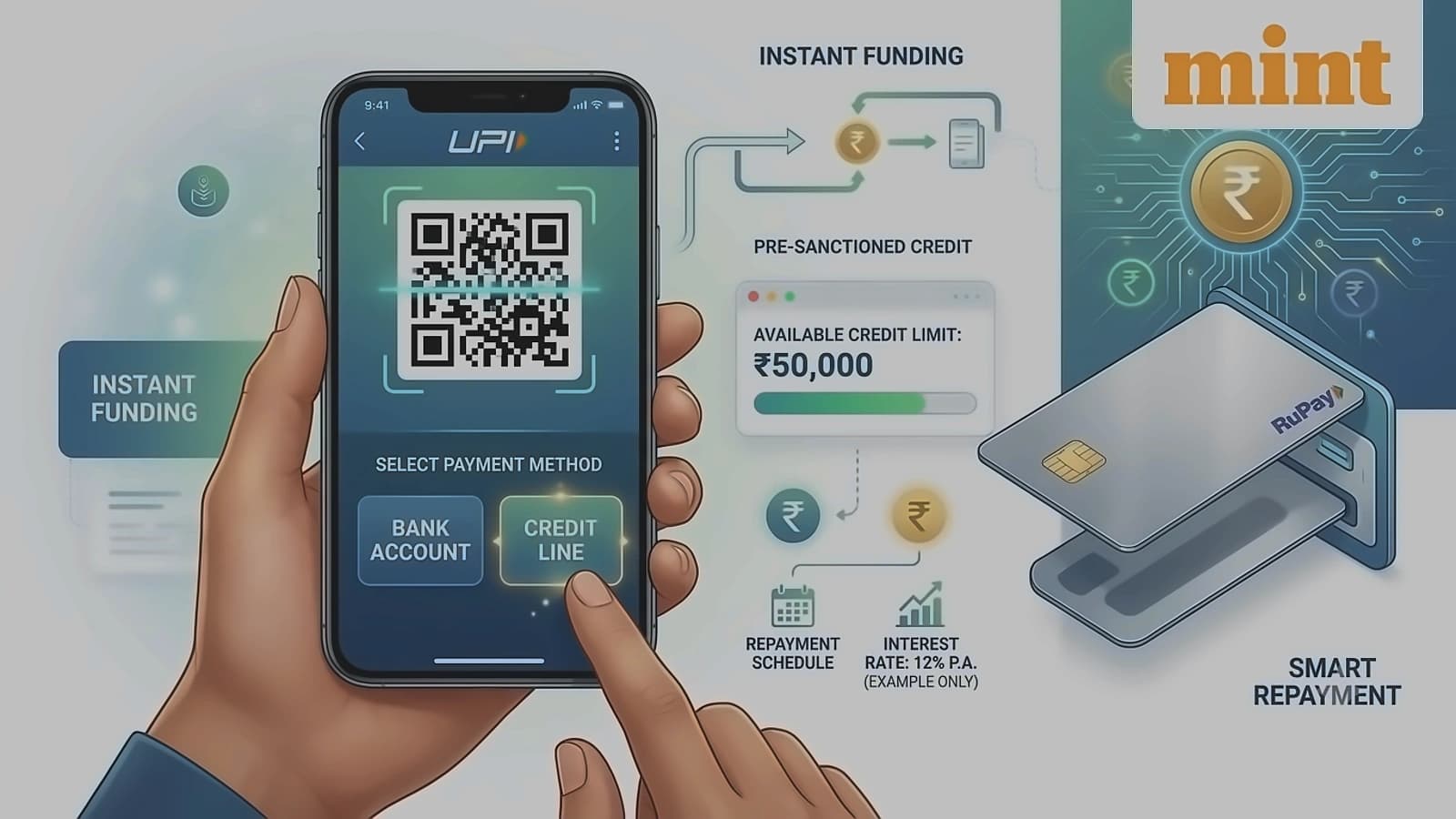
According to a white paper released by Suryoday Small Finance Bank, Credit Line on UPI (CLOU) is increasingly being adopted by prime borrowers rather than sub-prime customers as a last resort. The lender's data reveals that nearly 90 per cent of customers hold CIBIL scores above 725, indicating high creditworthiness among users. The average drawdown stands at around ₹7,000 against credit limits of up to ₹60,000, suggesting measured usage patterns among financially stable consumers. As per Baskar Babu Ramachandran, MD & CEO of Suryoday Small Finance Bank, the strong credit profiles, responsible borrowing behaviour and healthy utilization trends validate their belief that embedded credit can become a meaningful part of India's retail lending ecosystem. The trend reflects growing consumer preference for small-ticket, need-based credit embedded directly into daily payment habits, with the highest transaction volumes in groceries and supermarkets, followed by dining, fuel, telecom recharges, and pharmacies.
As reported by Business Standard, Suryoday SFB launched its Credit on UPI product in August 2025 in partnership with Paytm. The lender has pre-qualified nearly 11 lakh customers and sanctioned credit lines to 5.3 lakh customers. Total sanctioned limits stand at more than ₹362 crore, while utilized limits exceed ₹102 crore. Active utilizations have reached approximately 2.4 lakh, with the portfolio recording a Compounded Monthly Growth Rate (CMGR) of approximately 63% over the last five months. More than 97 per cent of these CLOU customers are new-to-bank (NTB), indicating significant market penetration and serving as a powerful customer acquisition engine. Approximately 50% of sanctioned accounts are actively utilized, a healthy activation rate for a product live for under eight months.
According to the white paper, rather than drawing down large lump sums, consumers are using the facility for 'sachet-sized' transactions. While roughly 50 per cent of the sanctioned accounts are active, overall utilisation against total sanctioned limits stands at about 28 per cent. Geographically, traction is highly concentrated in regions where digital payment habits and merchant UPI ecosystems are already deeply entrenched. North and West India lead adoption, with Jaipur emerging as the single-largest city contributor, accounting for nearly 14 per cent of the portfolio, followed by Delhi-NCR region contributing more than 20 per cent. In Western India, cities such as Mumbai, Ahmedabad, Surat, Pune, and Indore are showing meaningful momentum, while Bengaluru leads adoption in the South. The geographic spread reflects adoption concentrated in markets characterised by high UPI penetration, dense merchant ecosystems, and strong consumer familiarity with digital payments.
As reported by Business Standard, the data directly contradicts the assumption that embedded, app-based credit is primarily a tool for the credit-starved. The report states that creditworthy, financially active consumers are choosing CLOU because of its convenience, not its accessibility as a last resort. According to Baskar Babu Ramachandran, the bank sees significant opportunities to expand access to formal credit while maintaining prudent underwriting and portfolio quality. India's digital payments ecosystem presents a significant opportunity for embedded credit, with UPI processed over 24,162 crore transactions during FY26 and now accounts for nearly 63% of all retail digital payments by volume. In May 2026 alone, UPI recorded 23.2 billion transactions worth ₹29.9 lakh crore. Industry estimates believe CLOU could emerge as one of the largest embedded finance categories in the country, with Suryoday SFB's early traction, strong borrower quality and rapid portfolio growth positioning it favourably to participate in this structural transformation of India's retail lending landscape.