Punjab National Bank has maintained its one-year Marginal Cost of Funds Based Lending Rate (MCLR) at 8.80% starting September 1, 2026, as reported by multiple sources. The bank has also revised the three-month MCLR upward to 8.50% from the previous level of 8.45%, indicating an isolated adjustment in short-term funding costs. This decision preserves stable lending conditions for most retail loan portfolios while maintaining cost consistency for floating retail loans. The bank's overnight, one-month, six-month, and three-year MCLR rates remain unchanged at 8.00%, 8.25%, 8.65%, and 9.10% respectively, demonstrating a prudent approach to rate management amid current market conditions.
Punjab National Bank has announced a ₹3,400 crore technology and AI investment programme to strengthen its digital transformation strategy, as reported by multiple sources. The initiative focuses on improving cybersecurity, automation and operational capabilities while maintaining governance standards. This major investment comes alongside improved Q1 FY27 financial performance, with the bank reporting a standalone net profit of ₹5,253.29 crore, representing a 213.6% year-on-year increase. Asset quality also showed significant improvement during the quarter, with gross non-performing assets declining to 2.78% and net non-performing assets reducing to 0.26%. The bank's strong financial foundation provides the backdrop for continued investment in technology and operational improvements.
PNB has set an aggressive target of USD 2.5 billion in FCNR(B) deposits under RBI's special exemption window, with the bank mobilizing nearly USD 2.5 billion in FCNR(B) deposits by August 2026. This strategic approach allows the bank to raise foreign exchange liquidity without adding to domestic reserve strains, optimizing its funding portfolio amid challenging domestic deposit growth conditions. The bank is also actively discussing co-branded credit cards with Punjab & Sind Bank and has set a Q4FY27 or early FY28 IPO timeline for Haryana Gramin Bank. This dual-track approach manages balance sheet risk while capturing high-value foreign deposits to support overall resource profiles.
As reported by Informist Media, PNB MD and CEO Ashok Chandra announced that the bank will position itself as a leader in artificial intelligence adoption in India's financial sector. The public-sector lender has trained all its officers in the emerging technology and plans to systematically provide all employees with a basic understanding of AI. Chandra emphasized the need to use AI responsibly due to the unintended consequences its use can have, considering it the bank's responsibility to build awareness in the sector. The bank has integrated advanced Indian-language AI features via Digital India BHASHINI and expanded its digital gold loan processing by utilizing RBI's Unified Lending Interface (ULI) for 90% of its transactions. The bank is also exploring multilingual AI capabilities to support broader financial inclusion, with collaboration through Digital India's BHASHINI initiative to improve accessibility across different languages.
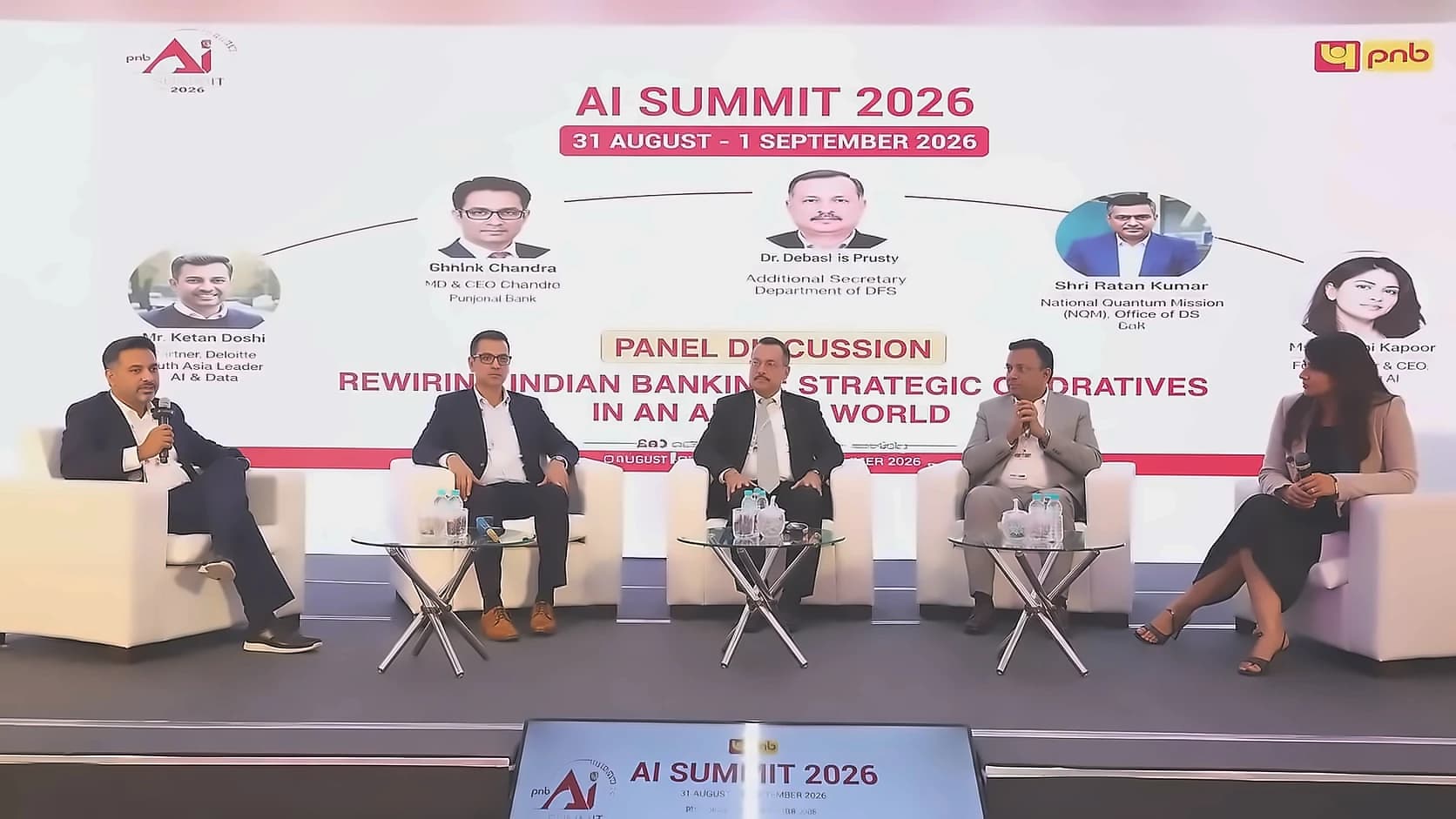
The summit successfully established PNB's vision in driving AI-led transformation in the Indian banking sector, with the overarching message that AI, GenAI, and Agentic AI will fundamentally reshape banking. Chief Guest Debasish Prushty, Additional Secretary, DFS, emphasised the alignment of AI adoption in banking with the national India AI Mission. Addressing the summit, he highlighted the importance of strong governance, workforce transformation, cybersecurity, and operational resilience in realising the full value of AI. The bank's board-approved ₹3,400 crore IT and AI roadmap underscores a long-term shift towards technology-enabled operational efficiency, with the continuous roll-out of digital lending tools and AI systems representing a long-term lever to gradually depress cost-to-income metrics. The progress of PNB's AI implementation will depend on execution across its operations and the ability to integrate new systems effectively, with market participants monitoring how technology investments influence operational efficiency, cybersecurity capabilities and customer experience.