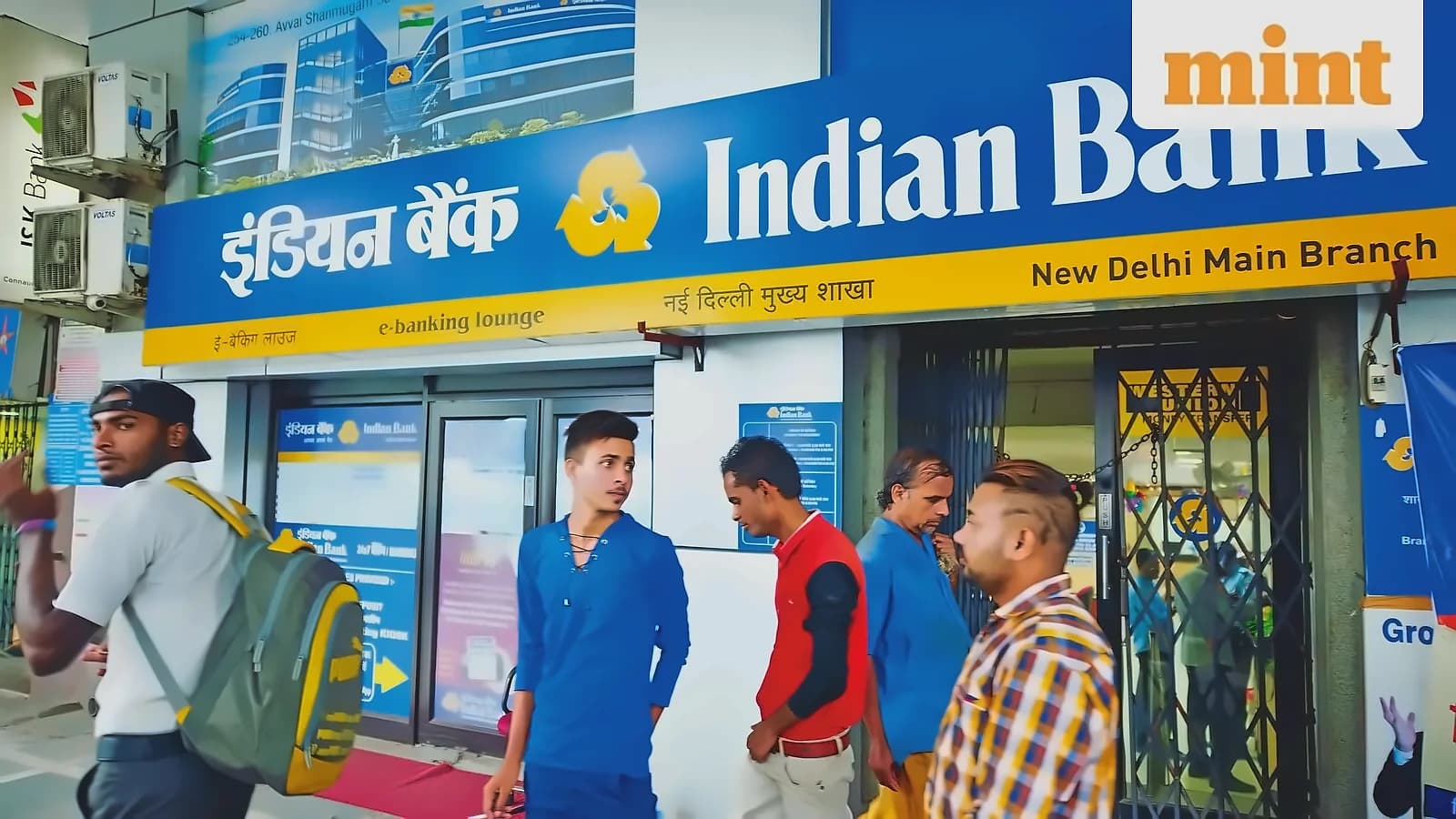
Indian Bank delivered robust Q4 FY26 results with profit after tax of ₹3,100 crore, though this was partially impacted by a ₹310 crore provision for the West Asia crisis. The bank's net interest income increased 11% and advances grew 14.7%, demonstrating strong operational performance. The state-owned lender maintains a robust 92.7% provision coverage ratio and declining GNPA ratio, with the bank's market capitalisation standing at over ₹1.17 lakh crore and trading at a P/E ratio of about 10.65. Motilal Oswal has set an ambitious price target of ₹1,025 for Indian Bank, representing 17% upside potential.
Indian Bank reported advances growth of 13.43% in FY26 to ₹6.7 trillion and deposits growth of 12.29% to ₹8.3 trillion as of March 31, 2026, according to latest reports. The state-owned lender's actual performance significantly exceeded its guidance of 10-12% for advances and 9-10% for deposits. Managing Director and CEO Binod Kumar explained that the bank sold ₹23,000 crore worth of IBPC (Interbank Participation Certificates) to improve profitability, which reduced reported loan growth but actually boosted the underlying credit expansion to approximately 17%. The bank's market capitalisation stands at ₹1,13,858.87 crore, with the stock rising over 49% in the past year.
The Reserve Bank of India has relaxed capital computation norms for banks, removing a key NPA-linked condition for including quarterly profits in capital adequacy calculations. Under existing rules, banks could include quarterly profits in their capital to risk weighted assets ratio (CRAR) only if incremental provisioning for non-performing assets (NPAs) did not deviate more than 25% from the four quarter average. The RBI has now proposed to dispense with this requirement, easing constraints on capital recognition. Separately, the central bank will remove the requirement for banks to maintain an Investment Fluctuation Reserve (IFR), which is an additional buffer against mark-to-market losses on investments, given the evolution of prudential norms.
Indian Bank expects net interest margin (NIM) to compress to 3.15-3.25% in FY27 from 3.24% in FY26, as reported by Mint. Kumar attributed this outlook to elevated deposit costs and funding growth lagging credit demand. The bank's ability to cut deposit rates is constrained by the need to maintain deposit mobilization aligned with credit growth. Kumar explained that if credit growth remains strong, the bank receives bulk deposits at higher rates, making retail term deposit rate cuts unnecessary. The bank's March quarter NIM stood at 3.23%, down from 3.28% in the preceding quarter and 3.37% a year earlier.
Despite higher credit costs during the quarter, Kumar reported no visible stress in asset quality, with slippages largely attributed to audit-related adjustments. The bank's SMA (Special Mention Account) book improved drastically from 8.06% last year to 4.73% this year, with only ₹922 crore in SMA-2 above ₹5 crore. Kumar explained that around ₹400 crore was classified as NPAs through MOC (Memorandum of Changes) during the quarter, which is typical for March when branches undergo audit. The bank's strategy of selling IBPC at attractive rates has improved bottom-line performance while maintaining asset quality standards.