India has achieved near-universal banking coverage with 99.92% of inhabited villages now served by banking outlets within a 5-kilometer radius, according to data uploaded by banks on the Jan Dhan Darshak (JDD) App. As reported by The Indian EYE, this milestone covers 6,00,868 out of 6,01,328 villages, representing a significant expansion in financial inclusion across the country. The achievement was confirmed by Minister of State for Finance Pankaj Chaudhary in the Lok Sabha on Monday, highlighting the government's commitment to financial inclusion. The data is based on information uploaded by banks on the Jan Dhan Darshak (JDD) App, with banking outlets including bank branches, Business Correspondents (BCs) and India Post Payments Bank (IPPB) branches.
The banking expansion is supported by a robust infrastructure comprising over 1.81 lakh bank branches, 17.36 lakh Business Correspondents (BCs), and 1.65 lakh India Post Payments Bank (IPPB) centers as of July 17, 2026, according to the Ministry of Finance data. This comprehensive network ensures that banking services are accessible to remote and rural areas through multiple channels including traditional bank branches, business correspondents, and IPPB centers. The government has established a policy to provide banking outlets within 5 kilometers radius of all inhabited villages to improve accessibility of financial services in rural and remote areas. The expansion of banking services is monitored through State Level Bankers' Committees (SLBCs) and Union Territory Bankers' Committees (UTLBCs), which coordinate with state governments, banks and other stakeholders to identify uncovered areas and facilitate the opening of new banking outlets based on business viability and local requirements.
To enhance accessibility in rural and remote areas, the Government has established a policy to provide banking outlets within 5 kilometers radius of all inhabited villages. As reported by The Indian EYE, the Reserve Bank of India (RBI) has permitted Commercial Banks, Small Finance Banks, Payments Banks, Local Area Banks and Regional Rural Banks to open bank branches anywhere in India without prior approval, provided 25% are in unbanked rural areas. This regulatory framework ensures that banking services reach previously underserved rural populations effectively, with the government's objective to provide a banking outlet — either a bank branch, Business Correspondent or India Post Payments Bank outlet — within a 5 km radius of every inhabited village. In pursuance of extant RBI guidelines, rolling out of banking outlets in uncovered areas is a continuous process looked after by the State Level Bankers' Committee (SLBC) / Union Territory Level Bankers Committee (UTLBC), in consultation with the concerned State/UT Government, member Banks and other stakeholders.
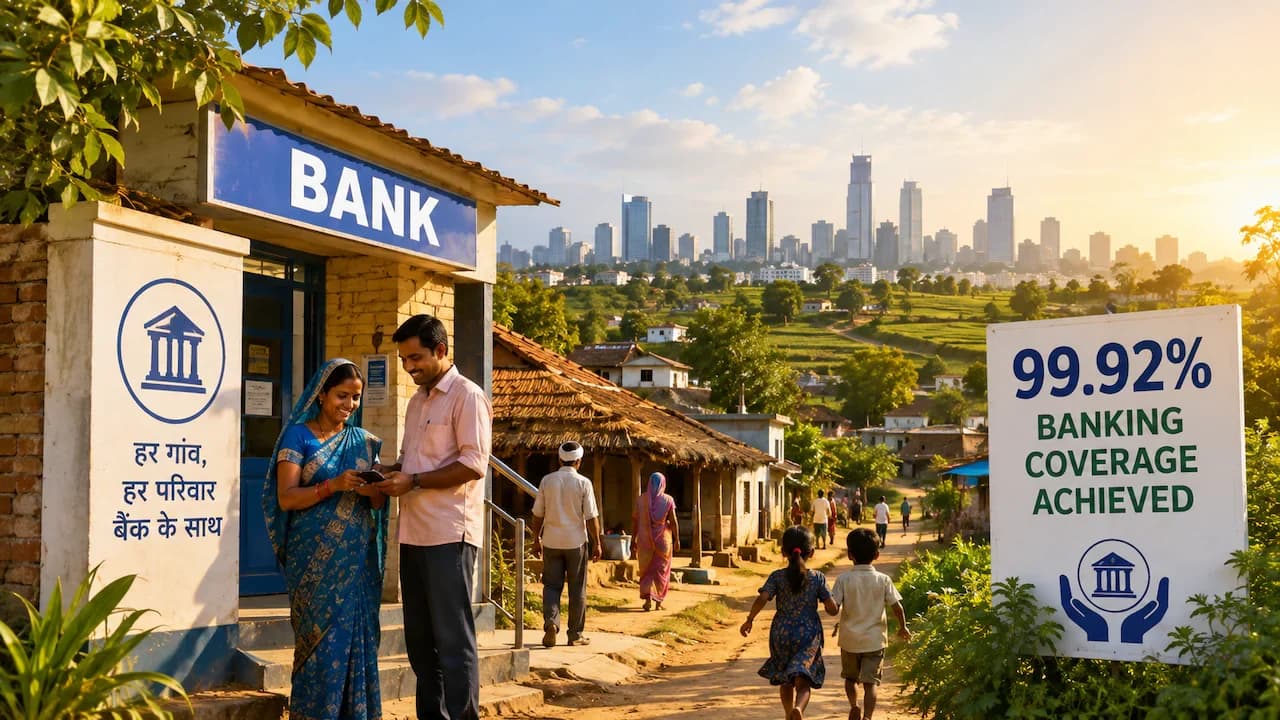
As of July 17, 2026, there are 58.77 crore PMJDY accounts in the country with a combined balance of ₹3,12,414 crore, according to the Ministry of Finance data. This substantial account base demonstrates the effectiveness of the banking expansion initiative in reaching previously underserved populations and improving financial inclusion across India. The government has also introduced digital initiatives to improve agricultural credit delivery and ensure transparency in loan disbursement through platforms like the Jan Samarth Portal and Kisan Rin Portal. The Jan Samarth Portal serves as a unified platform for government-sponsored loan and subsidy schemes, enabling digital loan applications and quicker approvals, while other technology-driven initiatives include NABARD's e-KYC application and the Department of Agriculture and Farmers Welfare's KRISHIKA platform. The Kisan Rin Portal, launched in September 2023, supports Aadhaar-based verification and faster digital claim settlements for eligible Kisan Credit Card loans.
The government and RBI are strengthening safeguards against cyber financial fraud through innovative digital solutions. The India Digital Payment Intelligence Corporation (IDPIC) has been established to share real-time fraud intelligence and alerts using technologies including artificial intelligence, machine learning and big data analytics. Additionally, RBI has introduced digital payment security controls and launched the AI-based 'MuleHunter' tool to identify money mule accounts. The RBI has also issued comprehensive Master Directions on Digital Payment Security Controls, requiring banks to implement minimum security standards across internet banking, mobile banking and card payment channels. Citizens can now report cybercrime through the National Cybercrime Reporting Portal and helpline 1930, ensuring comprehensive protection against digital financial fraud. The Ministry of Home Affairs' Indian Cyber Crime Coordination Centre (I4C) continues to monitor digital lending applications, while the RBI and banks regularly conduct public awareness campaigns through SMS alerts, radio broadcasts and the Electronic Banking Awareness and Training (e-BAAT) programme to educate customers about safe digital banking practices.