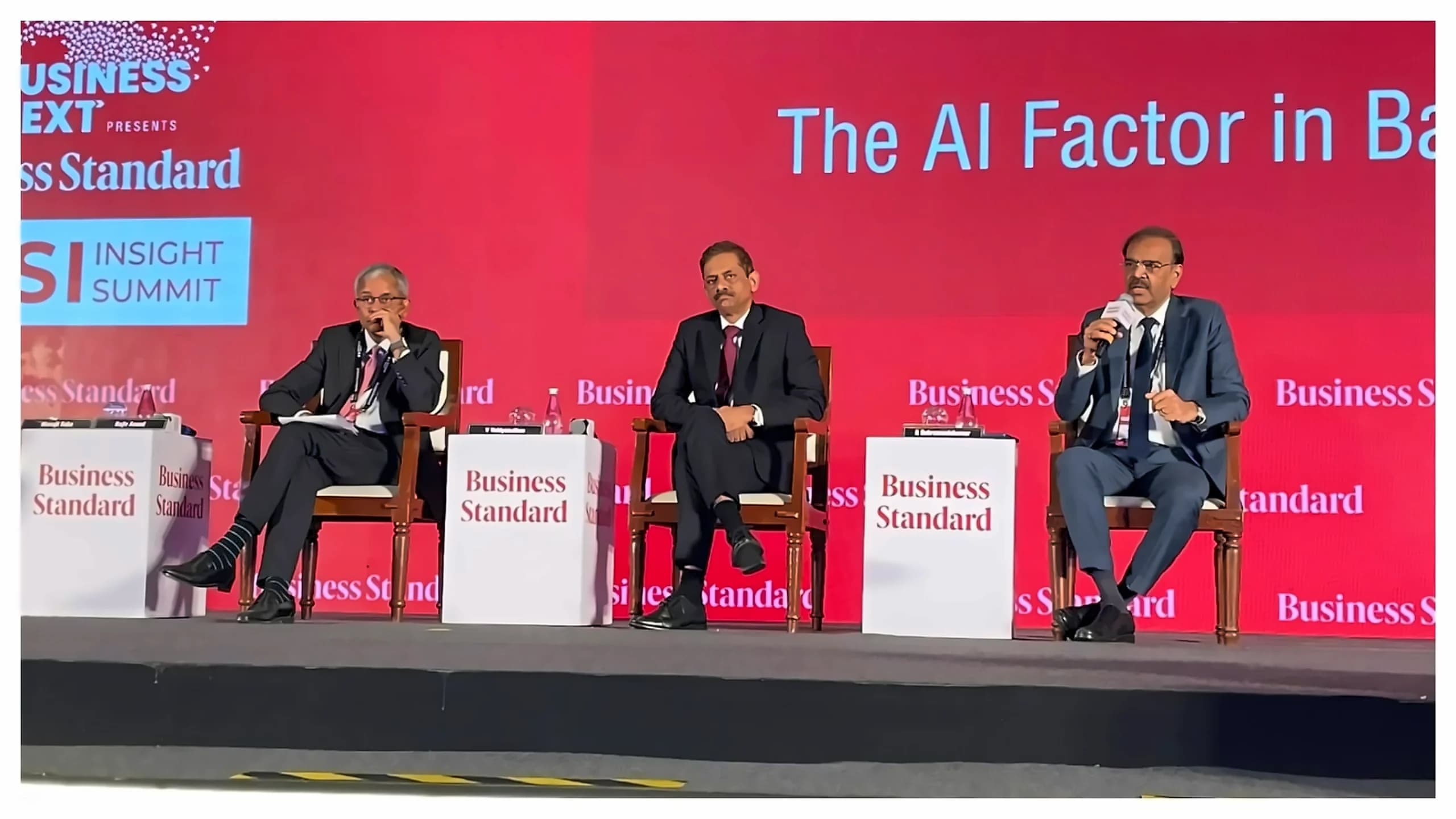
Indian banks need to move beyond experimenting with artificial intelligence (AI) and focus on implementing solutions that deliver measurable outcomes, while ensuring accountability, data security and effective governance, according to top bank chiefs at the Business Standard BFSI Insight Summit 2026. Speaking at a panel discussion titled 'The AI Factor in Banking', moderated by Business Standard's Manojit Saha, Rajiv Anand, MD & CEO of IndusInd Bank; R Subramaniakumar, MD & CEO of RBL Bank; and V Vaidyanathan, MD & CEO of IDFC First Bank discussed how AI is reshaping banking operations, lending decisions and customer experience. As reported by Business Standard, Subramaniakumar emphasized that the RBI is very clear: you have to move from experimentation to implementation, highlighting that banks needed to assess whether AI applications were ready for direct customer use or should first be deployed to support employees. He also noted that Indian banks were ahead in identifying AI use cases but adoption remained at an early stage, with the focus now shifting from experimentation to practical deployment.
As AI agents begin to search, shop, and make payments on behalf of consumers, industry experts at the BFSI Summit 2026 emphasized the critical need for secure authentication, consumer consent, and clear liability rules. During a panel discussion titled 'Machines with Mandates: Building India's Trust Layer for Agentic Payments' with Business Standard's Ajinkya Kawale, Visa India Country Manager Rishi Chhabra, Juspay Vice-President of Global Strategy Pramod Mulani, and Amazon Pay Chief Technology Officer Nirav Kamdar discussed the challenges of enabling AI agents to transact independently while keeping consumers and merchants protected. According to Mulani, travel bookings could be among the earliest use cases for agentic commerce because they involve multiple decisions, including comparing fares, selecting dates, and choosing airlines. Kamdar expects utility payments and subscription renewals to be among the earliest use cases to gain traction, citing the low risk and high friction associated with such transactions. Building trust will require several safeguards, including agent authentication, identity verification, fraud detection, explicit consent, and auditability, with consumers needing to trust agents to act on their behalf while merchants must verify agent authorization. McKinsey estimates that AI agents could put $75 billion in global payments revenue at risk by 2030, with a more aggressive adoption scenario potentially reaching $160 billion.
As banks explore more use of artificial intelligence (AI) to automate decisions and simplify customer journeys, industry leaders stress the need for stronger security controls, accountability and human oversight to protect customers from potential risks. Speaking at the 'Autonomous Banking & Security' session moderated by Business Standard's Shivani Shinde, HDFC Bank's Group Head of Information Technology and Chief Information Officer Ramesh Lakshminarayanan said agentic banking was here to stay and banks needed to prepare for the shift rather than resist it. He emphasized that "An AI bank is going to come, whether we like it or not. It is not going to be 200,000 employees; it will probably have 200 employees. We have to get ready for this. Whether this happens in two years or five years, we do not know, but banks have to be prepared for it." He added that "Agents will have to be authenticated just like a human. They have to be treated like humans," adding that banks would need to develop their own approaches until a clear regulatory framework for such systems emerges. Lakshminarayanan said banks would have to balance the risks associated with autonomous agents against the convenience they could offer customers and strengthen transaction monitoring, including checks that can identify suspicious activity in near real time. Punjab National Bank Director Rajesh Prasad said banks had a responsibility to put safeguards in place because managing risk was central to their business, drawing a parallel with lending where banks remain responsible even when precautions are taken.
AI could change the economics of lending by enabling banks to process larger volumes of data, assess borrowers more efficiently and make credit decisions faster, according to the panel discussion. Vaidyanathan explained that AI is changing how banks assess customers by allowing them to analyse unstructured data alongside conventional information, such as photographs of shops and recordings of customer calls. This capability could help lenders assess borrowers more accurately, speed up decisions and potentially expand the pool of customers they can serve. As reported by Business Standard, Subramaniakumar stressed that AI could help banks scale credit delivery, but emphasized that faster decisions must be accompanied by traceability and robust audit trails, with banks needing to establish what informed an AI-supported decision and be able to explain and audit the outcome. Anand noted that AI could help banks gain deeper insights into customers and assess creditworthiness, while enabling them to redesign customer journeys rather than merely automate existing processes. For instance, customers could upload documents through WhatsApp for housing or auto loans, enabling the system to read information and potentially pre-approve applications, changing the existing process where customers submit physical documents at branches.
Banks are approaching AI adoption with two broad objectives: improving customer experience and increasing productivity, according to Anand's comments at the summit. While many current applications focus on efficiency gains, he said the technology also offered an opportunity to rethink how banking services are delivered. Anand cautioned against viewing AI adoption as a race, describing it as an ongoing process in which banks would progress at different speeds, emphasizing that Indian banks have demonstrated flexibility to adopt new technologies over the years. Vaidyanathan said AI is dramatically changing the way employees are working and how customers are going to experience banking, with banks using AI agents and voice-based applications to automate routine work and improve productivity. Anand emphasized that AI should not be viewed as technology that can simply be added to existing processes, stating that the technology gives us the ability to completely reimagine customer journeys. Axis Bank's Group Head of Digital Business Sameer Shetty said AI represents a more fundamental shift than the move from traditional to digital banking because it could take decisions and carry out operations rather than simply make existing workflows easier to navigate. This could allow banks to automate more internal processes, while making banking simpler for customers by handling more complexity and eliminating rigid, form-based processes.
As banks deploy AI more widely, accountability for decisions made with the technology remains a central concern, with bank chiefs emphasizing the need for clear governance frameworks. Anand said banks could not transfer responsibility to machines and needed to understand how their AI systems and agents operated, stating that regardless of the operating model adopted, accountability for the outcome would remain with the bank. He also stressed the importance of transparency, saying banks needed to understand what an AI agent was doing rather than relying solely on the broader technology platform. Lakshminarayanan highlighted the question of accountability becomes particularly important when a customer authorises an AI agent to make a payment or carry out another banking activity, but the agent subsequently does something unexpected. Managing Director of Technology Services for India Business at Accenture Paritosh Wechalekar said banks need to distinguish between tasks that AI agents could perform within clearly defined limits and decisions that required greater oversight. For instance, an agent collecting documents, reviewing them, and verifying information would operate within controlled boundaries, while an agent independently approving a loan would involve a different level of risk. Business Next Founder and CEO Nishant Singh said banks needed to look beyond individual AI use cases and consider how they would build towards more autonomous operations, arguing that "The future of banking is zero touch" and calling for effective mechanisms to stop AI agents when something goes wrong. Singh also said while AI will not change the risk boundaries set by banks, the decision on whether to continue applying manual rules within those boundaries or follow the learning and outcomes suggested by agentic AI will rest with the banks, with this being a crucial step towards becoming truly autonomous banks.
The push for AI implementation comes as U.S. bank regulators are asking whether banks can audit and control AI agents, with the Federal Reserve, Office of the Comptroller of the Currency and Federal Deposit Insurance Corporation seeking answers on how lenders would track and shut down autonomous AI systems. According to Reuters, the agencies are gathering information rather than prescribing practices, following their April 17 revised model risk management guidance that excludes generative and agentic AI from its scope. In a Wolters Kluwer survey of 230 U.S. banking professionals, about one in three named kill-switch protocols as the AI incident response area where their institution is least prepared, highlighting the global challenge of AI governance across banking sectors. Singh also called for banks to develop effective mechanisms to stop AI agents when something goes wrong, noting that a kill switch should be treated as part of a broader security architecture rather than a single function. Vaidyanathan emphasized that every bank has to have a policy on AI because it is a fast-moving technology that requires strict security protocols and guardrails, with banks needing to assess business vulnerabilities, establish traceability, and ensure AI-supported decisions could be audited. Kamdar said the industry should not assume that a single protocol would dominate, suggesting financial institutions and fintech companies could build common capabilities for discovering, identifying, and authenticating agents while adapting to different protocols. To make the most of AI and autonomous agents, banks will need to establish appropriate guardrails and set clear boundaries for their agents, said Paritosh Wechalekar, with the regulator always emphasizing risk tiering when identifying use cases and working towards those boundaries.
The Data Security Council of India (DSCI) has released an India-focused AI liability industry guide for agentic AI, providing crucial guidance on responsibility allocation across the AI value chain. As reported by Business Standard, the DSCI guide outlines how liability should be allocated across enterprises, AI developers and service providers, highlighting governance risks in autonomous AI systems. Rather than proposing new standards, the guidance explains how established binding doctrines apply to autonomous, multi-vendor AI systems and maps where responsibility sits across the value chain. The responsibility essentially lies with five groups that bring AI into use: user organisations, service providers and integrators, product companies and startups, tool and framework providers, cloud and infrastructure providers, besides the model providers. The report cautioned against framing liability as a binary choice between end-user organisations and upstream players, stating that "Liability as a binary choice between the end-user organisation and players in the value chain would be legally flawed, technically inaccurate, commercially paralysing, and erode the level playing field." Vinayak Godse, CEO of DSCI, said "Organisations need clear decision spaces and instruments they can actually implement. Unless these are factored in across the value chain, conversations on liability will not turn into practical, sector-specific action." The framework addresses that AI enters enterprises through various routes, such as browsers, co-pilots, GenAI in enterprise software, and AI models and tools, with each route carrying its own liability questions that require careful examination.