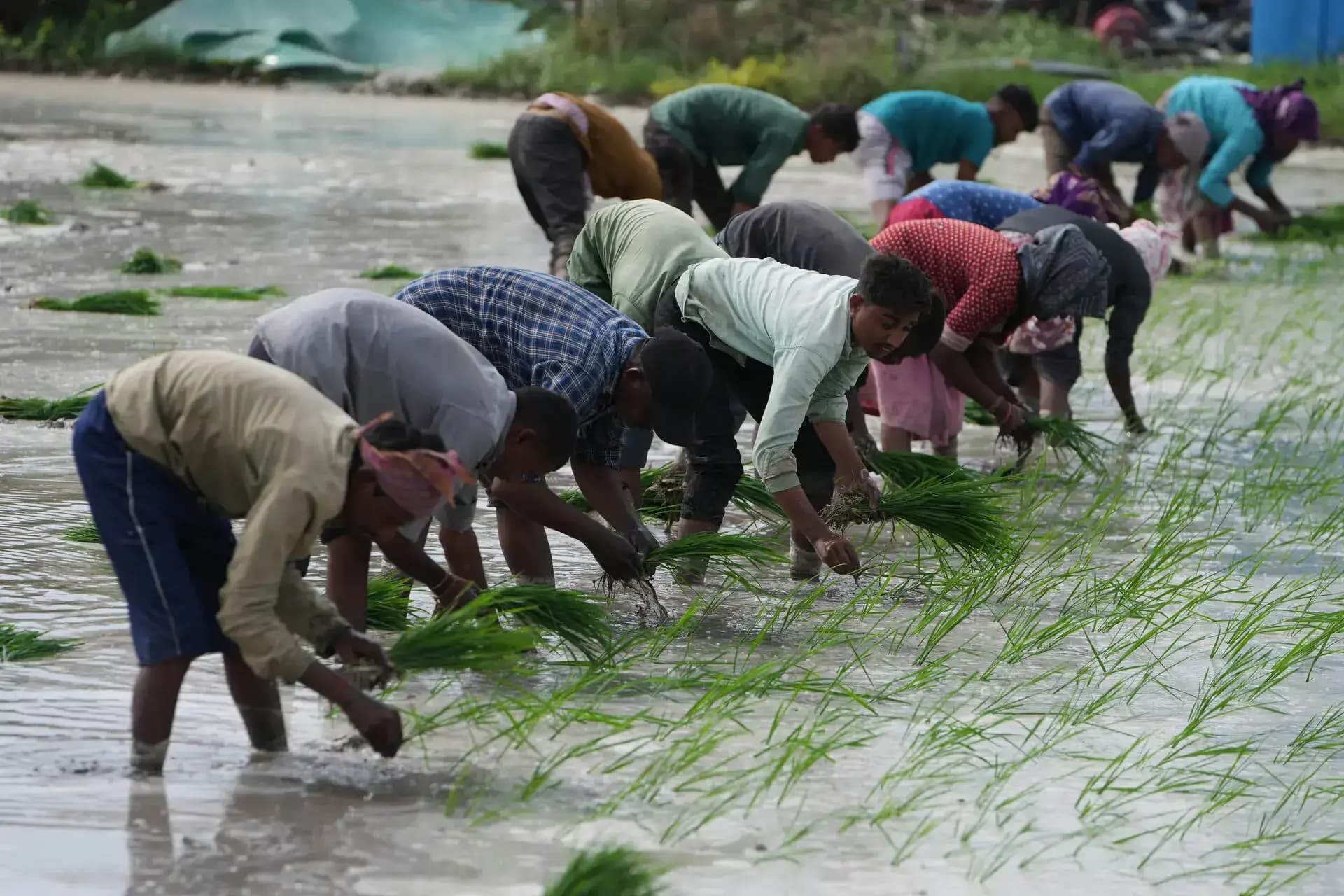
The El Nino weather phenomenon threatens agricultural production losses of approximately 3.86 crore tonnes, with Kharif losses estimated at 0.89 crore tonnes and Rabi losses at 2.97 crore tonnes. According to SBI's latest Economic Research Department report, the impact is concentrated across Madhya Pradesh, Maharashtra, West Bengal, Telangana and Andhra Pradesh, with ₹43,548 crore of agricultural credit in Tamil Nadu, ₹20,256 crore in Andhra Pradesh and ₹12,115 crore in Maharashtra located in districts classified as highly exposed to El Nino. The report estimates that valued using indicative market-arrival-weighted commodity prices, the estimated gross value of production at risk is around ₹1 lakh crore. The impact has been postponed from the initially expected Kharif season to the Rabi season, with approximately 13.5 million hectares, or 1.35 crore hectares, of seasonal cropped area facing production-equivalent impact across both seasons.
During the Kharif season, the highest production losses are concentrated in districts across Rajasthan, Punjab, Uttar Pradesh and Maharashtra, particularly Barmer, Jalore, Bathinda, Muktsar, Ferozepur and Ludhiana. The Rabi season assessment points to substantial exposure in Madhya Pradesh, Uttar Pradesh and West Bengal, with Madhya Pradesh accounting for nine of the 20 districts identified under SBI Research's Rabi Climate-Credit-Production Exposure Index. These districts combine a substantial share of national Rabi production with severe rainfall deviations, making them important areas for monitoring potential production disruptions. The district-level assessment reveals that the potential agricultural production losses are geographically dispersed across both Kharif and Rabi seasons, with the impact being postponed from the initially expected Kharif season to the Rabi season.
Agricultural loans have emerged as the biggest asset-quality risk for Indian banks, with the segment's bad-loan ratio far exceeding those of industry, services and retail despite a broader improvement in loan books. According to BMI Research, an arm of Fitch Group, the gross non-performing asset ratio for agricultural loans stood at 5.1% in the second quarter of 2026, compared with 1.5% each for industry and services and 1% for retail loans. The system-wide gross NPA ratio declined to 1.8%, making farm credit the clearest stress point in an otherwise healthier banking system. The impact of two back-to-back dry years (2014 and 2015), along with El Niño in 2018, resulted in Agriculture NPA rising to 10.1 per cent in FY20 from 5.4 per cent in FY17.
SBI Research estimates that El Nino could affect agricultural credit, though the exposure was estimated at only 2.8%. The report notes that the impact of El Nino though larger than FY16 would still be contained but will be visible in select pockets. At Bank of Baroda, agricultural NPAs rose 11.6% year on year to ₹9,128 crore and accounted for 34% of total slippages during the quarter. However, MD and CEO Debadatta Chand told analysts that the bank had not seen any signs of stress so far. The experience of Maharashtra, Karnataka, Rajasthan, Andhra Pradesh and Tamil Nadu illustrates that states tend towards farm loan waiver in such circumstances, with farm-loan waiver schemes amounting to approximately ₹1.26 lakh crore during 2014–18. SBI Research strongly advises that states must desist from loan waivers and suggests that banks should be approached for restructuring of loans, with governments sharing part of the cost.
Lower farm incomes could weaken borrowers' repayment capacity and add to agricultural loan arrears, particularly as the segment already carries relatively high credit risk. However, BMI does not expect the weak monsoon to cause a material deterioration in system-wide asset quality. The principal kharif crop has already been harvested, while the rabi crop is less dependent on southwest monsoon rainfall. SBI's ERD suggests that instead of resorting to loan waivers, state governments should approach banks for restructuring of loans, with governments sharing part of the cost. Greater irrigation coverage, government food buffers and more diversified rural incomes should also limit the transmission of deficient rainfall into borrower stress. The principal kharif crop has already been harvested, while the rabi crop is less dependent on southwest monsoon rainfall.