Sign in to fuzzto save your conversations, follow your research and come back anytime.

Vardhman Textiles Limited is a leading Indian textile manufacturer incorporated in 1973. The company produces cotton yarn, synthetic yarn, and woven fabric, with yarn being its largest business. It has a spinning capacity of over 100,000 spindles and can manufacture more than 670 MT of yarn daily. Vardhman Textiles operates 15 manufacturing units and exports to over 57 countries. The company's fabric division has a weaving capacity of over 193.4 million meters per annum and a processing capacity of over 151.7 million meters per annum. In 2019, Vardhman Textiles acquired full ownership of Vardhman Nisshinbo Garments Company Limited. As of 2022, the company merged its wholly-owned subsidiaries VMT Spinning Company Limited and Vardhman Nisshinbo Garments Company Limited.
In the news
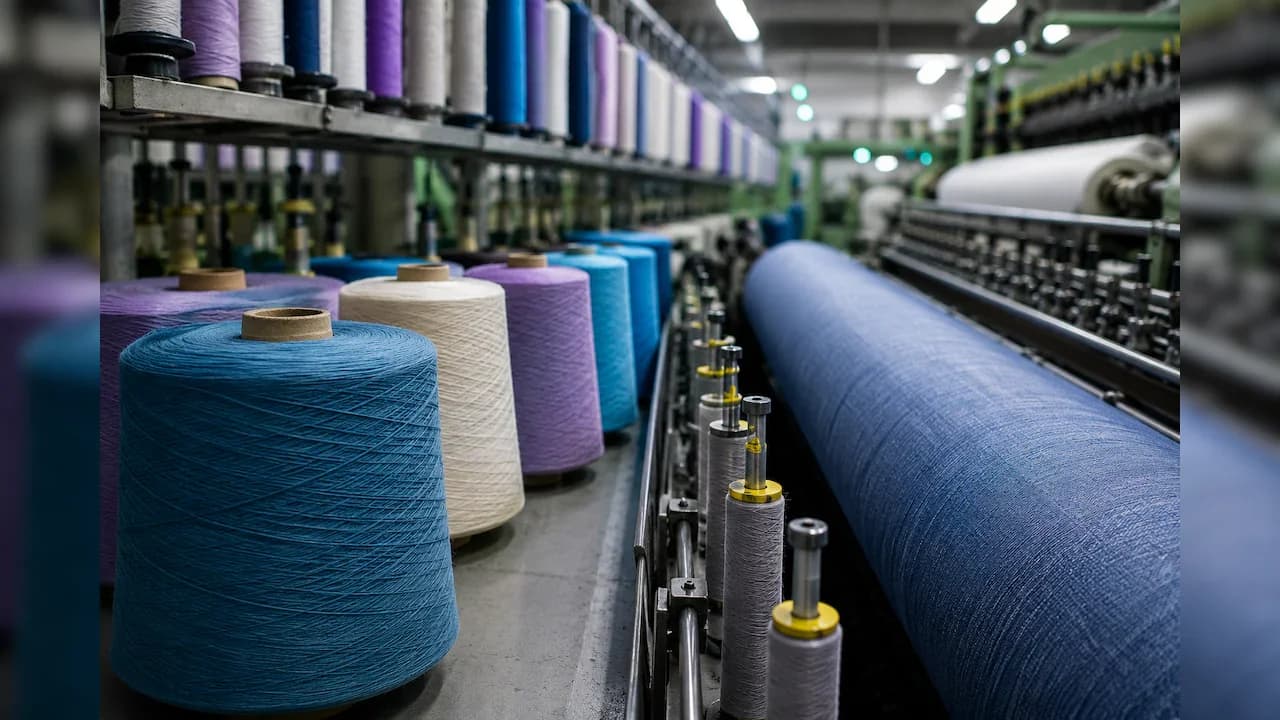
Vardhman Textiles Q1 profit surges 50% to ₹309.83 crore

5 Textile Stocks Expanding for India's ₹33T Market Growth

Textile stocks surge 6% on cotton duty exemption; market mixed
MarketSmith India Recommends Vardhman Textiles, RBL Bank
The Quarter story
The two most recent quarterly results, compared side-by-side.
Vardhman Textiles rebounds with EBITDA surging to ₹528 Cr and margins expanding to 19%, driven by yarn strength and export recovery.
EBITDA surged from ₹360 Cr in Q3 FY26 to ₹528 Cr in Q1 FY27, signaling a strong operational recovery.
Institutional holding declined from 22.61% in Q1 FY26 to 20.76% in Q1 FY27, suggesting reduced institutional interest.
PAT jumped from ₹170 Cr in Q3 FY26 to ₹285 Cr in Q1 FY27, confirming robust bottom-line growth.
Fabric revenue share fell from 36.3% in Q1 FY26 to 31.0% in Q1 FY27, showing a shrinking contribution to total revenue.
Yarn revenue share expanded from 62.2% in Q1 FY26 to 69.0% in Q1 FY27, highlighting the segment's growing dominance.
Grey fabric sales slipped from 497 Mtrs in Q1 FY26 to 463 Mtrs in Q1 FY27, pointing to weaker demand in this sub-segment.
Export revenue split rebounded from 44% in Q3 FY26 to 47% in Q1 FY27, indicating renewed overseas demand.
Promoter holding increased from 64.21% in Q1 FY26 to 65.08% in Q1 FY27, reflecting sustained insider confidence.
Company insights, generated from the most recent coverage.
Volume spiked 636% above average on a 2% up-move — informed/bulk buying, not retail noise, is driving this leg.
AGM on Sep 17 adopting FY26 audited standalone accounts removed the last governance overhang — post-AGM clarity is acting as the near-term trigger.
₹24.46 Cr for a 19 MW wind-solar hybrid plant in Madhya Pradesh is small in size but adds captive power — incremental opex saving, not a game-changer.