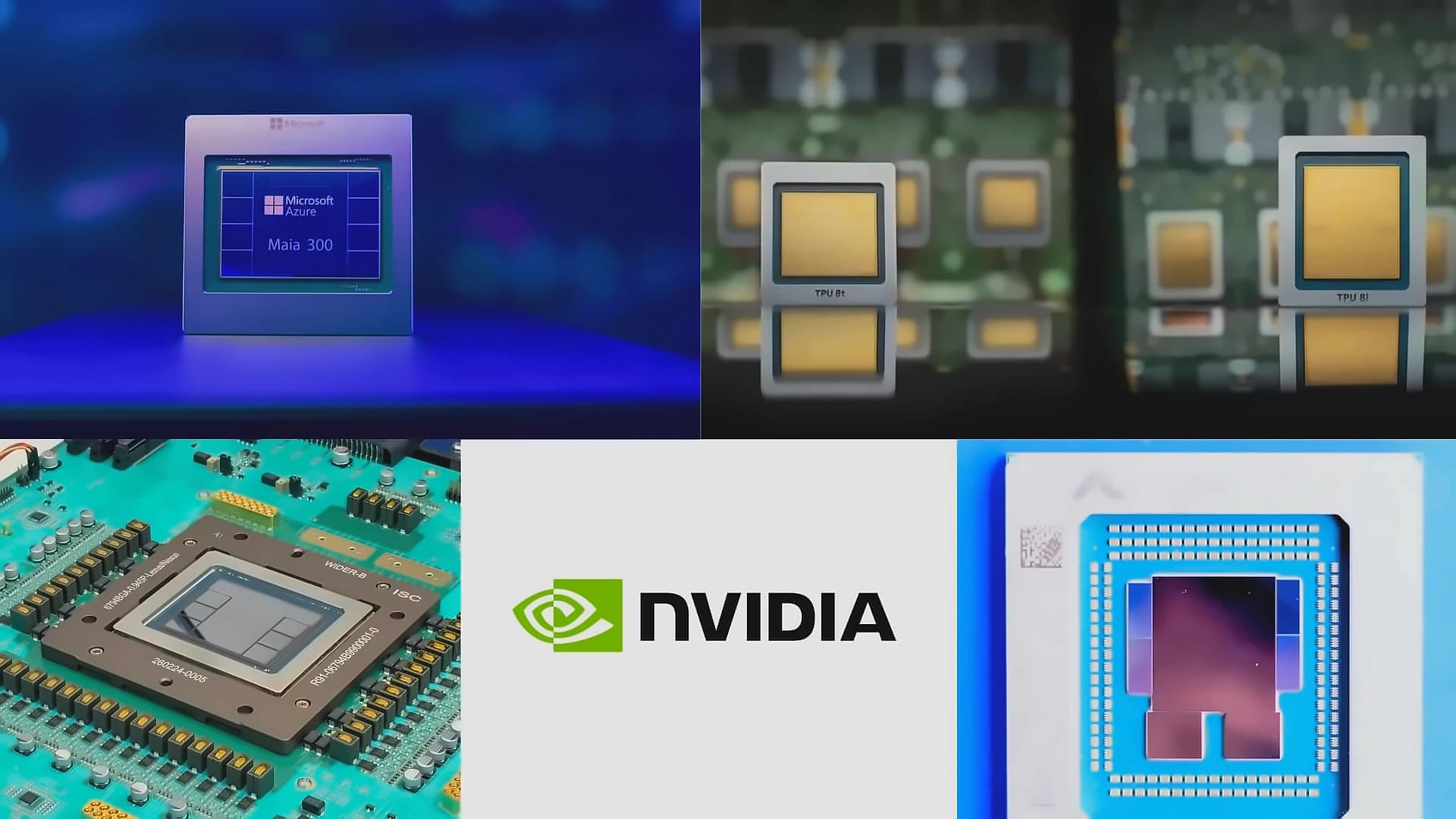
Microsoft shares rose 1% in Monday morning trading as the company outlined plans to shift more AI workloads to its own Maia chips, according to a company blog post published Monday. The stock movement reflects investor confidence in Microsoft's strategy to reduce dependence on external AI chip suppliers and gain greater control over its AI infrastructure costs and supply chain.
Microsoft has announced potentially more than a million deployments of its next-generation custom AI chip, the Maia 300, starting next year to support its internal AI services. As reported by Reuters, the company plans multi-gigawatt deployments of the Maia 300 chips, marking a significant scaling of its custom chip strategy. The deployment comes as Microsoft expects to spend more than $175 billion in capital expenditures this calendar year, demonstrating the company's substantial commitment to AI infrastructure development.
The Maia 300 represents the third generation of Microsoft's custom AI chips, designed to handle complex AI data crunching including coding and business tasks. According to Reuters, the chip uses 2-nanometer technology from Taiwan Semiconductor Manufacturing Co for key computing functions, while other chiplets utilize cheaper 3-nanometer technology for data movement and system functions. The Maia 300 processors will be housed in racks containing 96 chips that consume approximately 167 kilowatts of power, compared to 142 kilowatts used by Nvidia's most recent GB300 AI server racks with 72 GPUs. Microsoft claims the chips will deliver 40% more useful computing per megawatt than leading GPU-based systems, with Rani Borkar, president of Azure hardware systems and infrastructure, emphasizing optimization across the entire system for intelligence per watt, dollar, and memory.
Maia 200 is already running production workloads, including Copilot, with GitHub Copilot and Microsoft Foundry expected to follow by year-end. As reported by GuruFocus, Microsoft introduced Maia 300, the third generation of its custom AI accelerator, with production deployments due to start in 2027. The company aims to expand the Maia family to multi-gigawatt capacity and fit 96 chips in each rack, twice the Maia 200 configuration. Microsoft claims the Maia 300 could process up to seven times as many AI tokens per rack as its predecessor, with these efficiency gains helping address the computing and electricity demands of expanding AI services.
Microsoft is not alone in this custom chip development trend. As reported by Business Standard, from Google's Tensor Processing Units (TPUs) to Amazon's Trainium and OpenAI's planned inference chip, the industry is moving towards greater control over the hardware that powers AI services. Google announced its eighth-generation TPU systems in April 2026, separating the design into TPU 8t for training and TPU 8i for inference, while Amazon's custom-chip business had crossed a $25 billion annual revenue run rate by July 2026. This flurry of custom chips from both cloud computing rivals and AI firms is aimed at loosening the hold of Nvidia on the AI computing market.
Despite the expansion of custom chips, Business Standard reports that Nvidia's position in the AI market is changing rather than disappearing. Nvidia offers a broad hardware and software ecosystem, including its CUDA platform, that supports a wide range of AI workloads. The company is also moving deeper into the AI ecosystem, with its recent acquisition of AI repository platform Hugging Face being an example of how it's adapting to the changing landscape where companies choose hardware according to workload rather than relying on a single chip category. Microsoft's Maia 300 architecture is designed for long-context reasoning, memory-intensive processing and multi-step AI agent tasks, with planned uses including Copilot, GitHub Copilot, Microsoft Foundry and Dragon Copilot. Nvidia chips will remain part of Microsoft's infrastructure, especially for training models, and Microsoft also uses processors from Advanced Micro Devices, though broader Maia deployment could give the software maker more control over costs and supply.