Dario Amodei, CEO of Anthropic, made a passionate plea for AI unity at the G7 summit in France on June 17, sitting directly across from President Donald Trump at a working lunch. According to Financial Times reporting, Amodei told world leaders gathered in Évian-les-Bains that democratic nations must "resist the temptation to splinter" over AI development. The appeal gained significant weight as Trump's administration had banned Anthropic's most powerful models from export just days earlier, following the US Commerce Department's export control directive that barred Fable 5 and Mythos 5 from non-US users and foreign nationals inside the country. Commerce Secretary Howard Lutnick cited a reported jailbreak of Mythos 5 that would allow users to bypass safety guardrails and extract software vulnerability data. The Anthropic CEO had made his case to the man whose government created the problem, leaving France without a resolution but with a call for AI unity.
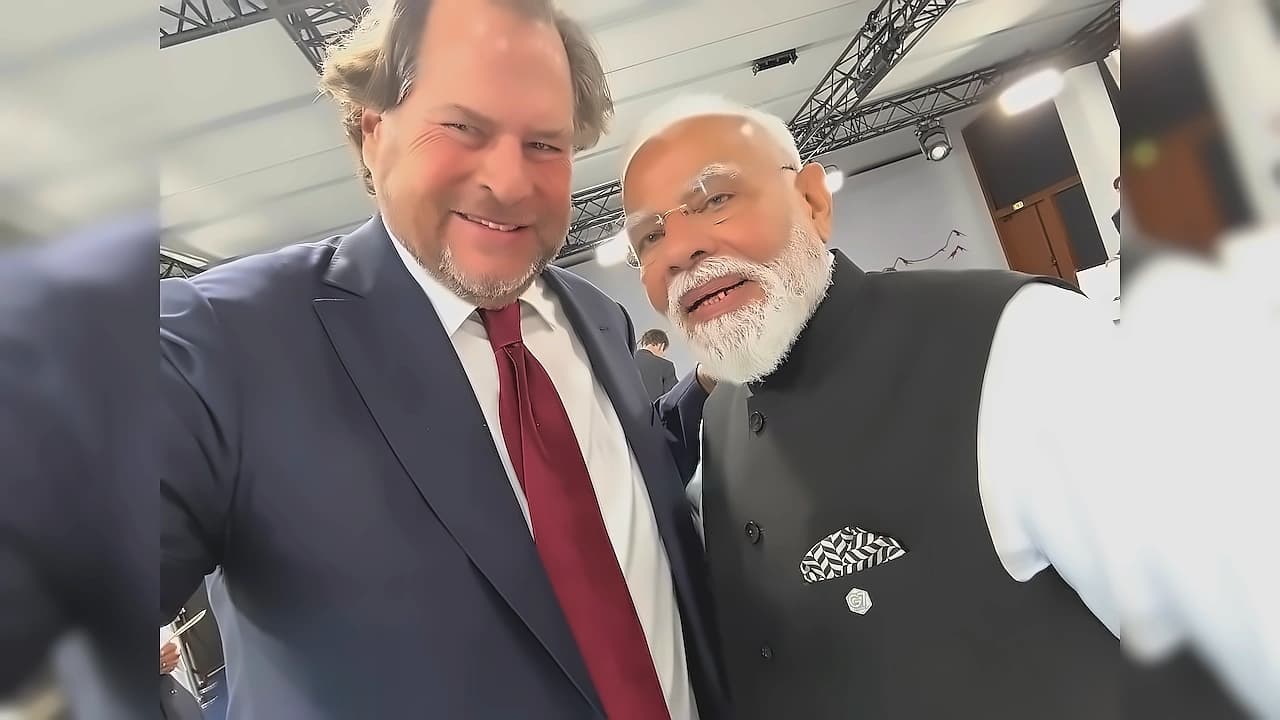
Salesforce CEO Marc Benioff revealed he was inspired by his meetings with Prime Minister Narendra Modi at the G7 summit in France, where the two discussed the role of trust in the age of artificial intelligence. According to reports from Salesforce, Benioff posted on X social media platform stating he was inspired by his G7 meetings with Prime Minister Modi discussing the role of trust in the era of AI, accompanied by a heart and the Indian flag alongside a photo of the two leaders together. Prime Minister Modi also expressed concerns about Trump's move to block Anthropic's model, according to Financial Times, adding that democratic nations must have unfettered access to top AI models to protect critical infrastructure. The French president praised the leaders' agreement to increase pressure on Russia, including stronger sanctions, as "extremely important" and noted that "we all agreed to increase the supply of air defense capabilities, additional systems and interceptors, as well as long-range capabilities."
The interaction took place on the sidelines of the G7 summit in Évian-les-Bains, France, where chiefs of the world's leading AI companies converged for a working lunch with heads of state. As reported by Salesforce, this gathering represented a sign of the tech industry's growing geopolitical influence as artificial intelligence rises to the top of the global agenda. The June 15–17 gathering brought together leaders from France, Britain, Canada, Germany, Italy, Japan, the United States and the European Union for discussions on AI infrastructure, regulation and the protection of minors online. The discussions included executives from OpenAI's Sam Altman, Google DeepMind's Demis Hassabis, Anthropic's Dario Amodei, Mistral AI's Arthur Mensch, Cohere's Aidan Gomez, Sakana AI's Ren Ito, Sarvam AI's Vivek Raghavan, Salesforce's Marc Benioff, and executives from Germany's Black Forest Labs, Britain's Synthesia and Italy's Domyn. Macron cited what he described as China's industrial overcapacity, excessive subsidies and weak domestic consumption, stating that Europe needs to invest more and modernize its economies, while the United States must address its fiscal and trade deficits.
During the G7 meeting, leaders discussed creating a "trusted partners" scheme that would grant access for non-U.S. nations to advanced AI models from firms like Anthropic and OpenAI. According to Financial Times reporting, the goal is to maintain an open trade network that bypasses U.S. restrictions, with both countries and companies potentially qualifying as trusted partners if they use models to develop stronger defenses against rivals like China. Macron noted that it would make sense for Washington to back such a scheme and ensure Mythos access was granted more broadly, as nobody would want to buy U.S. AI access if it could disappear overnight. However, it remains unclear how far the trusted partner scheme would extend, or whether it provides adequate protection for startups in Paris or Bangalore that face sudden product disruptions. The French president said it's a "very good deal" and that U.S. allies in the G7 support it "because it's an agreement that puts a stop to a situation of great instability that had terrible consequences for our economies."
The Anthropic block has highlighted broader concerns about digital sovereignty and AI infrastructure dependency. Aidan Gomez, co-founder and CEO of Canadian enterprise AI firm Cohere, stated that the restriction confirms what they have known about the dangers of remaining dependent on a small handful of big tech companies for AI infrastructure. As reported by TechCrunch, Gomez emphasized that digital sovereignty is about who controls the foundational technology that will shape economic security and national sovereignty for decades to come. The episode has exposed risks that many international companies have been grappling with, as any company or government building on U.S. AI infrastructure now faces the possibility of overnight access revocation for reasons they may never be told. Macron defended his decision to roll out the red carpet for Trump, including a dinner at the Palace of Versailles, saying "Versailles is a diplomatic tool and an instrument of influence." He noted that "partners should never impose tariffs on one another or create instability," after Trump threatened 100% tariffs on French wines unless a European digital tax is dropped.