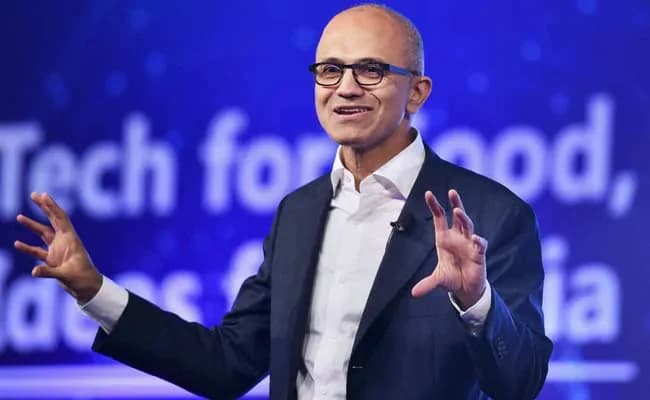
Microsoft CEO Satya Nadella has outlined a comprehensive strategy for companies to navigate the AI economy, emphasizing the critical importance of building token capital and human capital as core business assets. According to reports from Microsoft, Nadella defined token capital as proprietary AI capability - the systems and models companies build and own - while describing human capital as employee knowledge, judgment, relationships, ingenuity, and pattern recognition. The CEO positioned human direction as the engine behind AI value creation, stating that human capital does not diminish in value as token capital grows. As reported by Microsoft, Nadella set out this framework in a talk with Reid Hoffman just after Microsoft Build 2026 and in subsequent interviews, introducing the phrase token capital into boardroom conversations about AI strategy. In his latest post on the future of the firm in an AI-driven economy, Nadella called this moment unlike earlier platform shifts, noting that for the first time, a company can build a cognitive loop between its people and its machines. As reported by Moneycontrol, Nadella wrote: "This transition is different than any previous platform shift. In the past, we used digital systems to enhance human capital. This is the first time we can create a real cognitive loop between people and digital systems."
Nadella's approach centers on building learning loops that compound human and token capital rather than relying on the strongest AI models alone. As reported by Microsoft, he explained that while tasks and jobs can be offloaded to AI, learning remains a human capability that cannot be automated. The CEO envisioned a future where firms build agentic systems that improve over time while maintaining control of their intellectual property. His strategy emphasizes creating private evaluations and reinforcement learning environments built on company-specific data, turning workflows, domain knowledge, and accumulated judgment into AI systems that improve with each use. As reported by Firstpost, Nadella highlighted the importance of creating learning loops where human capital and token capital continuously reinforce one another, enabling businesses to develop agentic systems that improve over time while allowing organizations to retain ownership of their intellectual property and institutional knowledge. According to Firstpost, Nadella stressed that you can offload a task, or even a job, but you can never offload your learning. The learning loop works like a circle where your people do the work, the system captures what matters - the context, the decisions, the corrections, the way the work actually gets done - then uses this information to make the next AI-assisted step a little better. Nadella emphasized that the real prize is not picking the best model but building a learning loop, warning that a few models could otherwise commoditize whole industries, as outsourcing once hollowed out manufacturing. The CEO noted that the critical challenge for modern enterprises involves navigating a landscape where AI models can continuously absorb and commoditize the expertise of humans and organizations, requiring organizations to establish a continuous learning loop where human capabilities and artificial intelligence compound together.
The Microsoft CEO warned against a future where few dominant models capture most of the AI value, comparing it to globalization that hollowed out industrial economies decades ago. According to Microsoft reports, Nadella argued that political economy will not tolerate a world where companies across all sectors cede value to a few models. He emphasized that every organization should own the learning loop that holds its institutional knowledge, allowing companies to swap base models without losing accumulated expertise. This control mechanism represents what he described as the key test of sovereignty in the AI era ahead. The warning comes from Microsoft, which is one of the handful of giants that sell AI models, arriving in the same week the company launched seven of its own AI models built in-house. As reported by Moneycontrol, Nadella does not want a world where every company across every sector is ceding value to a few models that eat everything they see. Instead, he called for "a frontier ecosystem, not just a frontier model," urging firms to govern AI agents like their own employees and treat AI as a scaffold for human potential, not a substitute. The CEO concluded by emphasizing that when platforms enable more value on top than is captured inside, employees see their expertise amplified and their judgment integrated into replicable, scalable systems, creating a stable economic equilibrium. Nadella warned against repeating the mistakes seen during the first phase of globalization, noting that while surface GDP numbers looked fine, the displacement was real and the consequences are still felt today. According to Firstpost, Nadella advocates for an AI economy in which value is distributed broadly rather than concentrated among a small number of model providers, such a future would allow businesses, employees, and local economies to benefit from AI while maintaining ownership of the knowledge and capabilities that make them unique.
The conversation around AI has evolved from technical capabilities to economic outcomes and productivity, with Nadella's vision focusing on abundant intelligence where AI intelligence becomes widely available like computing power and internet connectivity. As reported by Business Standard, Nadella's article can be read as Microsoft's blueprint for what comes next, with the debate shifting from benchmarks and model performance to productivity, labour markets and who benefits from AI-driven growth. The CEO argues that what is at stake is not some digital tool or system and its use, but how organisations continue to learn, build IP, differentiate, and thrive in a world where AI models can continuously absorb the expertise of humans and organisations and commoditise it. Put simply, if every company has access to powerful AI models, the differentiator will no longer be the model itself but the unique knowledge, workflows, expertise and business processes companies build on top of those models. To explain this, Nadella introduces the concept of learning loops where human expertise improves AI systems, better AI systems make people more effective, and those improved outcomes generate new knowledge that further strengthens both human and AI capabilities. Over time, this loop becomes a company's intellectual property. According to Business Standard, Nadella repeatedly argues that human capital does not become less valuable as token capital grows - it only becomes more valuable! I believe human agency will be the driver of token capital growth, with humans setting ambitious goals, connecting dots across domains, building relationships, and recognizing patterns that matter most. The CEO noted that human capital does not become less valuable as token capital grows - it only becomes more valuable! I believe human agency will be the driver of token capital growth, with humans setting ambitious goals, connecting dots across domains, building relationships, and recognizing patterns that matter most. According to Firstpost, Nadella argues that the future of enterprise AI is not about identifying the most powerful model available today, but it is about building systems capable of preserving a company's unique expertise regardless of the underlying AI model being used.