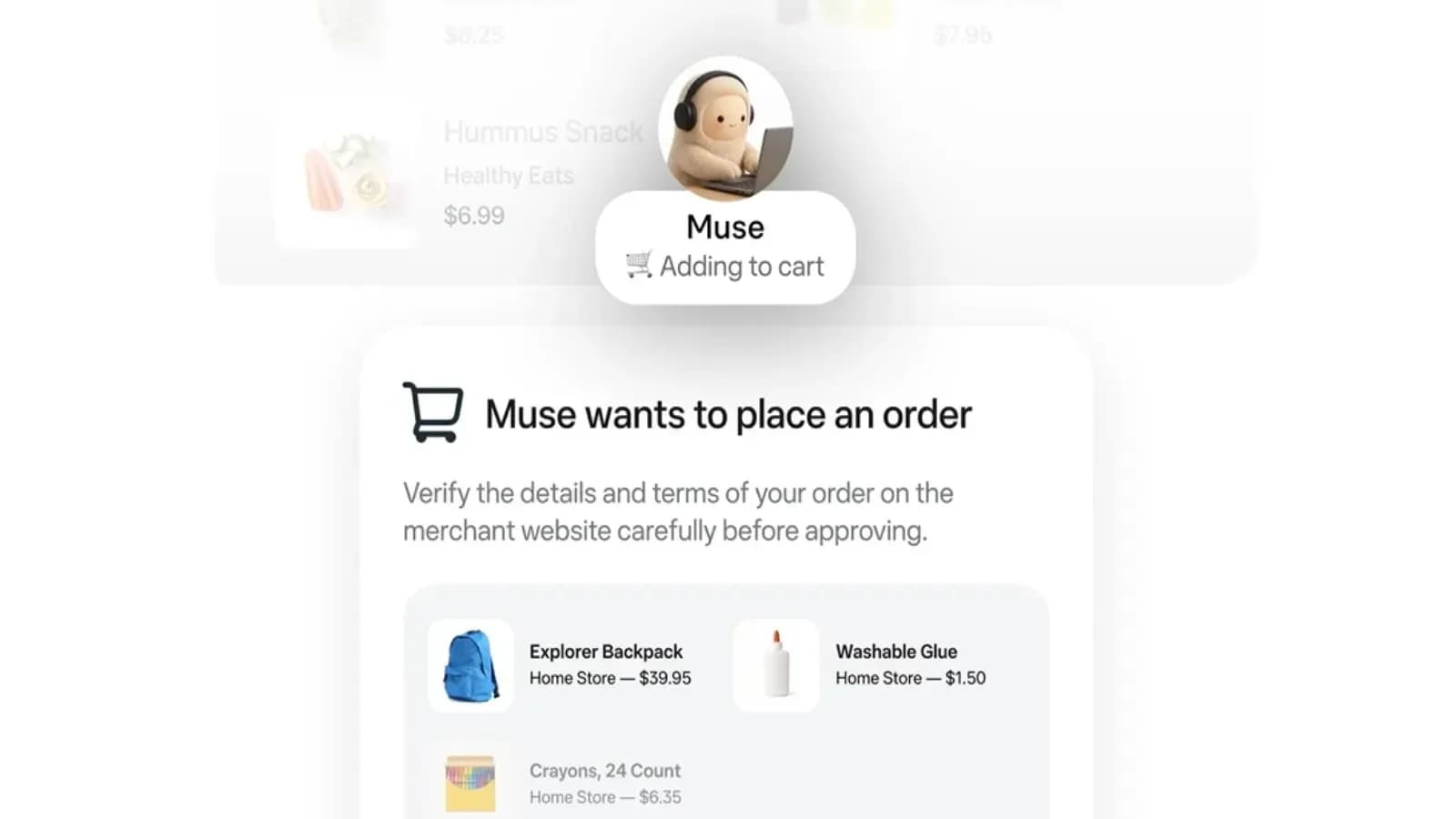
Meta has launched Muse, its personal AI agent, with significantly expanded capabilities beyond basic chat responses. The agent is designed to work more like an agent than a chatbot, allowing users to tell it what they want to accomplish and creating a plan to coordinate the steps involved. Muse can browse the web, book travel, send emails, make purchases, and complete online transactions while continuing to work in the background without requiring instructions at every step. The agent maintains persistent memory across conversations, allowing it to retain context about a user's goals and preferences, and can monitor long-running tasks and return when something changes or when it needs the user's approval. According to Meta CEO Mark Zuckerberg, the agent understands a user's goals and works around the clock to get things done, with users maintaining control over which apps and services Muse can access and disconnect at any time.
Meta launched Muse, its personal AI agent, on Tuesday despite internal concerns about the technology's ability to manage access to sensitive personal data. The company's Muse agent, known internally as Hatch, is the centerpiece of CEO Mark Zuckerberg's plan to supply "personal superintelligence" to billions of Meta users. However, as recently as this week, Meta employees testing the tool have reported mixed results, according to internal posts seen by Reuters. One employee wrote that the product had been so useful in arranging vacation logistics that Muse had become "the third participant" on a recent three-week honeymoon in Indonesia. Others flagged serious security flaws, including an agent routing around guardrails to expose personal iCloud photos after being prompted to identify toys visible in pictures from a child's birthday party. Meta Chief Technology Officer Andrew Bosworth posted that he kept getting logged out and needing to log back in, sometimes several times within a few minutes.
To use Muse, consumers will have to trust Meta with more of their personal information than ever before. The AI agent works by connecting to the user's apps and services that are part of everyday workflows, including email, calendars, payments, and other regular applications like health and fitness, smart home, dining, shopping, music and events. Users can decide which apps and services they want to connect, doing so one at a time, to make the opt-in nature of using Muse more transparent. The agent is powered by Meta's AI model, Muse Spark, and ships with built-in connectors for several services, with plans to add more over time. If a service isn't available but offers a public API, Muse can set up a connection using credentials the user provides, or access the service via the browser when no API is available. Meta emphasizes that Muse cannot see users' passwords or payment information, and users can opt out of having their interactions with Muse used to train its AI models.
Muse will be free to use initially, with subscription plans kicking in as usage increases, which is why the agent requires a payment card to get started. Two paid plans will be available at launch: Power at $20/month and Maximum at $100/month, both offering more Muse usage for handling everyday tasks. The company believes most people will remain on the free tier, with the app including a usage meter that shows users what percentage of their usage they have left. Muse will initially be available via the web at muse.ai, through apps on iOS and Android, and through chats in WhatsApp, with plans to expand to Meta's AI glasses. The agent will continue working even after the user leaves the app and improve over time by learning from user conversations to make unprompted suggestions. Meta CEO Mark Zuckerberg announced that the company's longer-term goal with Muse is to help deliver "personal superintelligence" to everyone, with free access of up to 100 million tokens a week and paid plans for users requiring more compute capacity.
Under the hood, Meta claims that Muse runs in its own dedicated, secure computer with its own browser, Muse Secure VM, which offers various privacy, safety, and security protections over customers' data. Each Muse agent runs on its own virtual machine, a cloud-based emulation of a personal computer, which enables it to keep carrying out requests in the background even when a person is not actively using it. The system combines Meta's AI model, the Muse software framework, deterministic code and multiple classifiers to identify threats such as prompt injection attacks. A separate "Sentinel" agent runs on the same machine and is isolated from Muse at the system level, with actions or data sent to the internet requiring Sentinel approval. The system is designed to quarantine threats before they reach the model's context window, and Meta plans to introduce Muse Confidential VM later this year, under which the entire virtual machine, including users' data and conversations, will be encrypted using a key held only by the user.
The launch represents Meta's latest attempt to diversify its revenue sources beyond advertising and build a viable business out of its enormous investments in AI chips and other infrastructure, which the company forecasts will exceed $130 billion this year. The product will be available only in the U.S. initially, via a dedicated Muse app or Meta's WhatsApp messaging service, with plans to add the agent to its line of smart glasses "soon." The launch comes amid revelations that AI agents from multiple leading labs, including OpenAI and Anthropic as well as Meta, have caused unintended problems by bending rules and behaving in other unpredictable ways. Inside Meta, major technical and security incidents have spiked 40% from last year as a result of an AI-driven coding surge and agent-related issues, while time staffers spent "firefighting" those incidents has gone up 70%.