Meta has officially launched its productivity overhaul of Meta AI on July 24, 2026, marking a significant shift from its previous entertainment-focused positioning. According to Reuters, the company announced this update as it moves the assistant onto the same ground as OpenAI, Google, and Anthropic with their productivity tools. The new features include automated daily briefings that pull from connected calendars, flag conflicts such as double-bookings, and deliver summaries at set times. Users can now set up recurring tasks once and leave the assistant to run them independently, including weekly meal plans, product restock alerts, and trend updates without requiring repeated instructions. As Meta stated in its blog post, this represents 'our next step toward personal superintelligence: an AI that knows your context, is there for you whenever you need it'.
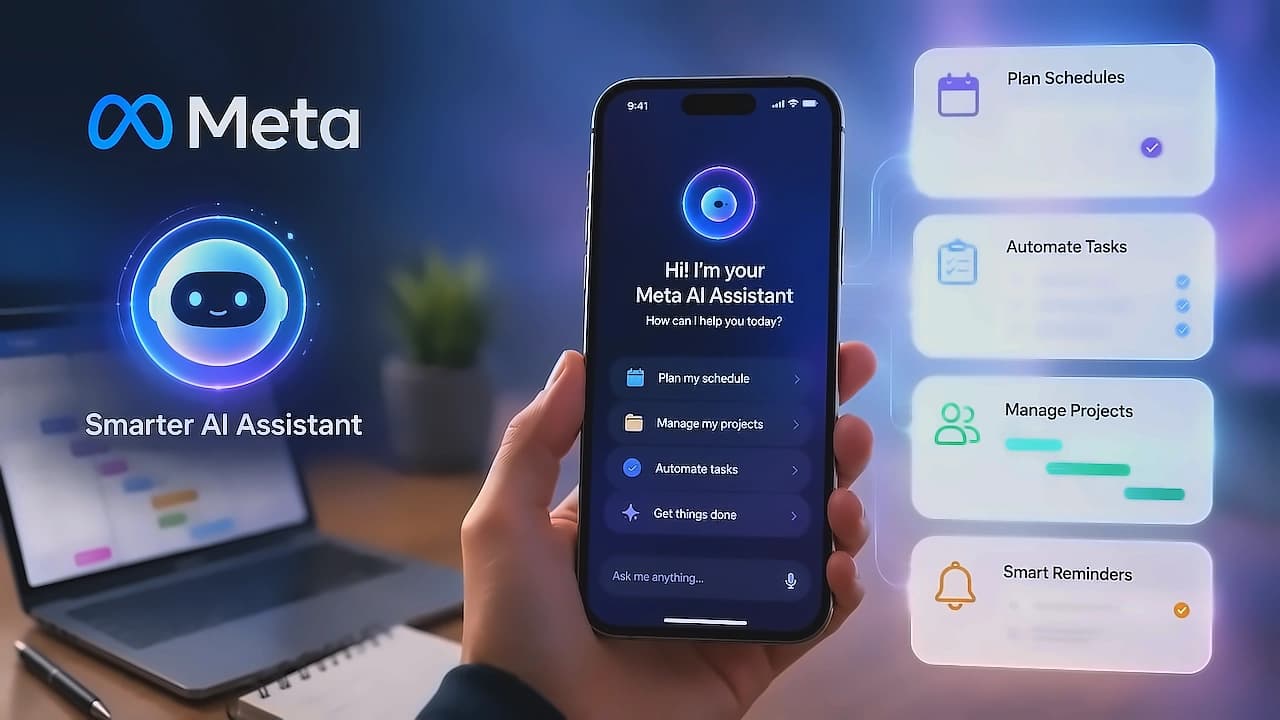
The updated assistant is powered by Meta's Muse Spark 1.1 AI model released on July 9, 2026 from its Superintelligence Labs group, which Meta describes as an agentic model built for planning and tool use with a one-million-token context window. According to Reuters, the assistant can now research topics and synthesize sources from the open web across Meta's apps, then turn results into reports, presentations, or sets of slides. Users can steer the output while it's being generated, telling the assistant to change tone, shift focus, or cut sections mid-response, mirroring a feature already in ChatGPT. The company tested the model against frontier-risk categories before release and integrated it with a new Meta Model API now in public preview for US developers. Reuters reports that the assistant is designed to understand user context and execute tasks without constant prompting, with everything the assistant produces now collecting in one place inside the app. Reuters notes that users retain control over how they interact with the AI and incognito chats remain available for private conversations.
Meta CEO Mark Zuckerberg has outlined his comprehensive vision for artificial intelligence, arguing that access to superintelligence should empower individuals rather than remain concentrated in the hands of a few governments or technology companies. In an opinion piece published in The Wall Street Journal, Zuckerberg said the biggest question surrounding AI is not whether superintelligence will become a reality, but who will be able to use it. He argued that widespread access to advanced AI systems could unlock innovation, improve healthcare, create businesses and help people pursue their personal and professional goals. Addressing growing concerns over AI safety and job losses, Zuckerberg criticised what he described as overly pessimistic views surrounding the technology, stating 'It is surprising that the discourse from many of those who are developing artificial intelligence is so filled with doom. I don't understand why anyone who believes that AI will eliminate most jobs and much of humanity's relevance would rush to build that future.' He also questioned the idea that AI should be tightly controlled by a handful of organisations, saying history has repeatedly shown that concentrating power rarely produces positive outcomes.
Zuckerberg believes that widely distributed superintelligence could lower barriers to entrepreneurship, making it easier for individuals to launch businesses without significant capital. According to his vision, this could eventually lead to an economy with more small businesses and greater individual innovation. On the future of work, Zuckerberg argued that AI should primarily serve as a tool that expands human capabilities instead of replacing workers. He concluded that if superintelligence is widely distributed, then I believe we will see more jobs in the future, not fewer. This represents a fundamental shift from Meta's previous deliberate bet on holding attention rather than competing in productivity, with the company restructuring around its Superintelligence Labs group and pouring money into AI infrastructure to support this vision.
The features are currently rolling out in select markets through the Meta AI app and meta.ai, with WhatsApp and additional countries promised in the coming weeks. As reported by Reuters, Meta named no specific launch markets and gave no date for wider expansion, unlike competitors' paid subscription models. The company maintains that Meta AI will remain free, consistent with a company that monetizes attention and advertising rather than subscriptions. The rollout represents a capability claim paired with staged deployment, with engagement figures expected to surface in Meta's next reporting period to determine whether users continue using the productivity features beyond the initial novelty. Reuters notes that the competitive logic is direct, as OpenAI, Google, and Anthropic have each pushed their assistants toward scheduled tasks and agentic work, and Meta's move to match them signals that its personal-superintelligence pitch needs a credible productivity story to sit beside theirs.