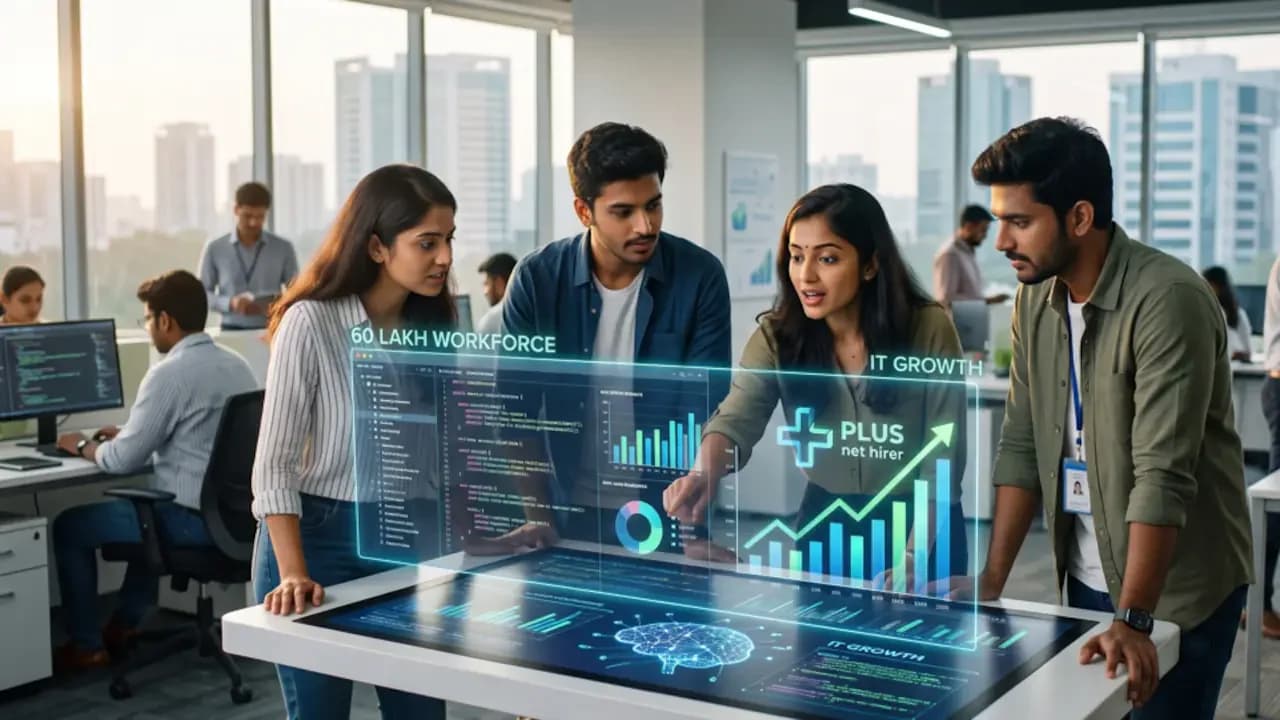
India's Information Technology sector demonstrated resilience in FY26, adding 1.35 lakh jobs to reach a total workforce of 60 lakh employees, as reported by the Ministry of Electronics and Information Technology (MeitY) in a written reply to the Lok Sabha. This employment growth comes despite mounting concerns over technology-driven layoffs and the impact of artificial intelligence on traditional IT roles. The government has pushed back against mounting concerns over technology-driven layoffs, informing Parliament that India's IT sector remains a net job creator despite automation fears. However, recent developments show a more nuanced picture with freshers now accounting for around 15% of hiring, down from nearly 28% a few years ago, as companies focus more on AI, cloud, data and automation skills.
According to assessments from NITI Aayog, artificial intelligence is rapidly transforming the workplace and putting routine, repetitive IT roles at risk. As reported by MeitY, entry-level positions, particularly junior quality assurance and Level-1 IT support jobs, are bearing the brunt of this automation wave. However, the ministry emphasized that this same technological shift is actively generating demand for specialized, next-generation technology roles, which is keeping overall hiring numbers in the green. The government noted that while job shifts are occurring across the sector, the broader IT industry continues to be a net job creator rather than shedding its headcount. According to Aon Hewitt's research, 43% of organisations in India have already deployed AI and another 20% are piloting programmes, with employers placing greater emphasis on digital, analytical and AI-related skills when evaluating fresh graduates.
The IT sector is experiencing a significant shift in hiring practices, with companies becoming increasingly selective and project-driven. Major firms including IBM, Accenture, Oracle Financial Services Software and Cognizant have informed candidates that joining timelines depend on project availability, business requirements or administrative processes. This has left many engineering graduates waiting months and sometimes more than a year just to start work. The trend reflects a broader reset in the sector, with India's five largest IT companies cutting a net 6,981 jobs in FY26 after adding 12,718 in FY25, while Nasscom estimates the industry's workforce grew by only 1.35 lakh to 5.9 million in 2026. However, some green shoots have emerged with India's six largest IT companies adding a net 5,400 employees in Q1 FY27, reversing the previous quarter's 7,100 job reduction, driven largely by TCS hiring a net 9,000 employees.
Global Capability Centres (GCCs) are emerging as major talent absorption centres, with their fresher hiring growing from around 85,000 two years ago to more than 130,000 today. According to Aon Hewitt, there is a maturity shift in GCCs moving from execution-oriented work towards innovation, ownership and global capability building. However, Xpheno's Anil Ethanur notes that GCCs cannot completely offset the scale of hiring done by IT services companies, as their hiring model focuses on specific roles and specialized skills rather than large-scale campus drives. The challenge lies in the scale of campus hiring, with enterprises requiring ₹400-450 crore compensation for every 10,000 freshers hired, making talent acquisition expensive amid current market conditions.
The evolving hiring landscape demands that freshers acquire specialized AI-related skills beyond traditional technical proficiency. According to TeamLease Digital's Neeti Sharma, employers now want graduates who can start contributing with AI tools from day one, moving away from months of training requirements. Key skills in demand include AI, data analytics, automation tools, cloud technologies, cybersecurity and digital engineering. Aon Hewitt's research shows that 87% of organisations across Asia Pacific believe AI will create new opportunities and require new skills, with employers increasingly favoring candidates who demonstrate workforce readiness and the ability to continuously learn. The future workplace will reward engineers who can combine domain expertise with AI literacy, apply technology to solve business problems and adapt quickly as roles evolve.