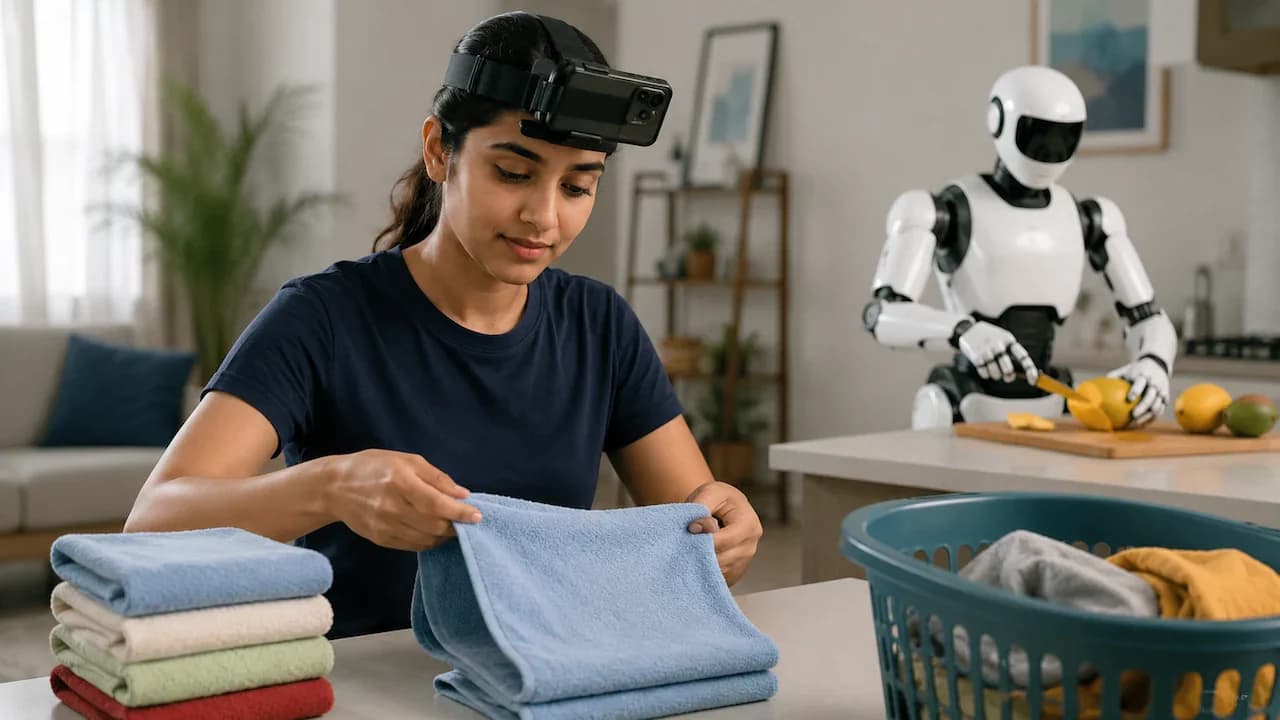
Thousands of Indians are generating crucial data that could enable robots to perform household and industrial tasks, according to reports from AFP. In Chennai, 25-year-old Nagireddy Sriramyachandra straps a smartphone to her head and films herself doing household chores for approximately ₹250 per hour. The recordings, known as 'egocentric data', are increasingly sought after by AI developers trying to build robots capable of performing routine tasks autonomously. As Sriramyachandra noted from her kitchen in Chennai, "Who else will give you 250 rupees an hour just for doing housework?"
Tamil Nadu-based AI data company Objectways, which serves multinational clients and works with Amazon SageMaker, is among firms tapping India's growing workforce of AI trainers. The company collects videos of activities such as folding clothes, preparing coffee and making sandwiches. At a Karur textile factory, AFP witnessed eight people wearing head cameras and smart glasses supplied by Objectways, busy with workers attaching labels to caps and ironing cloth bags. Objectways CEO Ravi Shankar stated that 'Some jobs are supposed to be taken over, so humans can go and do better things,' listing videos requested by clients including folding clothes, coffee making, and cooking specific things like sandwich making.
The industry has expanded significantly with multiple startups now participating in AI data capture. Home services startup Pronto recently admitted to piloting in-home video recordings to train physical AI systems, joining companies such as Human Archive, Humyn Labs, Egolab AI and Neocambrian. These startups partner with cloud kitchens, hotels, home services platforms, small textile and garment factories, and warehouse operators to record everyday tasks from cooking meals and washing dishes to stitching garments, assembling components and sorting inventory. Some have even built dedicated 'data factories' with motion-tracking rigs, as reported by The Times of India.
The trend comes as India strengthens its position as a global hub for AI data collection, processing and annotation, according to AFP reports. The humanoid robot market is booming, with investment bank Morgan Stanley predicting there could be over a billion robots in use by 2050, mostly for industrial and commercial purposes. Digital labour expert Aditi Surie of the Indian Institute for Human Settlements noted that demand for such services is likely to increase as AI systems become more sophisticated. Neocambrian AI founder Abhinav Kukreja explained that "There is no equivalent repository of physical behaviour on the internet. Robots need to learn from messy homes, crowded factories, small shops and repair stations, which India offers."
A recent NITI Aayog report highlighted concerns about AI's impact on employment, noting that discussions often focus on white-collar jobs while overlooking India's vast informal workforce of nearly 490 million people. The think-tank examined how AI could help or harm dozens of professions, from cobblers to sewer cleaners, farmers to tea sellers. However, some industry leaders see collaboration rather than competition between humans and machines. Manish Agarwal of Humyn Labs argued that 'A welder in India could be managing a welder-robot in Prague,' suggesting humans and robots will increasingly work together in the future. The practice also raises questions about privacy, legality and compensation, with some factories reportedly pausing pilots after recent backlash.