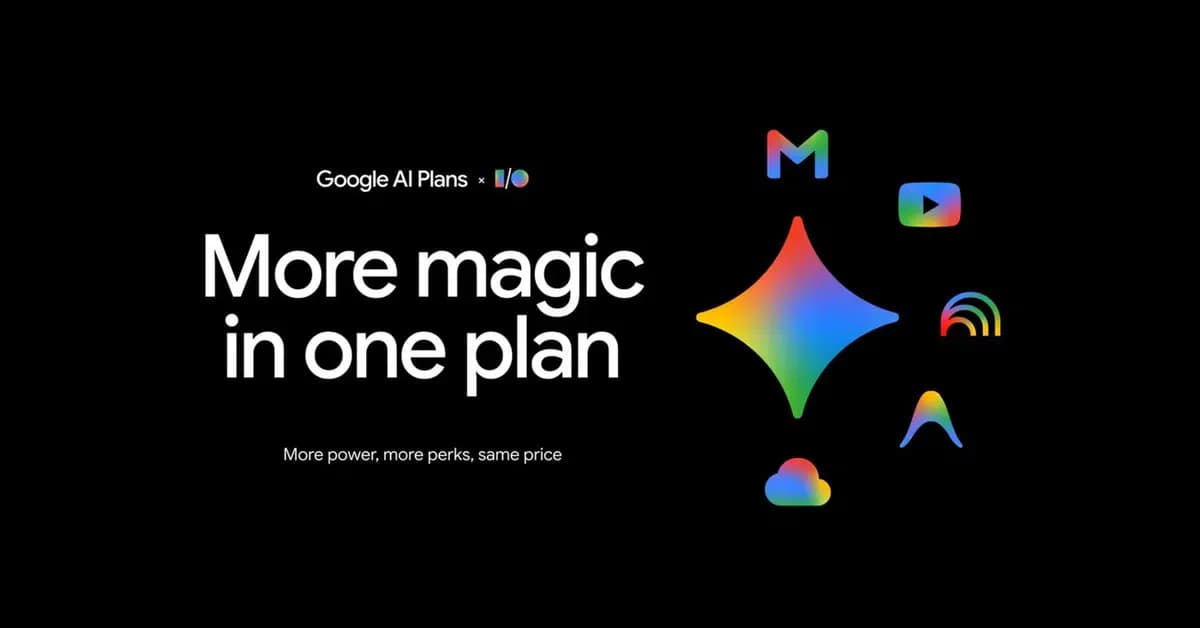
Google has announced a comprehensive overhaul of its AI subscription plans at Google I/O 2026, introducing a new $99.99-per-month AI Ultra tier for developers and advanced users. The company has also reduced the price of its existing top-tier AI Ultra subscription from $250 to $200 while maintaining the same features. According to reports from Business Standard, the new Ultra plan is designed for users who rely heavily on AI tools for coding, media generation, automation, and other complex workflows, offering up to 5X higher usage limits compared to the AI Pro plan. As reported by TechCrunch, the price reduction from $250 to $200 represents a 50% decrease that signals Google's strategy to undercut rivals during the ongoing AI subscription war.
The restructured AI subscription lineup now features a three-tier system with AI Plus at $7.99/month, AI Pro at $19.99/month, and AI Ultra starting at $99.99/month. The new Ultra plan includes 20TB of cloud storage, a full YouTube Premium individual plan, priority access to Google Antigravity, and Gemini 3.5 Flash. As reported by Business Standard, the company has also introduced Gemini Spark, an autonomous AI agent exclusive to Ultra subscribers rolling out in beta next week in the U.S. AI Pro and Ultra subscribers will also be able to purchase pay-as-you-go credits for Google Antigravity and Google Flow, with Gemini app support coming soon. According to TechCrunch, the new Ultra tier offers usage limits five times higher than Pro, integration with the new Gemini 3.5 Flash model, and priority access to Google Antigravity.
Google has implemented significant changes to its existing AI Pro subscription plan, moving from a product-based system to a compute-based usage model that depends on prompt complexity, chat length, and AI tools used. As reported by Business Standard, the new system calculates usage dynamically based on resource-intensity rather than fixed prompt counts, with limits refreshing every five hours until users reach their broader weekly quota. The company has removed the 1,000 monthly AI credits that were previously bundled with the AI Pro subscription, requiring users to purchase additional credits separately for products like Flow and Antigravity. According to TechCrunch, the compute-based limits use a vague enough metric of "complexity" that could quietly shrink usage over time without price changes.
Google has completely rethought how usage limits work across all tiers, moving away from individual prompt counting to compute-based measurement. According to Business Standard, this means that a simple text question costs far less against your limit than a complex video or coding task. The new system automatically drops users to faster, lighter models when they hit their caps on top-tier models instead of cutting them off entirely. AI Pro and Ultra subscribers will also be able to purchase pay-as-you-go credits for Google Antigravity and Google Flow, with Gemini app support coming soon. As reported by recent analysis, this approach shows Google is trying to package Gemini subscriptions as an entry point for "model + app + creation + development tools + Google ecosystem."
In India, Google currently offers four AI subscription tiers with pricing starting at ₹399 per month for AI Plus and extending to ₹6,500 per month for AI Ultra. According to Business Standard, the AI Ultra Premium plan is priced at ₹19,500 per month and includes the highest limits for Flow AI filmmaking and Whisk image-to-video tools. The company has expanded access to Project Genie, allowing users to create AI-generated worlds using Google Street View data, with the updated version available for users with the ₹6,500 AI Ultra subscription. The latest pricing changes represent a significant shift in Google's competitive positioning, with the company now offering more competitive rates across all tiers while maintaining premium features for advanced users. Recent analysis suggests that for regular users, ChatGPT Plus remains the safest primary subscription, while Gemini's value depends heavily on deep integration with the Google ecosystem.