The AI infrastructure boom has added a fifth critical bottleneck to the traditional challenges of chips, power, and capital. According to latest reports, the massive global investment in AI compute infrastructure has created enormous demand for semiconductors and advanced electronic components, with data centers consuming chips at a pace that's straining the entire electronics supply ecosystem. This hardware bottleneck is transforming supply chains for robotics, IoT sensors, and physical automation, as the same electronics supply ecosystem that warehouse robotics vendors, IoT sensor suppliers, and autonomous vehicle fleets depend on for building products is now being consumed by AI infrastructure projects. The AI semiconductor boom is already showing up in lead times, pricing, and vendor capacity, with operations leaders who treat this as background noise finding their automation plans disrupted.
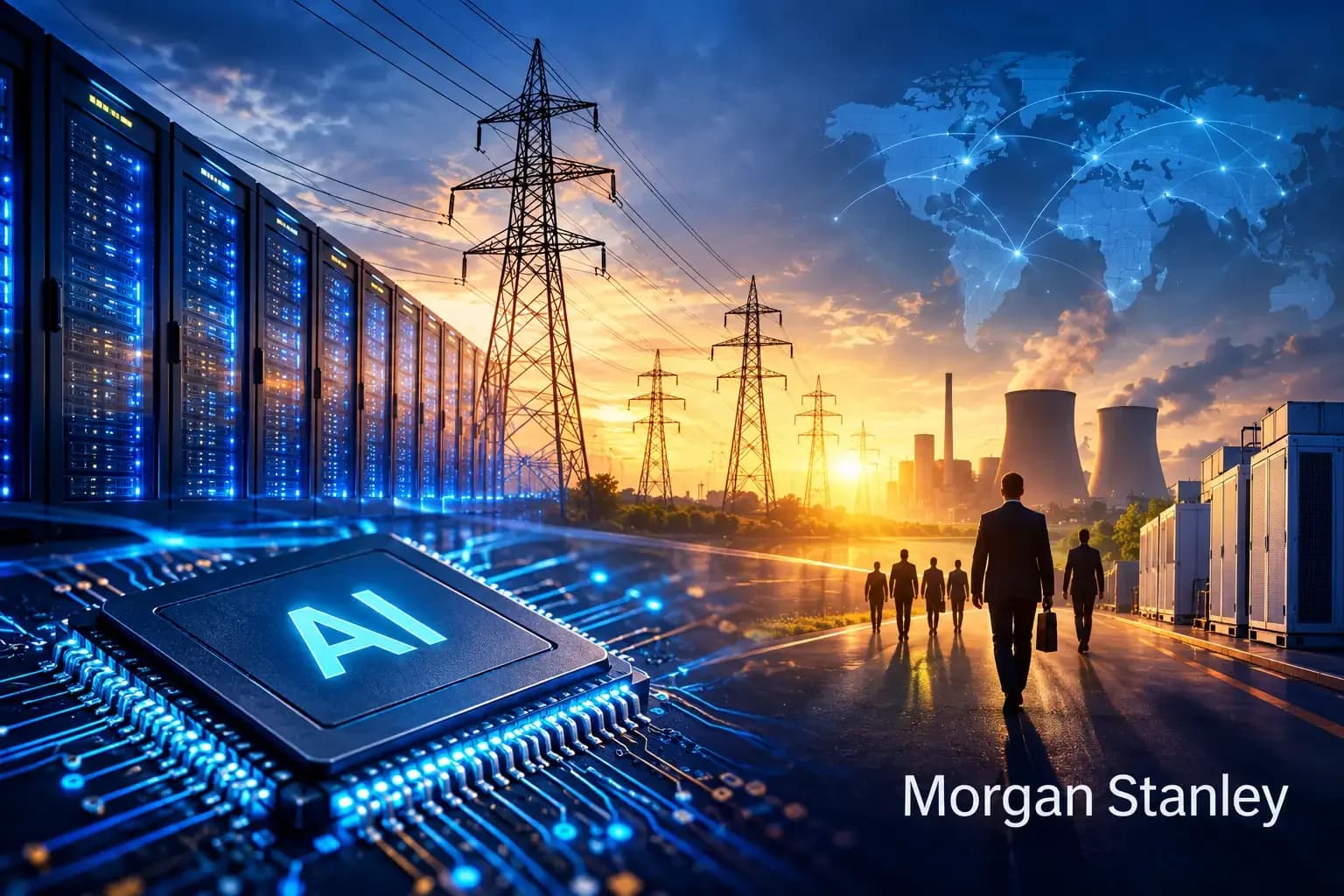
The AI infrastructure boom has added a fourth critical bottleneck to the traditional challenges of chips, power, and capital. According to Morgan Stanley estimates reported by Investing.com India, roughly $156 billion of data center projects were cancelled or delayed during 2025, with another $130 billion facing delays or cancellation in the first quarter of 2026 alone. Data Centre Watch separately counted at least 75 disrupted projects in that quarter, with opposition groups spanning 49 states. The latest evidence shows that AI accelerated code generation has not automatically accelerated delivery, creating new verification bottlenecks in software development pipelines. Morgan Stanley now forecasts that hyperscale cloud computing deployment capacity will grow from about 35 GW in 2025 to about 145 GW in 2028—some 4.1 times the original scale, with aggregate capital expenditures by the four North American supercloud and AI players' data centers rising from $917 billion in 2026 to $1.47 trillion in 2027 and $1.64 trillion in 2028.
The scale of opposition has intensified dramatically, with Wells Fargo now tracking 374 active local moratoriums, up from just 92 reported in June. As reported by Investing.com India, these moratoriums are averaging approximately 346 days in duration, while the average across all tracked measures has risen to 311 days from 277 days. Michigan, Ohio, North Carolina, Iowa, and Tennessee are among the states showing particularly heavy activity, with objections focusing on electricity costs, grid capacity, water use, and impacts on surrounding communities. According to a recent University of Pennsylvania's Annenberg Public Policy Center survey, 61% of U.S. adults opposed new data center construction in their area—up 12 percentage points from a February-March survey, with 75% of Democrats and 63% of Republicans opposing new data centers locally. The political resistance reflects broader concerns about AI infrastructure's environmental and community impacts, with 47% of registered voters listing cost of living as the most important factor in their midterm vote.

AI coding tools are creating significant delivery challenges as pull requests grew 154% larger in 2025 and another 51.3% in 2026, according to Faros AI telemetry covering roughly 22,000 developers. Developers are now handling 67.4% more pull-request contexts per day, with more code arriving in larger packages across more simultaneous threads of work. The traditional CI/CD and deployment processes remain largely unchanged, creating verification bottlenecks that move the pipeline constraints further along the delivery system. This represents a fundamental shift where AI is now both a workload running on the stack and a worker operating inside it, pulling DevOps, platform engineering, software development, QA and security into a shared operating model. Akamai's Jon Alexander emphasizes that "if you make the right architectural decisions upfront, if you think about where you want to end up, you can architect in the cloud to be able to deploy and run in many locations."
The permitting challenges are already affecting financing decisions, with Reuters reporting that lenders are paying much closer attention to permitting, community acceptance, and regulatory readiness when underwriting data center projects. According to Investing.com India, AI-related infrastructure is increasingly tapping both public and private credit markets, making political permission a critical component of credit analysis rather than an afterthought. Morgan Stanley's scenario analysis shows that model companies using in-house infrastructure to provide API services earn a 46% Return on Invested Capital (ROIC), higher than the 31% of cloud vendors renting GPUs and the 25% of third-party infrastructure API providers. The company forecasts that combined operating cash flow for the four companies will grow from $739 billion in 2026 to $1.23 trillion in 2028, with new debt financing needs dropping from $238 billion to $90 billion. However, rising electricity costs are increasing the burden on U.S. consumers and fueling dissatisfaction among lower- and middle-income voters, with 71% of U.S. adults disapproving of Trump's handling of living costs.
Despite the growing challenges, Wells Fargo analyst Shahriar Pourreza expects some political noise to fade after November and argues that credible projects should remain manageable. The essential point is that the freewheeling stage of the buildout is ending, not the demand for additional computing capacity. Projects that protect ratepayers, offer genuine local benefits, and arrive with believable power and water plans should still receive approval, though the process will likely become more complex and time-consuming than previously anticipated. Operations leaders who treat the AI semiconductor boom as background noise will find their automation plans disrupted, while those who take it seriously will build more durable hardware strategies. Organizations that benefit most from AI coding tools will be those that keep batch sizes small, make verification a first-class capability and preserve human attention for decisions where it has the greatest value, rather than optimizing purely for code-generation volume. Bank of America's Michael Hartnett warns that if Republicans fail to win the Senate and lose both chambers, project approvals will be delayed, while if Democrats control Congress and interest rates rise, the cost of data center construction will increase, reducing the present value of future cash flows.