Google DeepMind CEO Demis Hassabis has received significant industry backing for his proposed US-led AI standards framework, with Microsoft CEO Satya Nadella calling it 'an important piece' and emphasizing the need for a frontier ecosystem that 'promotes innovation and choice while avoiding any one model drop that breaks the world'. As reported by Axios, Nadella's endorsement from the boss of OpenAI's biggest backer represents 'not idle applause' but a signal that the industry's heaviest players are converging on the same regulatory idea. The support extends beyond Microsoft, with OpenAI's Sam Altman calling it 'a thoughtful proposal' and DeepMind's Mustafa Suleyman offering full support, while Google CEO Sundar Pichai simply said 'Well said Demis!' for a rare moment of alignment in the fractious AI field.
Google DeepMind CEO Demis Hassabis has unveiled a comprehensive proposal for a US-led Frontier AI Standards Body to govern advanced artificial intelligence models globally. As reported by Business Standard, Hassabis describes the current moment as 'the foothills of the singularity', comparing the emergence of AGI not to prior tech breakthroughs like the internet or mobile, but to fundamental discoveries like fire or electricity. He estimates the impact could be '10x of the Industrial Revolution at 10x the speed', potentially accelerating drug discovery, clean energy development and new materials while ushering in an era where resources are no longer a constraint on progress. The framework would classify models meeting certain capability thresholds as 'Frontier-class' and designate developers as 'Frontier Labs' with mandatory requirements for model cards, cybersecurity standards and personnel vetting. Hassabis specifically argues that 'a conventional government agency would not be able to move fast enough, or have the right resources', instead proposing a public-private body modeled on the Financial Industry Regulatory Authority—a federally overseen public-private partnership funded largely by industry. The proposed board would be majority-independent, stacked with Turing Award winners and other credentialed experts, alongside industry, government, and open-source representatives, with funding coming from industry contributions.
Hassabis has significantly escalated his warnings about AI safety, now cautioning that frontier models already pose cybersecurity risks, with nuclear and biological threats potentially emerging as capabilities advance further. According to Business Standard, he notes that intense commercial and geopolitical competition is currently outpacing the field's understanding of the technology's risks. The proposed standards body would conduct evaluations covering cybersecurity, biological threats and agentic risks such as attempts to bypass safety guardrails, with quarterly updates to ensure ongoing monitoring. Labs would initially share models voluntarily for review up to 30 days before release, a step Hassabis suggests could later become mandatory. As reported by Open Data Science, testing would examine whether agentic systems attempt to bypass safeguards, conceal their behavior, or deceive users and evaluators. The evaluations would cover cybersecurity, biological threats, and high-risk capability domains, with agentic tests specifically looking for attempts to bypass safety guardrails or signs of deception, and would ensure practices like digital watermarking and human-readable output tokens are in place. The benchmarks themselves would be revised quarterly at first, with the body eventually developing its own held-out tests—so labs cannot simply train their models toward known evaluation criteria.
Google DeepMind CEO Demis Hassabis has called for Washington to establish an AI watchdog empowered to screen advanced models and orchestrate industry-wide slowdowns if dangers mount. According to reports from CNBC TV18, Hassabis warns that AI is advancing roughly 10 times faster than the Industrial Revolution, creating a "species-level transition" with little margin for error. Within 18 months, he warns, severe biological and cyber threats could exist inside open-source models beyond government control. This call for regulation is part of a broader industry movement, as three of the world's top AI chiefs have called for binding oversight this year, though they differ on specific frameworks. The proposal reflects broader calls from OpenAI CEO Sam Altman and Anthropic CEO Dario Amodei for coordinated international AI standards. However, a powerful faction of tech leaders is pushing back against pre-emptive oversight proposals. Meta CEO Mark Zuckerberg and Chief AI Scientist Yann LeCun have become the industry's most vocal opponents of pre-emptive regulation, with LeCun explicitly accusing frontier AI labs of fearmongering to achieve "regulatory capture"—a classic manoeuvre where incumbents lobby for strict compliance rules to pull up the ladder behind them. For Meta, which freely distributes its Llama models to the public, Hassabis's proposals for mandatory pre-deployment testing amount to a market-entry barrier disguised as public protection.
Despite the urgency for regulation, a powerful faction of tech leaders is pushing back against pre-emptive oversight proposals. As reported by CNBC TV18, Meta CEO Mark Zuckerberg and Chief AI Scientist Yann LeCun have become the industry's most vocal opponents of pre-emptive regulation. LeCun has explicitly accused frontier AI labs of fearmongering to achieve "regulatory capture"—a classic manoeuvre where incumbents lobby for strict compliance rules to pull up the ladder behind them. For Meta, which freely distributes its Llama models to the public, Hassabis's proposals for mandatory pre-deployment testing amount to a market-entry barrier disguised as public protection. The economists who signed the "We Must Act Now" statement are warning specifically about the speed and scale of economic disruption, not just safety risks. Their argument, articulated by organizer Anton Korinek, is that every prior major technological transformation — steam power, electricity, computing — gave societies decades to adapt their labor markets, institutions, and safety nets. AI, in their assessment, may compress that adaptation window to a few years. The extent of expert disagreement on these timelines could not be sharper. Last December, Yann LeCun called the concept of general intelligence based on language models "complete BS" on the podcast The Information Bottleneck, dismissing AGI predictions in the near term as "just complete delusion." Hassabis fired back publicly, calling LeCun "just plain incorrect." DeepMind co-founder Shane Legg considers a "minimal AGI" — AI capable of handling many human cognitive tasks — possible as early as 2028.
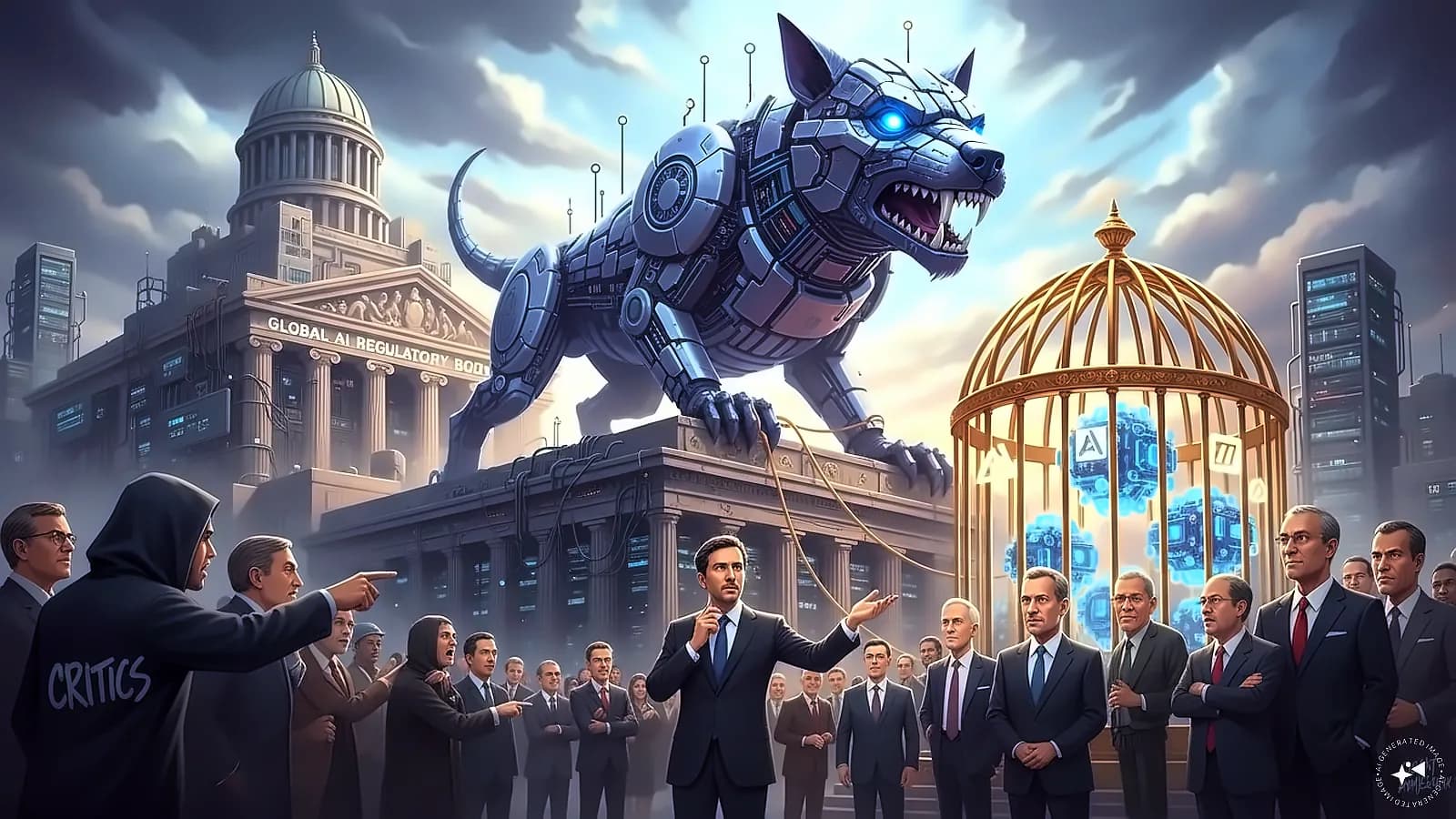
Hassabis emphasizes that the proposed US-led initiative could serve as a starting point for international consensus, with the framework applying regardless of a model's country of origin or whether it is open or closed source. According to Business Standard, the standards body would be modeled on bodies such as the Financial Industry Regulatory Authority (FINRA)—a federally overseen public-private partnership funded largely by industry. The framework would exempt non-frontier models built by startups or academic institutions, while questions around new economic models and human purpose in a "post-scarcity world" would ultimately require society-wide deliberation, not just technologists. As reported by Axios, Hassabis has spent months briefing the Trump administration, rival labs, and European officials, and wants the body running before year's end, with his read on the White House being 'very positive'. The manifesto follows months of quiet groundwork, with Hassabis and Amodei jointly urging assembled world leaders at the G7 summit in Évian-les-Bains to back a US-led AI governance framework. However, the proposal faces significant structural hurdles. Washington would need to formally authorize the organization before voluntary pre-release review could become a binding gate for US deployment. Without congressional legislation or a sufficiently explicit executive order, the body could function only in the voluntary mode that already exists informally—which is precisely the problem it is designed to solve. The Trump administration's handling of Anthropic's models last month was "a bit of a wake-up call" showing that Washington requires a formal governance structure rather than improvised, case-by-case responses. As The Hacker News documented, the Commerce Department imposed export controls on Claude Fable 5 and Mythos 5 on June 12 after Amazon researchers reported a jailbreak technique, with controls lifted on June 30 after 18 days of negotiations.