Hyderabad-based Skyroot Aerospace announced on July 2 that its Vikram-1 launch vehicle will carry multiple payloads beyond the primary mission, marking a significant milestone for India's private space sector. The maiden orbital flight will feature technology demonstration payloads from Grahaa Space, Cosmoserve Space, DCubed and Skyroot's own SCOPE, along with Cosmos Diamonds' artwork Cosmic Bloom and MicroArt by Ajay Kumar Mattewada. According to Business Standard, the mission will also include Embrace, a robotic arm experiment developed by Cosmoserve Space, which will remain attached to Vikram-1's payload deck during the planned demonstration. As per Skyroot Aerospace, the company described the mission as the beginning of a new era in Indian spaceflight, with the countdown now officially underway.
Cosmoserve Space has announced Mission Embrace, its first orbital technology demonstration mission, which will fly aboard Skyroot's maiden orbital launch during the approved launch window between July 12 and August 4, 2026. Mission Embrace will attempt what the company describes as the world's first demonstration of soft robotic capture in orbit, addressing one of the most pressing challenges in spaceflight: the growing population of inactive satellites and orbital debris. According to Business Standard, Chiranjeevi Phanindra, Founder and CEO of Cosmoserve Space, stated that Mission Embrace forms part of India's first private orbital launch carrying satellite payloads while also attempting the world's first demonstration of soft robotic capture in orbit. The company's proposed solution is a dual-spacecraft system in which a robotic servicer spacecraft captures and removes defunct satellites at what it says is around one-tenth the cost of comparable solutions.
The mission will feature Cosmic Bloom, developed by Cosmos Diamonds, featuring a diamond jewellery creation mounted on an aluminium base plate, and MicroArt by Ajay Kumar Mattewada, an 18K gold rocket holding micro-sculptures of C. V. Raman, Vikram Sarabhai (Vikram-1's namesake) and A. P. J. Abdul Kalam - each smaller than a grain of rice. According to Business Standard, Ramesh Kumar V, Co-founder and CEO of Grahaa Space, stated that missions like Vikram-1 are helping expand opportunities for emerging space companies to demonstrate and scale their technologies. Chiranjeevi Phanindra, Founder and CEO of Cosmoserve Space, noted that Mission Aagaman gave them a platform to rapidly send their systems to space and test them, advancing their soft robotic capture technology from concept to flight-ready in just four months. The technology underwent a structured engineering review process overseen by an independent committee comprising former ISRO scientists and industry veterans, with system concept review, preliminary design review, critical design review and flight readiness review before receiving clearance for launch.
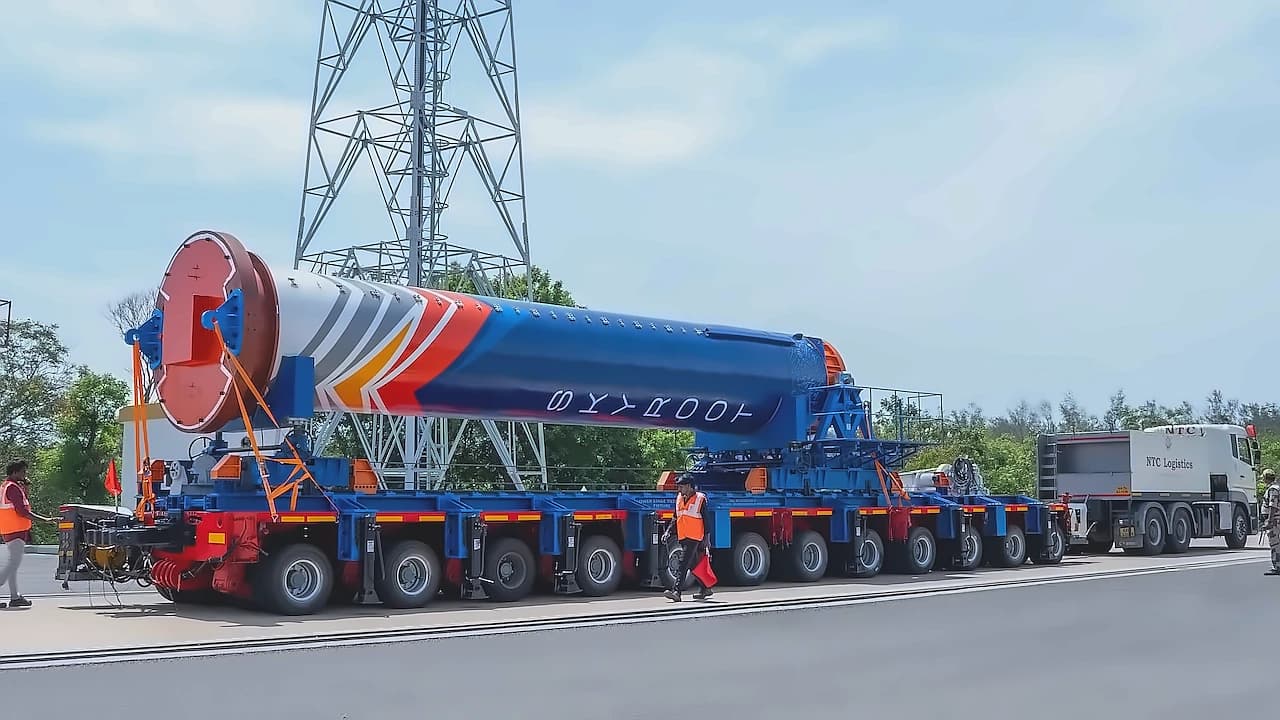
As reported by Business Standard, Vikram-1 is a seven-storey-tall, multi-stage orbital launch vehicle built with an all-carbon composite structure and powered by in-house developed propulsion systems, including 3D-printed engines and high-thrust solid-fuel rocket boosters. The mission will gather critical data across propulsion, stage separation, guidance, navigation, control and overall vehicle performance. The rocket is designed to carry small satellites weighing up to 350 kg to low Earth orbit (LEO), with the maiden mission targeting an orbit at an altitude of 450 km with a 60-degree orbital inclination. According to Skyroot Aerospace, the Vikram-1 Test Flight-1 is scheduled to lift off from the Satish Dhawan Space Centre in Sriharikota during the launch window, with the rocket now fully assembled and stacked at India's historic First Launch Pad (FLP).
According to Business Standard, Pawan Kumar Chandana, Co-founder and CEO of Skyroot Aerospace, stated that the mission aims to understand how the vehicle performs from lift-off through every phase of ascent, emphasizing that this data cannot be fully replicated through ground testing. The company expects one or two successful demonstration flights before transitioning to full-scale commercial launches, with data collected during the Vikram-S suborbital mission in November 2022 helping validate nearly 80% of Vikram-1's technology stack. This will be a partially commercial flight, with the company planning to commence full commercial flights after one or two successful demonstrations to orbit. The mission will join a mix of domestic and international customers, with Skyroot's commercial ambitions extending well beyond the domestic market, expecting 70-80% of launch demand to come from international customers, particularly from the US, Europe and Southeast Asia.
According to Business Standard, Skyroot Aerospace is backed by investors including GIC, Temasek, Sherpalo Ventures and funds managed by BlackRock, and recently raised $60 million, taking its valuation beyond $1.1 billion and making it India's first space technology unicorn. The company enjoys an early-mover advantage in India's emerging private launch market, as while rivals such as Agnikul Cosmos are also developing orbital launch vehicles, Skyroot is poised to become the country's first private company to attempt an orbital mission. The economic opportunity is equally significant, with India's space economy expected to grow from around $8.4 billion today to $44 billion by 2033.