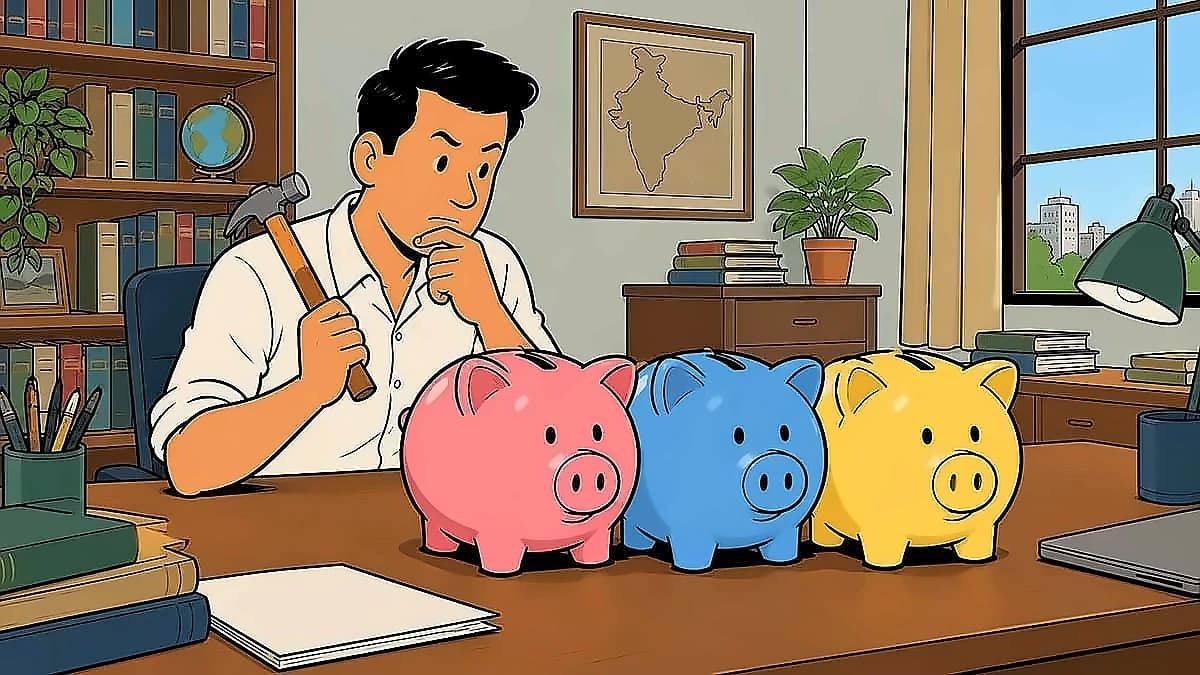
According to The Economic Times, couples in their 40s should consider transitioning from a two-income household to a two-portfolio household as their financial needs evolve. The strategy involves creating distinct portfolios for different time horizons - a growth portfolio for retirement and long-term wealth creation, and a monetary responsibilities portfolio for expenses visible within the next five to seven years. This approach allows households to fulfill immediate needs like education and healthcare without sacrificing long-term financial growth.
On a ₹1.5 crore corpus, the recommended allocation works out to approximately ₹90 lakh in growth assets and ₹60 lakh in debt and fixed income, as reported by The Economic Times. The allocation should reflect actual monetary needs rather than age alone. Ajay and Supriya calculate they will need around ₹40 lakh over the next five to seven years for foreseeable obligations, leaving the remaining ₹1.1 crore invested for long-term growth. Different couples may require different allocations based on their specific financial calendar and needs.
The article emphasizes building the second portfolio around specific dates rather than percentages. ₹10 lakh may be required in two years for education, another ₹15 lakh in four years, and the balance over the following three years. Fixed income becomes more useful when viewed through maturities rather than simply as a percentage allocation. Investors can spread money across fixed deposits, government securities, listed corporate bonds, and other suitable instruments based on tenure, liquidity, and credit profile to align with expected cash-flow needs.

The two-portfolio approach becomes particularly important as wealth grows, as reported by The Economic Times. At ₹1.5 crore, a 10% portfolio move represents ₹15 lakh. The larger the corpus, the greater the consequence of having too much near-term money exposed to assets meant for long-term growth. This distinction becomes crucial because timing changes risk - if equity markets fall 20%, a ₹1.5 crore portfolio can decline by ₹30 lakh. For retirement money with a 15-year horizon, such corrections may be part of the investment cycle, but immediate needs may force premature selling.
The strategy is designed to evolve with life stages, as noted in The Economic Times report. Once children's education is funded, couples may have fewer near-term obligations and can redirect more fresh savings toward retirement. A decade later, retirement itself will move closer, and some money that today belongs in the growth portfolio may gradually move into fixed income. The approach is not about maintaining a permanent allocation but about separating capital that needs time to compound from capital that needs to show up on time.