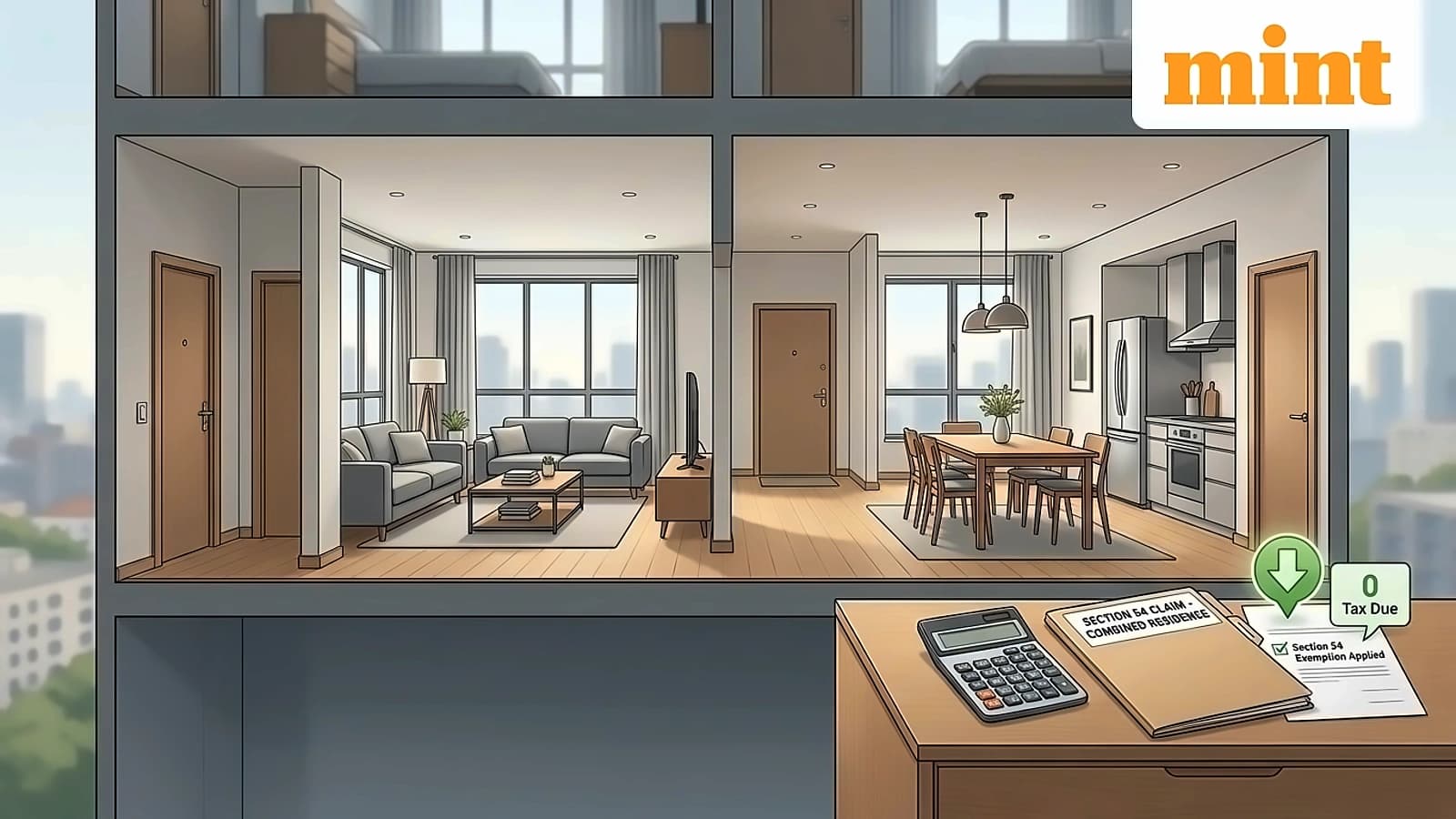
Homebuyers planning to sell both residential property and shares during the current financial year can claim tax exemptions on both long-term capital gains under the Income Tax Act, 2025. According to personal finance expert Balwant Jain, the provisions of Section 82 and Section 86 offer separate but complementary exemptions that can be utilized simultaneously for the same residential house property. For AY 2026-2027, taxpayers can now claim these benefits under Section 54 and Section 54F when filing their ITR, providing full tax exemption on capital gains from selling specified assets. The exemption is disclosed under Schedule CG (Capital Gains) and detailed information is required in Schedule CG - Part D Information about deduction claimed against Capital Gains.
Section 54 provides exemption for long-term capital gains arising on sale of a residential house when the capital gains are reinvested in another residential house property in India. As reported by tax expert Surana, the exemption is available if the taxpayer does not own more than one residential house on the date of sale of the capital asset. The prescribed time period allows purchase of a new house property within 1 year before or 2 years after the date of transfer, or construction of a new house property within 3 years from the date of transfer. However, the benefit is subject to a monetary limit of ₹10 crore, meaning any capital gains exceeding this limit would remain taxable. Additionally, taxpayers can exercise the option to invest in two residential houses where capital gains do not exceed ₹2 crore, though this option can be exercised only once in a lifetime.
Section 54F offers exemption for long-term capital gains arising on sale of any capital asset other than a residential house, provided the net sale consideration is invested in a new residential house within the prescribed time period. According to Surana's analysis, this section applies when the taxpayer does not own more than one residential house on the date of sale of the capital asset. The same time periods apply under both sections for different asset types, with Section 54F specifically covering sales of assets like land, gold, and shares. However, the benefit is subject to a monetary limit of ₹10 crore, meaning any capital gains exceeding this limit would remain taxable. If the new property is transferred within 3 years, the earlier exemption is effectively withdrawn through adjustment in the cost of acquisition, leading to higher taxable capital gains.

The Income Tax Act, 2025 allows simultaneous exemption claims under both sections for the same residential house property. As reported by Jain, homebuyers can invest capital gains from residential house sale and net sale proceeds from shares in a single house property, satisfying both exemption conditions. However, the analysis emphasizes that the existing house must be sold before starting share sales to avoid owning more than one residential house on the date of share sale. For ITR filing, taxpayers must select Section 54 for reinvestment in residential house against LTCG from residential property sale, and Section 54F for reinvestment in residential house against LTCG from transfer of other capital assets. The exemption is claimed under Section 54 in case of "Reinvestment in a residential house against LTCG arising from sale of residential property", and Section 54F in case of "Reinvestment in a residential house against LTCG arising from transfer of other capital assets".