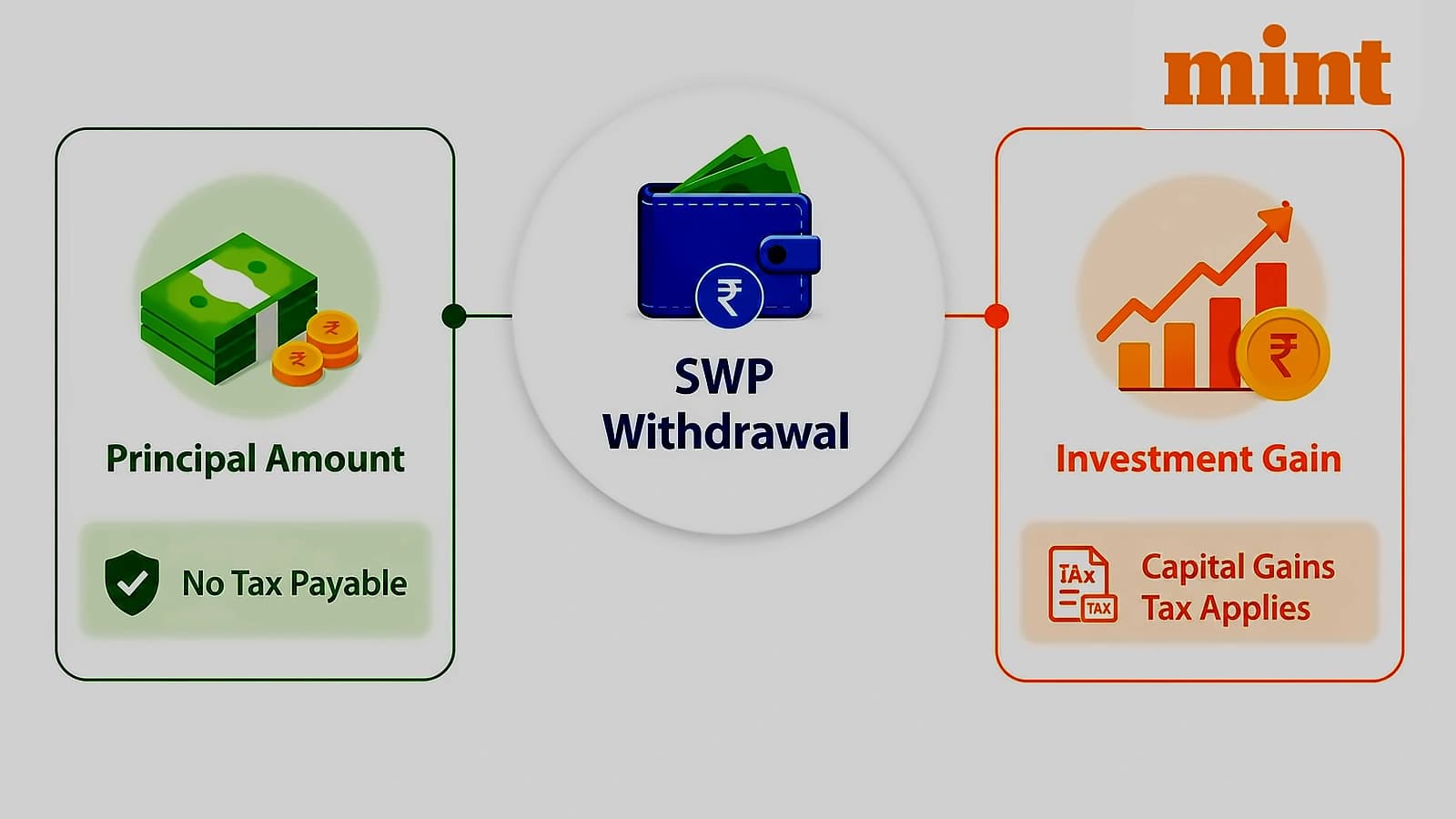
A Systematic Withdrawal Plan (SWP) allows investors to withdraw a fixed amount at pre-decided intervals while keeping the remaining corpus invested. For tax purposes, each SWP payout is considered a partial redemption of mutual fund units, comprising two components: the return of original investment (principal) and capital gains. According to reports from Mint, the principal portion is not taxable because it represents the investor's own money being returned. Tax is levied only on the capital gains component of each withdrawal, calculated as (Number of Units Redeemed × Current NAV) - (Number of Units Redeemed × Purchase NAV).
The taxable capital gain for each SWP withdrawal can vary significantly depending on NAV movements and unit redemptions. As reported by Mint, consider an investor who invested ₹1,00,000 at an NAV of ₹100, receiving 1,000 units. If the NAV rises to ₹130 and the investor starts an SWP of ₹13,000, the first withdrawal redeems 100 units originally costing ₹10,000 but now worth ₹13,000, resulting in a capital gain of ₹3,000. The second withdrawal, assuming NAV rises to ₹140, would redeem only 92.86 units with original cost of ₹9,286, generating a capital gain of ₹3,714. This demonstrates how taxable gains can differ substantially between consecutive withdrawals.
The applicable tax on SWP withdrawals varies significantly by fund type. Equity-oriented mutual funds follow holding period rules: gains from units held less than 12 months are taxed as short-term capital gains (STCG) at 20%, while gains from units held more than 12 months qualify as long-term capital gains (LTCG) at 12.5% on amounts exceeding ₹1.25 lakh in a financial year. Debt funds tax capital gains according to the investor's applicable income tax slab, regardless of holding period. Hybrid funds with more than 65% equity exposure are taxed like equity funds, while those with less than 65% equity exposure follow debt fund rules.
SWP can create passive income when withdrawals remain sustainable relative to portfolio growth. As reported by inXits, an investor with ₹50 lakh withdrawing ₹25,000 monthly represents a 6% annual withdrawal rate. The mutual fund does not pay interest like a bank deposit, instead redeeming units to generate cash flow. Whether the corpus survives depends on whether the portfolio earns more than 6% after tax each year. The structure provides flexibility because investors can modify, increase, reduce, or stop withdrawals based on requirements. However, SWP should not be viewed as a guaranteed income source - the investment remains exposed to market fluctuations, and during weak market periods, aggressive withdrawals may reduce the corpus more quickly.