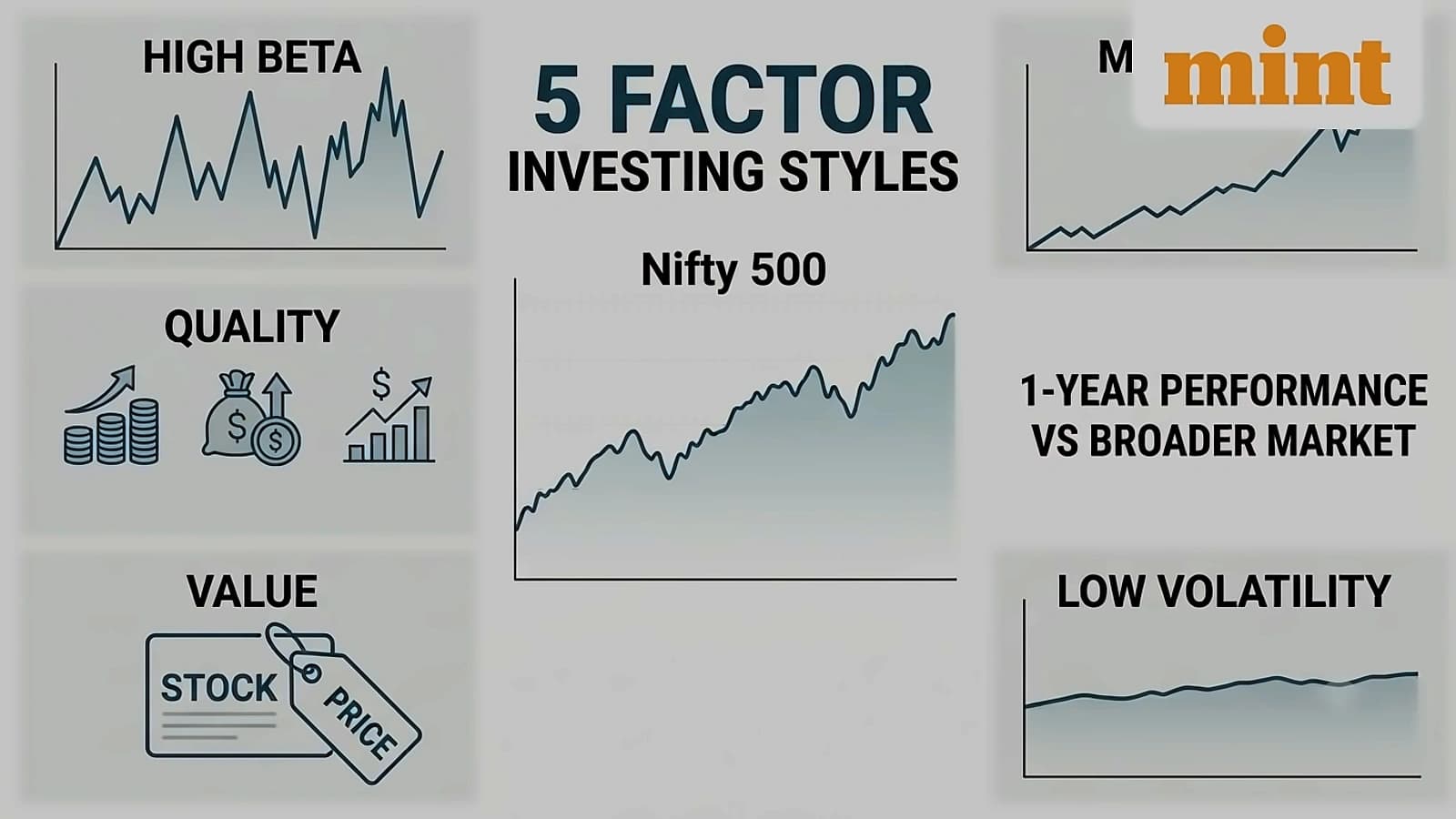
Smart beta funds, which use factors like value, momentum, quality, and low volatility to create unique stock baskets, have shown mixed performance across different strategies. According to reports from Personal Finance News, these funds aim to outperform conventional indices by combining passive investing with factor-based stock selection. The analysis covers 11 schemes with assets under management (AUM) of at least ₹500 crore, providing insights into how these funds have performed since their launch.
In the current market environment, value funds are outperforming all other smart beta strategies across all time horizons analyzed. As reported by Personal Finance News, the two value funds included in the study have delivered nearly 30% returns over both 3 and 5 years. The Motilal Oswal BSE Enhanced Value Index Fund leads with 31.51% returns over 5 years, while the UTI Nifty 500 Value 50 Index Fund shows 30.54% returns over 5 years. The trend continues in 2026, with the Nifty500 Value 50 TRI gaining 7.3% year-to-date, compared with a 4.8% decline in the Nifty 500 TRI, indicating an outperformance of 12.1 percentage points. According to Mahavir Kaswa, head of passive research at Axis Mutual Fund, investors have preferred relatively inexpensive stocks with stronger valuation support.

Momentum funds tracking the same indices have produced nearly identical returns, with 3-month returns ranging from 7.57% to 7.63% and 6-month returns from 0.45% to 0.76%. According to the analysis, four funds tracking the Nifty 200 Momentum 30 index show minimal differences in performance. However, all four Nifty 200 Momentum 30 funds have delivered negative 1-year returns, with returns ranging from -0.17% to -0.70%. The Bandhan Nifty Alpha 50 Index Fund stands out with the highest 3-month return at 12.96% and 6-month returns of 8.01%. In 2026, momentum strategies have rebounded on improving earnings, though they continue to lag behind value factors.
The Bandhan Nifty 100 Low Volatility 30 Index Fund has delivered 0.74% returns over 1 year, significantly outperforming momentum strategies during volatile periods. As reported by Personal Finance News, this fund has posted strong 3-year returns of 11.76% and 5-year returns of 12.71%. The fund appears to be delivering on its low volatility promise by avoiding the losses that momentum strategies suffered recently due to market volatility. The UTI Nifty200 Quality 30 Index Fund, launched in September 2024, has already returned -3.67% over 6 months and -1.67% over 1 year. Low volatility and quality factors have struggled in 2026 due to higher exposure to sectors like IT and FMCG, which have delivered relatively muted returns.
Factor investing is experiencing a resurgence with AUM growing from under ₹7,000 crore across 50 schemes in 2023 to over ₹50,000 crore across 125 schemes by April 2026. The trend began with Franklin Templeton's Franklin India Multi Factor Fund in November 2025, followed by Motilal Oswal's Multi Factor Passive Fund of Funds in February 2026, and continued with Groww's Nifty Smallcap 250 Momentum Quality 100 ETF in May 2026. According to experts, factor investing will remain relevant through 2026 and could gain further momentum as markets stabilize. Bharat Lahoti from Edelweiss Mutual Fund believes factor strategies can potentially deliver 2-4% alpha over traditional benchmarks with better risk-adjusted returns across market cycles, though single-factor performance remains volatile and regime-dependent.