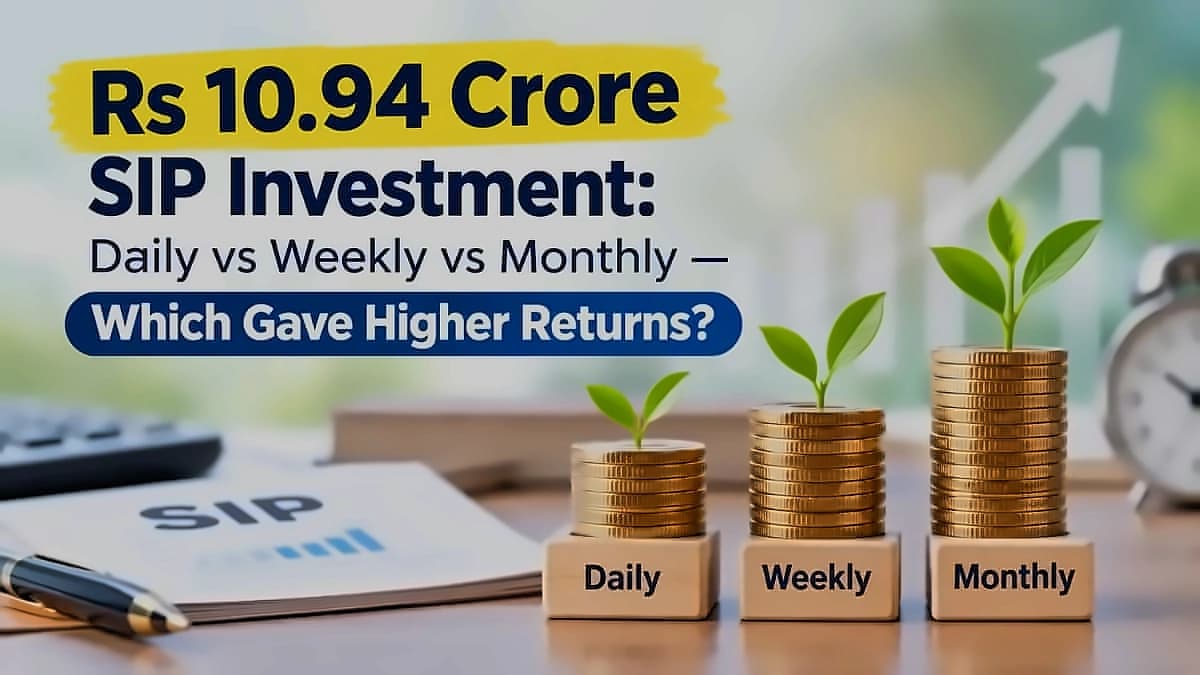
A comprehensive analysis comparing daily, weekly, and monthly systematic investment plans (SIPs) based on the BSE Sensex TRI from 1996 to July 2026 revealed minimal differences in long-term returns. According to the analysis reported by Zee Business, when the same total investment of approximately ₹10.94 crore was divided across different SIP frequencies, the investment values showed marginal variations. The daily SIP generated an investment value of ₹12.61 crore with an Extended Internal Rate of Return (XIRR) of 13.53%, while the weekly SIP produced ₹12.62 crore and the monthly SIP achieved ₹12.73 crore with the same 13.53% XIRR. Financial expert Pankaj Mathpal, MD of Optima Money, explained that the difference between SIP frequencies is more related to investor behavior than wealth creation, emphasizing that there is no specific 'right time' to invest and stressing the importance of starting early, remaining disciplined, and continuing investments over the long term.
According to Zee Business, Mathpal cautioned that investors should not change their SIP frequency simply for higher returns, noting that "there have been many studies. This daily, weekly, monthly does not give any different benefit." He emphasized that long-term data does not show a meaningful advantage simply because an investor chooses a higher SIP frequency, stating that "there is no right time for SIP." The expert highlighted that what matters is how long an investor stays invested and maintains the investment, rather than focusing on specific SIP dates or frequencies. He also warned that results could vary across different indices and that investors should not assume that a higher SIP frequency automatically means higher returns.
Experts recommend choosing SIP frequency based on cash flow convenience rather than following specific trends. For salaried investors, Mathpal suggested aligning SIPs with salary cycles, recommending "for salaried people, their salary comes on the last day of the month or the beginning of the month... immediately between the 1st and 5th, you can do your SIP." For investors with uneven cash flows, he advised choosing SIP dates according to when money is available, noting that "if you have uneven cash flow... you can decide according to which date of the month you have more money." The analysis of SIP dates between 1st and 28th consistently for the BSE Sensex TRI found that XIRR ranged from 13.50% to 13.56%, indicating very small differences from SIP date selection. Mathpal recommended that investors choose SIP dates based on cash flow rather than trying to identify specific 'good' or 'bad' days.
Certified Financial Planner Poonam Rungta highlighted that daily and small-ticket SIPs are gaining popularity due to digital transactions making it easier for investors to invest smaller amounts more frequently. According to Zee Business, Rungta cited examples such as ₹250 micro-SIPs and ₹100 monthly investments, while daily investments of small amounts have become increasingly accessible. She noted that such investments can help increase participation among investors in Tier-2 and Tier-3 cities and lower-middle-income groups, though she cautioned against blindly following trends without understanding financial goals and risk appetite. The increasing use of UPI and digital transactions has made smaller investments more convenient, with Rungta explaining that "Rs 10 is not a big thing" and can help make equity investments more accessible to a wider range of investors.
The analysis suggests that investors can choose SIP frequency based on cash-flow convenience and discipline rather than assuming higher frequency automatically generates significantly higher returns. According to Zee Business, experts emphasized that consistency is more important than simply following the trend of daily SIPs. For salaried investors, monthly SIPs shortly after receiving salary may be convenient, while those with irregular income may prefer different frequencies or dates based on money availability. Daily SIPs can facilitate smaller-ticket investments, though experts warned against choosing them simply because they are becoming popular. The comparison is based on the BSE Sensex TRI and outcomes could differ for other indices or investment periods, but the historical analysis shows SIP frequency did not materially change long-term return outcomes when total investments were comparable. Experts also highlighted the importance of asset allocation, selecting appropriate funds, reviewing and rebalancing portfolios, and maintaining long-term investment discipline over focusing exclusively on SIP frequency.