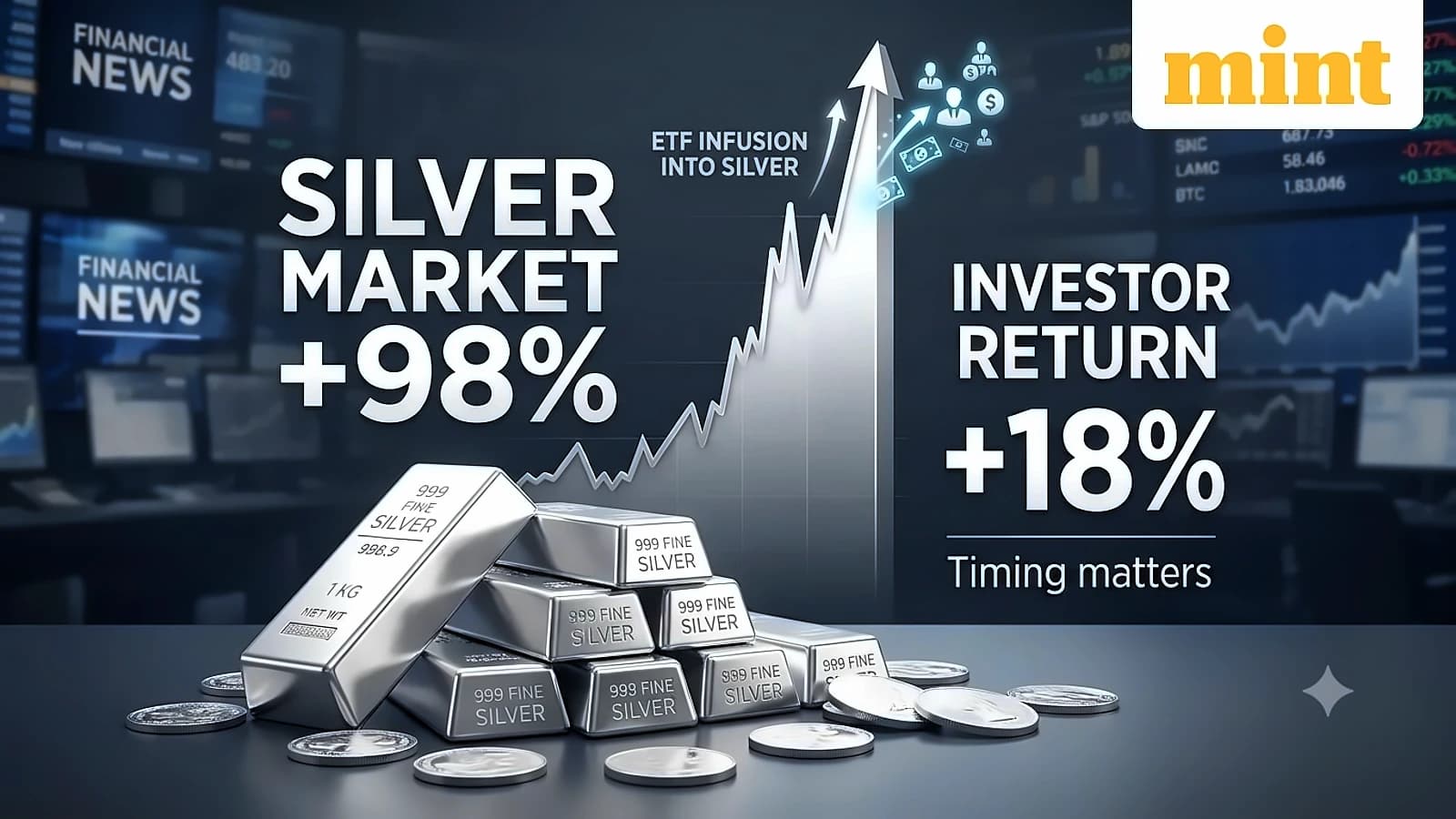
Silver has delivered an impressive 98% gain over the past year, but investors have earned significantly less. According to the September 2026 report from DSP Mutual Fund titled 'NETRA - Early Signals Through Charts', the average investor earned only 18% on a money-weighted basis during the same period. The stark contrast between silver's price performance and investor returns highlights a critical timing issue in market participation, with the gap representing a 80 percentage point difference between asset returns and investor returns.
The 56% figure represents a more concerning statistic, showing that 56% of the money invested in silver over the past 12 months is currently sitting at a loss as of July 31, 2026. As reported by DSP Mutual Fund, this money-weighted return reflects both the amount invested and the timing of those investments. When larger amounts enter after sharp price rises, those late investments have a greater impact on overall returns, explaining why silver's impressive 98% price gain didn't translate into similar investor returns. According to Amol Joshi, Founder of PlanRupee Investment Services, this pattern is particularly visible in categories with sharp swings in returns, where investors tend to monitor one-year returns closely and strong recent performance can quickly translate into higher flows.
The report identifies FOMO (fear of missing out) as a key factor in poor investor timing. According to DSP Mutual Fund, FOMO doesn't involve buying the wrong asset but rather buying the right asset after most of the return has already happened. When investors see spectacular returns, past performance creates expectations that rallies will continue, leading to pro-cyclical behavior where money chases rising prices. This behavior was particularly evident in silver ETFs, where investors put substantially more money in after prices had already climbed sharply. As Bajaj AMC's Ganesh Mohan noted, this industry requires very critical advice, pointing to the tendency of investors to make behavioral mistakes when markets turn volatile.
Silver ETF inflows accelerated significantly as prices moved higher, with January 2026 recording ₹11,761 crore in a single month - the largest monthly inflow on record. As reported by DSP Mutual Fund, these January inflows were roughly equal to the total inflows silver ETFs received over the entire 12-month period from September 2024 to August 2025, when silver prices were still below ₹1.41 lakh. The report notes that investor demand became strongly pro-cyclical, with more money chasing silver as prices rose, demonstrating how timing can significantly impact investment returns. According to DSP's analysis, this pattern is visible across multiple asset classes, with investors adding ₹19,000 crore to technology funds over 24 months after the category had already delivered strong gains.
The silver example illustrates a fundamental principle that 'FOMO converts past returns into future expectations' but warns that 'the price you pay determines the return you get'. According to DSP Mutual Fund, there's an important difference between asset returns and investor returns, and large portions of money entering near price peaks may not benefit equally from subsequent gains. The report emphasizes that this lesson applies broadly to all markets, with Bajaj AMC's Ganesh Mohan citing data showing investors earned 2.5-5% less than fund returns across three-, five-, and 10-year periods. Amol Joshi advises investors to use asset allocation and time-bucket strategies, keeping money needed for 6-12 months in liquid funds and only allocating long-term money to broader asset classes. The message is clear: systematic investing can reduce entry-point risks, but behavioral discipline remains crucial for investment success regardless of asset performance.