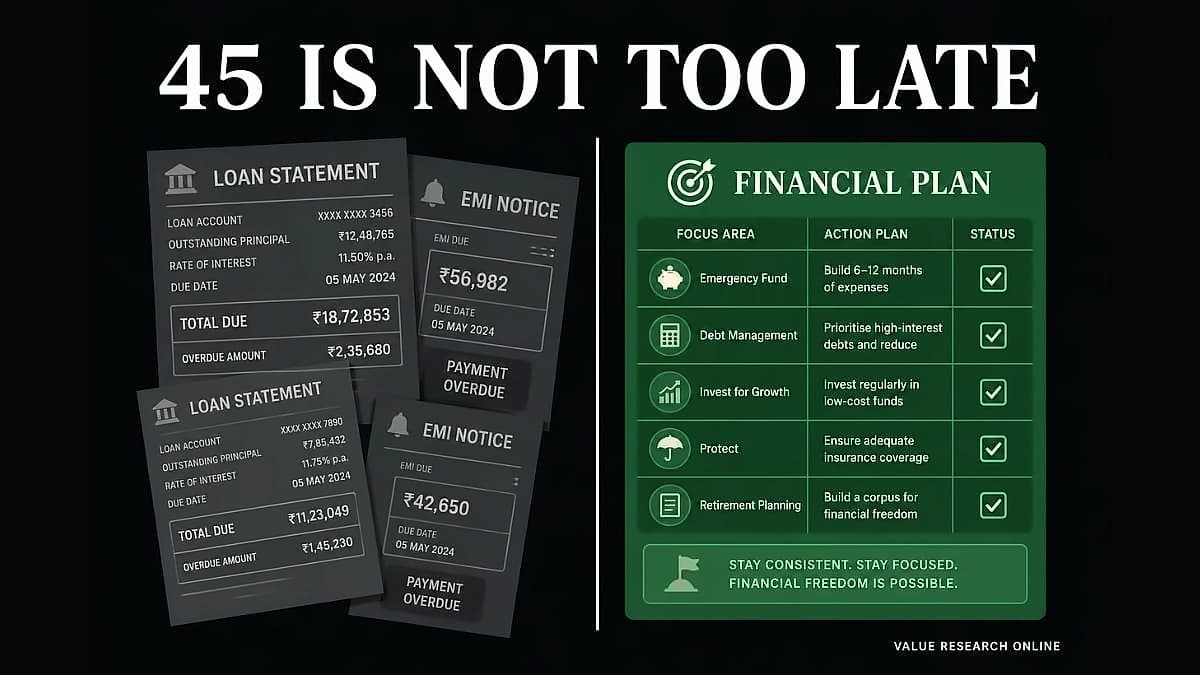
A recent survey by 1 Finance of 1,218 individuals aged 40-60 revealed significant gaps in retirement preparedness. According to the survey findings, 75.5% of Indians nearing retirement do not have a detailed retirement plan. This crisis was highlighted by Ritu Arora, a 40-year-old publishing house employee in Delhi, who realized she had not begun saving for retirement after a conversation with a senior citizen neighbor struggling with inflation and rising healthcare expenses. As reported by financial experts, present bias often makes near-term expenses appear more urgent than retirement, which may be 20-25 years away. Retirement falls into the category of important but not urgent goals, with benefits visible only after a long period of time while shorter-term goals demand immediate attention.
The delay in starting retirement savings creates a significant financial burden. According to financial advisors, a person who starts saving at 25 has 35 years to build the target retirement corpus, while someone who starts at 40 has only 20 years. Assuming a target corpus of ₹5 crore and a 10% annual return, a person who starts at 25 needs to save about ₹15,500 a month, while one who starts at 40 needs to save almost ₹73,000 a month. As reported by Arvind Rao from Arvind Rao and Associates, the required monthly saving becomes nearly five times higher when saving is delayed by 15 years due to the lost compounding benefit. However, recent developments show that time remains an ally - a portfolio with 8% annual return will double every nine years, meaning a 50-year-old with ₹200,000 saved could see that value quadruple to ₹800,000 by age 60 without additional contributions.
Financial experts recommend a systematic approach to retirement planning for late starters. According to Arvind Rao, a 40-year-old should begin by calculating current annual expenses and identifying expenses that may not continue after retirement, such as children's education and home loan EMIs. The estimated annual retirement expense should then be inflated to age 60, with 6% inflation over 20 years making an annual expense of ₹9.6 lakh become about ₹30.8 lakh at 60. A common thumb rule suggests targeting a retirement corpus equal to 30-35 times annual expenses at 60, though this estimate varies across families. Another approach uses the 4% withdrawal rule, assuming annual withdrawals should not exceed 4% of the corpus. If annual retirement expense at age 60 is ₹30.8 lakh, the base corpus required would be around ₹8 crore. Financial planners suggest adding a healthcare buffer once the required corpus is known, and the investor should back-calculate the monthly saving needed to reach it. As reported by Kevin Estes from Scaled Finance, someone who's established in their career may be closer to their financial goals than they think, potentially having more income than ever, a low mortgage balance and 35 years of earnings for Social Security retirement benefits.
For a 40-year-old with a 20-year retirement horizon, equity mutual funds should be a key investment vehicle as they tend to beat inflation and outperform many other asset classes over long periods. As reported by financial experts, equity fund values can fall by 30-35% during market corrections, requiring investors to tolerate volatility. The National Pension System (NPS) offers additional tax benefits of ₹50,000 and allows equity allocation of up to 75%. Under the new tax regime, salaried individuals can invest up to 14% of basic salary through NPS and qualify for a deduction. EPF returns of 8.25%* are higher than many fixed-income instruments, while PPF provides risk-free and tax-free returns with a 15-year lock-in period, though investment is limited to ₹1.5 lakh per annum. Financial planners recommend removing any product yielding less than 6% from the retirement portfolio. Additionally, diversifying retirement accounts across 401(k)s, Roth IRAs, HSAs, and regular brokerage accounts can benefit retirement tax strategy. Recent recommendations include paying off high-interest debts before retirement, trimming discretionary spending like dining out and unused subscriptions, and considering part-time work to bridge any retirement gaps. The retirement plan should also be protected against the risk of the earner's death through adequate term insurance, with the term insurance running at least until 70.

Late starters should prioritize retirement over short-term goals and automate retirement investments to avoid manual saving delays. According to financial advisors, retirement should receive priority over vacations, furnishing a new house, or buying a new car. If the projected corpus appears inadequate, late starters should consider reskilling or upskilling to work longer beyond 60. As reported by Renu Maheshwari from Finscholarz Wealth Managers, working beyond 60 can reduce withdrawals from the retirement corpus and allow it to compound for longer. However, employment after 60 may be difficult to find in a young country with favorable demographics, and health may not permit full-time work after 60. Avoiding 401(k) loans is crucial as the lost potential investment compounding can be substantial by retirement. Even though it might seem insignificant, 1% changes in contribution rates can reduce nest eggs by up to $300,000 or more by retirement. Recent recommendations include paying off high-interest debts before retirement, trimming discretionary spending like dining out and unused subscriptions, and considering part-time work to bridge any retirement gaps. Additionally, Health Savings Accounts (HSA) offer triple tax advantages with $4,400 individual and $8,750 family limits in 2026, plus an additional $1,000 for ages 55 and older. The retirement plan should also be protected against the risk of the earner's death through adequate term insurance, with the term insurance running at least until 70.