The Punjab government has approached the Supreme Court challenging a Punjab and Haryana High Court order directing it to clear all pending dearness allowance (DA) and dearness relief (DR) dues owed to state employees and pensioners within a fortnight. The special petition, filed by the additional chief secretary of the finance department, challenges the 3 August judgment of the High Court that directed the state to pay the pending dues at rates applicable to All India Services officers posted in Punjab. According to the government's plea, 'compliance is not merely difficult; it is constitutionally impossible in the time allowed', citing Article 266(3) which states that no money may be appropriated from the consolidated fund of a state except in the manner provided by the Constitution. The state has also challenged the High Court's direction to pay 6 per cent simple interest if it failed to comply and restraining it from undertaking 'unproductive' expenditure until the outstanding dues are settled.
Punjab's primary objection centers on the constitutional process for withdrawing money from the state's Consolidated Fund. The government has cited Article 266(3), which requires withdrawals from the Consolidated Fund to follow the procedure laid down under Articles 202 to 206 of the Constitution. According to the state's petition, releasing ₹14,191 crore within 14 days without following this process cannot be legally done. The state has also pointed to a liquidation plan approved by its Cabinet in February 2025, under which the outstanding arrears were to be cleared in stages over five financial years rather than through a one-time payment. Punjab has asked the Supreme Court to set aside the High Court's order and restore the state's discretion to determine DA rates and the timeline for clearing arrears.
In its Supreme Court petition, the Punjab government has argued that its service rules do not require the state to pay DA to its employees at the rate announced by the Centre for its employees. The state contends that the Punjab Civil Services (Revised Pay) Rules, 2021, do not specify any particular index, formula, rate or periodicity for calculating DA, with the decision on these aspects remaining within the state government's discretion. Punjab has also questioned the High Court's reliance on DA paid to All India Services officers as a benchmark for determining state employee entitlements. The petition states that 'All India Services officers receive DA at Central rates because their service conditions are governed by Union law', giving Punjab no authority to independently determine its service conditions. The government has also challenged the restriction on 'unproductive' expenditure, arguing that such spending was neither specifically established nor supported by evidence before the High Court.
The state government has argued that its existing DA rate of 42 per cent already provides higher aggregate monthly emoluments than those applicable to corresponding Central categories in five of the seven representative categories cited by the government. According to the government's plea, 'in five of the seven categories, the Punjab employee already draws more at the existing 42 per cent by between ₹1,832 and ₹17,852 a month'. In the clerk and constable cadres, Punjab's basic pay alone of ₹38,600 exceeds the entire Central aggregate of basic pay and DA at 60 per cent, namely ₹36,960. The government has also challenged the High Court's direction to pay 6 per cent simple interest if it failed to comply and restraining it from undertaking 'unproductive' expenditure until the outstanding dues are settled. In the remaining two categories, Punjab said the gap would also turn into a surplus under the state's proposed calculations.

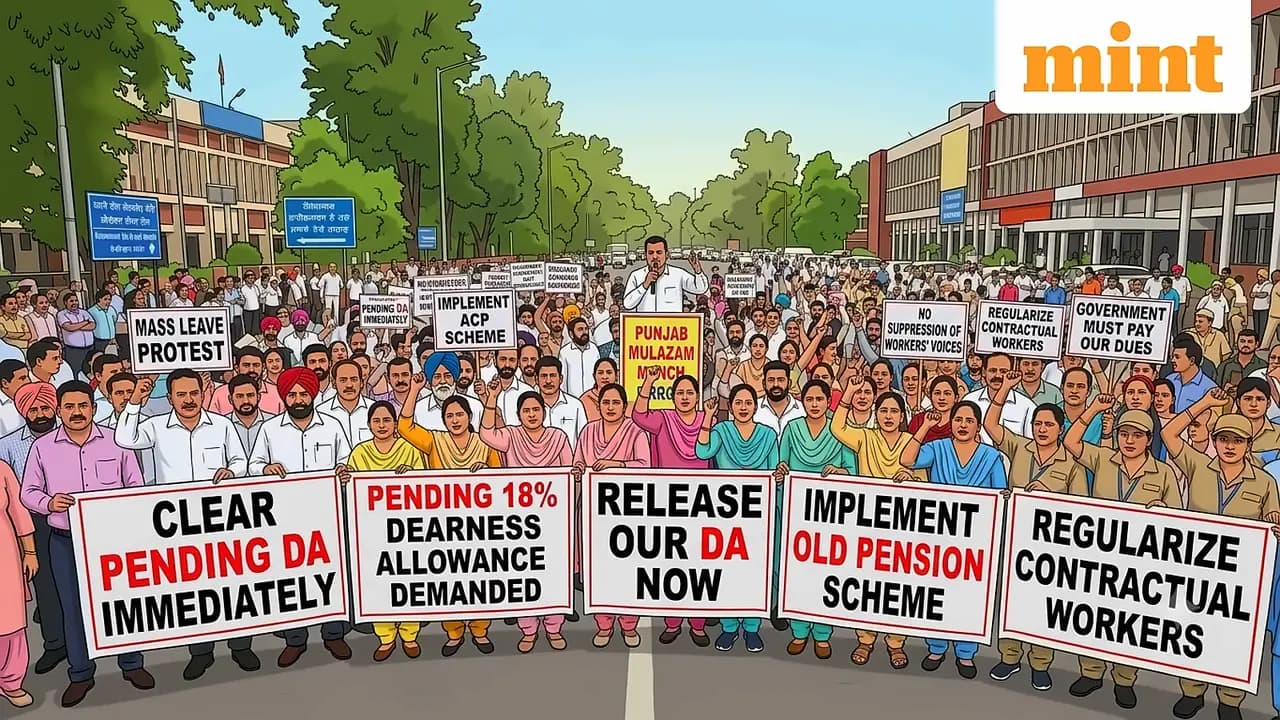
Over 3 lakh state government employees participated in a mass strike on 27 August to demand payment of pending Dearness Allowance (DA) and other employee benefits. The strike affected government hospitals, dispensaries and educational institutions, with nearly four lakh pensioners joining employees in staging day-long demonstrations outside government offices at district, tehsil and block levels. According to employee unions, DA arrears amounting to ₹20,191 crore remained unpaid, with ₹14,191 crore related to the preceding period. The employees are currently receiving DA equivalent to 42 per cent of their basic pay but maintain that the applicable rate should be 58 per cent. The strike was organized by over 150 employees' bodies unified under the 'Punjab Sanjha Mulazam Manch' banner, with support from more than 3.50 lakh pensioners.
BJP national spokesperson Gaurav Bhatia has accused the Mann government of 'persecuting' state employees and called the leader a 'dictator', alleging that the Punjab government was 'suppressing and harassing' its employees through 'oppressive policies' and denying them the 'constitutional right' to raise their voice and protest. Punjab Congress president Amarinder Singh Raja Warring has expressed support for protesting employees, calling their demands 'fully justified' as they were seeking their rightful dues rather than any special favour. The Punjab government may move the Supreme Court against the Punjab and Haryana High Court's order in the DA case, with the petition likely coming this week, citing sources. Warring questioned the government's inability to provide around ₹14,000 crore for employee-related dues and criticised the state for paying ₹341 crore to consultants in connection with raising a ₹25,000-crore loan.