The Pension Fund Regulatory and Development Authority (PFRDA) has postponed the implementation of revised charges for Points of Presence (PoPs) under the National Pension System (NPS) and NPS Lite. According to PFRDA's circular released on October 26, 2026, the new implementation date is December 1, 2026, instead of the earlier prescribed date of October 1, 2026. The regulator stated that Central Recordkeeping Agencies (CRAs) shall implement the revised charge structure for deduction of applicable charges with effect from December 1, 2026. The circular, numbered PFRDA/2026/53/REG-POP/09, was issued to all Points of Presence, CRAs and other stakeholders, giving CRAs additional time to implement the revised charges applicable to subscribers across the covered schemes. The extension applies to revised Point of Presence (PoP) charges under the schemes, with all other provisions of the PFRDA's August 28 circular remaining unchanged.
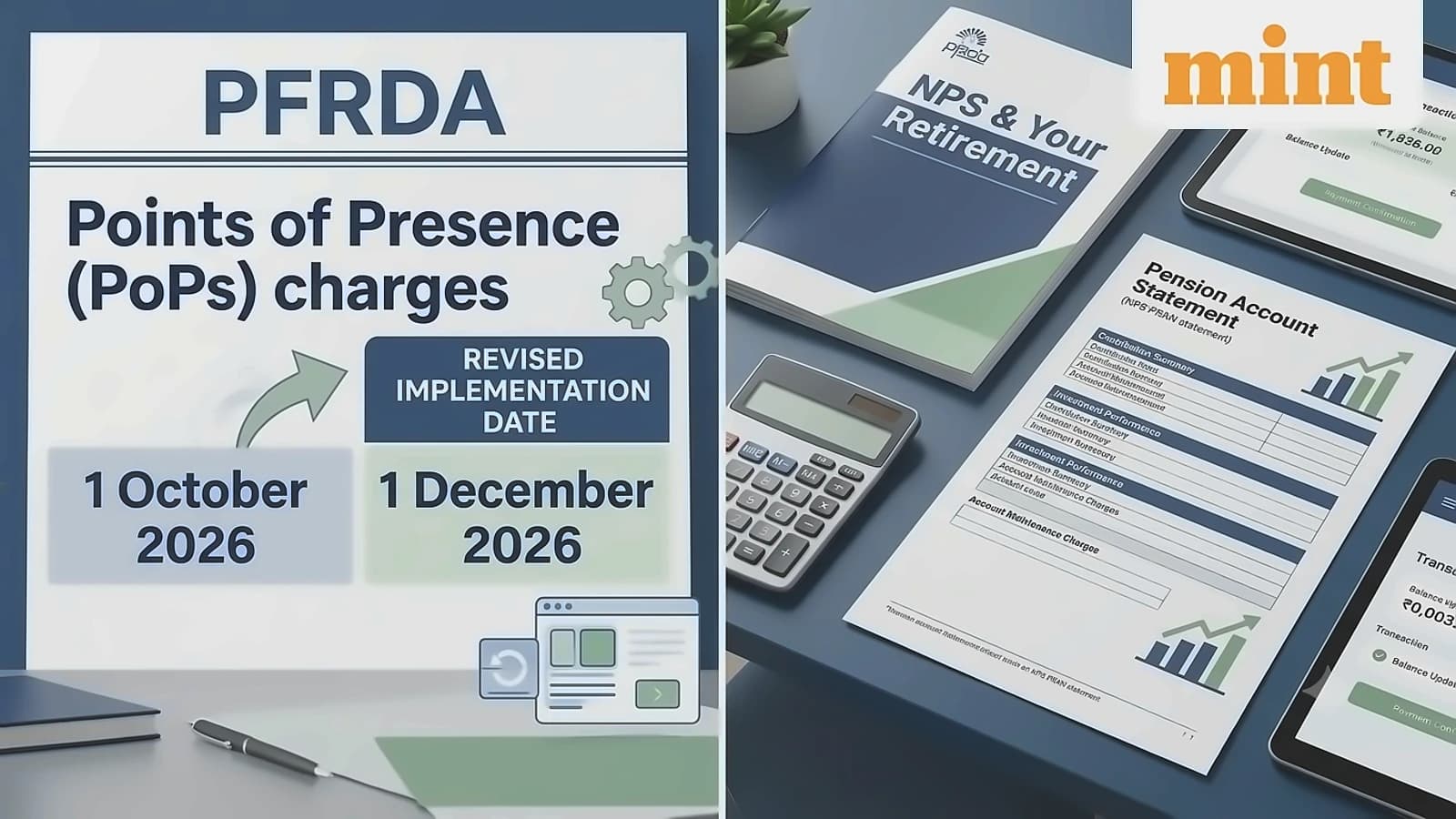
The revised structure, announced on August 28, 2026, provides for a one-time onboarding charge of ₹200 per Permanent Retirement Account Number (PRAN) and an annual charge of 0.20% of assets under management (AUM) across all NPS schemes. As reported by PFRDA, the onboarding charge will be deducted in four quarterly instalments of ₹50 through cancellation of units by CRAs and paid to the Point of Presence (PoP) in the month following the quarter in which onboarding is completed. A reduced one-time charge of ₹100 may apply where onboarding is fully digital and non-face-to-face, as determined by the regulator. Digital onboarding through e-NPS could potentially eliminate PoP fees entirely for subscribers who use e-NPS for both joining and subsequent contributions. The revised framework excludes dormant accounts from the annual AUM-linked PoP charge, with accounts classified as dormant where there has been no contribution for four consecutive quarters following a contribution, based on the prescribed identification process across CRAs. The annual charge varies with the value of the assets managed, with an NPS corpus of ₹5 lakh attracting ₹1,000 annually and a ₹10 lakh corpus attracting ₹2,000 before applicable taxes.
According to PFRDA, subscribers onboarded through e-NPS who make subsequent contributions through e-NPS or D-Remit will not be liable to pay PoP charges. However, subscribers onboarded through a PoP will remain liable for prescribed charges even if they subsequently contribute through e-NPS or D-Remit. The circular specifies that a dormant account is one linked to a unique PAN across all CRAs in which no contribution is made for four consecutive quarters, as identified at the end of each quarter, and such accounts will not attract annual charges. The circular also specifies minimum contributions of ₹250 at onboarding and ₹10 for subsequent contributions under NPS. Subscribers should check the detailed August 28 circular for the precise applicability conditions and how their accounts are classified. Certain accounts opened and funded exclusively through specified e-NPS and D-Remit channels are exempt from PoP charges, with subscribers required to confirm their eligibility rather than assuming that every online account qualifies for exemption.
As reported by PFRDA, PoPs must display their updated charge structures on their websites and clearly communicate the applicable charges to subscribers through pop-up notifications during digital onboarding. Subscribers should check the PoP's revised fees before opening an account, and the circular emphasizes that GST and other applicable taxes are additional to the stated charges. Before December 1, 2026, subscribers should check whether their account is serviced through a PoP or qualifies for an exemption, ask their PoP or CRA for a breakdown of applicable charges and taxes, and confirm whether their account meets the conditions for dormant-account exemption. Points of Presence are authorised intermediaries that help subscribers access NPS services, including account opening and contributions, while Central Recordkeeping Agencies maintain subscriber records and process related transactions. The revised charge structure is scheduled to come into effect on December 1, 2026, with CRAs implementing the revised framework for the deduction of applicable charges from that date.