The Reserve Bank of India's Monetary Policy Committee (MPC) will meet from October 5 to October 7, 2026, with the policy decision on the repo rate to be announced on October 7. According to reports, the repo rate currently stands at 5.25 percent following the RBI's August policy review. Any change in the repo rate can impact borrowing and deposit rates, though the actual effect on consumers depends on how banks transmit these changes to their lending and deposit rates. The October meeting will decide whether the central bank keeps the rate unchanged or makes a fresh change, with banks not always changing their loan or fixed deposit rates immediately or by the same amount.
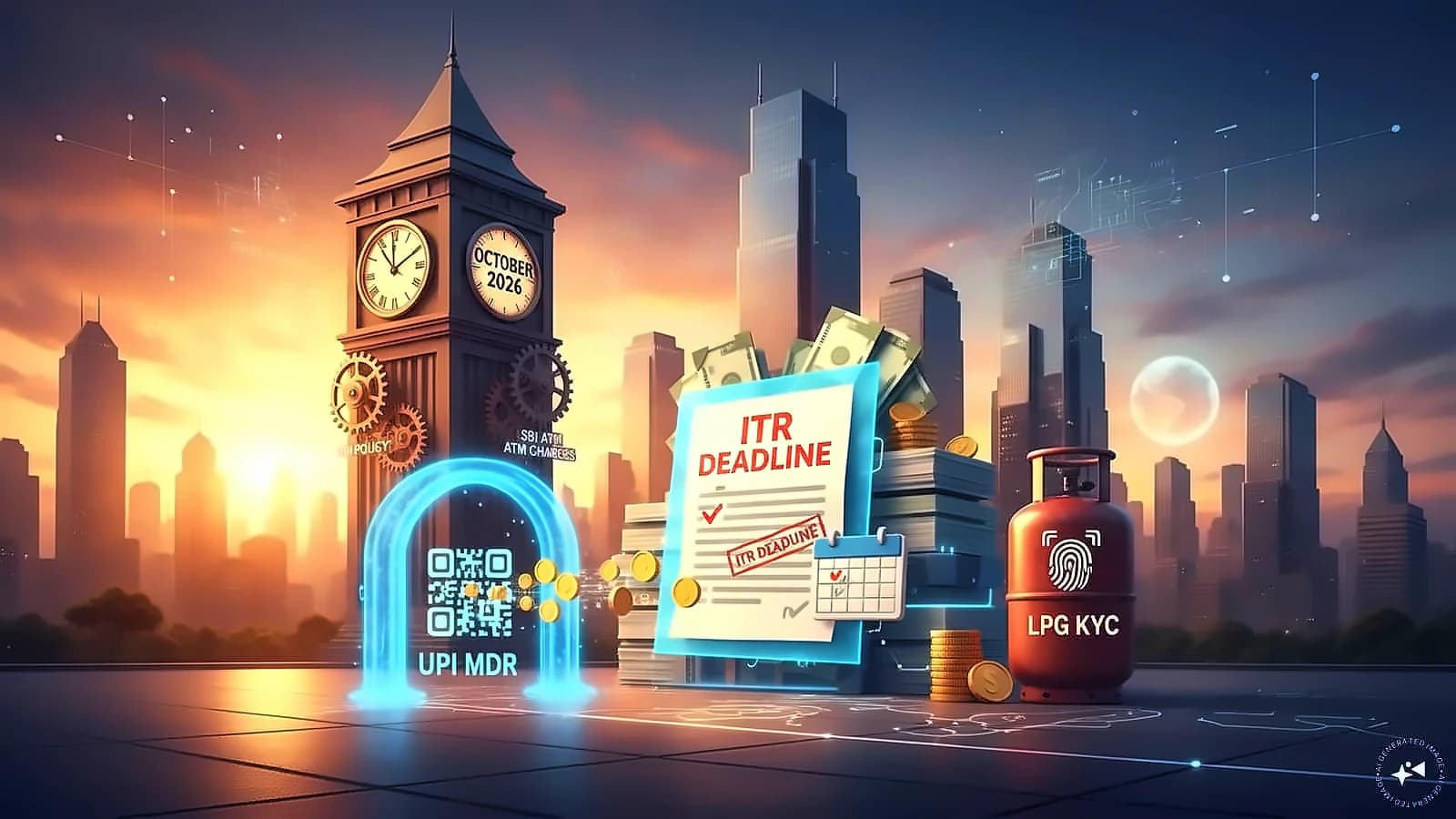
A significant change to the UPI ecosystem will take effect from October 15, 2026, when a 0.4% MDR will be levied on UPI transactions between person to merchant above ₹2,000. As reported, the Supreme Court has declined to grant an interim stay on this framework while seeking responses from the Centre, RBI and NPCI. Nearly 96% of UPI users will not be affected by this change, as person-to-person transactions and those qualifying for exemption will remain exempt from paying the MDR. The National Payments Corporation of India (NPCI) has implemented a Merchant Discount Rate (MDR) of 0.4% for Person-to-Merchant (P2M) UPI transactions above ₹2,000, with the MDR limited to ₹300 per transaction for amounts over ₹75,000. This implies that the merchant, not you, will be responsible for paying the MDR if you pay them more than ₹2,000. Therefore, small-value UPI transactions up to ₹2,000 will not be subject to the MDR, and customers can continue utilizing UPI applications for all regular expenses without worrying about the MDR. The Supreme Court has refused to put a stay on the decision after it was challenged through a Public Interest Litigation (PIL), while seeking responses from the Centre, RBI, NPCI, and other parties on the decision to allow a 0.4% MDR on specified transactions above ₹2,000. Finance Minister Nirmala Sitharaman has clarified that the MDR will be borne by merchants and will not be passed on to consumers, with the government reiterating that appropriate measures will be taken to prevent merchants from passing these charges on to customers.
Indian stock brokerages are considering new charges, including mandate-based payments and scaling back free offerings, to cushion the impact of the 0.02% MDR on UPI transactions for capital-market payments, capped at ₹300 per transaction. According to people familiar with the matter, the framework threatens to squeeze already-thin margins as money transferred into trading accounts doesn't always result in a trade, with investors potentially moving funds in and leaving them unused while the broker still bears payment-related costs. "Unlike other business transactions, brokerage houses receive funds very often towards margin. Every transaction is not going to generate income," said K Suresh, president and chief executive officer at India Cements Capital. "We are expecting a hit of ₹5 crore to ₹6 crore on revenue monthly after the MDR is implemented. In the long term, we may look at increasing our brokerage costs or introducing another line of charges to offset the impact of the charges," said an official from one of the top brokerages. The concern stems from SEBI rules requiring brokers to return unused client funds every month or quarter, generating additional transactions without corresponding revenue.
The All India Mobile Retailers Association (AIMRA) has called for a nationwide 'No UPI Day' on October 2 to protest against the proposed Merchant Discount Rate (MDR) for UPI transactions above ₹2,000. According to The Economic Times, the retailers' body said that the proposed charge may increase the cost burden on small businesses and impact their profit margins significantly. To mark the protest, retailers nationwide will have UPI QR codes hidden under black cloth, as announced by AIMRA. The association emphasized that micro, small and medium enterprises, shopkeepers and independent retailers are on a narrow profit margin and rely on digital payments to do their daily business, making the imposition of charges on routine digital payments particularly concerning. AIMRA stated that retailers support the wider adoption of digital payments but want policymakers, financial institutions and the National Payments Corporation of India (NPCI) to reconsider the proposed MDR and withdraw it entirely. The association demanded the proposed 0.4% MDR be reconsidered and withdrawn, stating that it was 'One Nation, One Trade Fraternity, One Voice'.
October 2026 brings several critical income tax compliance deadlines that taxpayers must be aware of. October 7 marks the deadline for routine tax compliance requirements including deposit of tax deducted or collected during September 2026, quarterly deposit of TDS for July-September 2026, and uploading of declarations received from recipients in Form 121 during the quarter ended September 30, 2026. October 15 is significant for TDS certificates and quarterly statements, including the issue of prescribed TDS certificate in Form 132 for tax deducted in August 2026 and furnishing of Form 92 by specified fund or stock broker for the quarter ended September 30, 2026. October 21 represents the revised tax audit deadline for taxpayers covered by the specified audit category, with the deadline extended from September 30 to October 21, 2026, as announced by the CBDT on September 28, 2026. October 30 requires the challan-cum-statement in Form 141 for specified cases covering tax deducted during September 2026, while October 31 remains important for quarterly TDS and TCS statements including Form 140, Form 143, and Form 144 for the quarter ended September 30, 2026. November 21 marks the revised ITR deadline for taxpayers covered by the specified audit category, with the deadline extended from October 31 to November 21, 2026, specifically for taxpayers covered by the relevant provisions mentioned in the CBDT circular.
SBI is revising the number of free monthly transactions available to salary package account holders who use their SBI debit cards at ATMs and Automated Deposit-cum-Withdrawal Machines of other banks. As reported, the revised rules will come into effect from October 1, 2026, with the number of free transactions at other banks' ATMs being reduced from 10 to 5 per month across all SBI salary package account variants. For Basic Savings Bank Deposit accounts, four cash withdrawals will continue to be free, after which every transaction will attract a charge of ₹15 plus GST. Additionally, SBI has announced new service charges for holders of Basic Savings Deposit Accounts (BSBDs) that will take effect from October 1st, 2026. After the free limit is exhausted, SBI will charge ₹23 plus GST for a financial transaction and ₹11 plus GST for a non-financial transaction. This change specifically affects SBI Salary Package Account holders using other banks' ATMs, with those who largely use SBI ATMs or digital banking seeing little or no direct impact. Digital transactions would continue to remain free under the revised rules.
Starting October 1, 2026, the Pension Fund Regulatory and Development Authority (PFRDA) has revised NPS charges for Points of Presence (PoPs) under the National Pension System and NPS Lite, with the new structure applying from October 1, 2026. According to reports, subscribers registering through a PoP will have to pay a one-time onboarding charge of ₹200 for each Permanent Retirement Account Number (PRAN). Additionally, NPS Swasthya is launching on October 1, 2026, which is a health-focused pension product that allows subscribers to build a dedicated corpus for medical expenses. The minimum initial contribution must cover the first-year premium, including taxes, a ₹200 maintenance charge plus applicable taxes, and ₹1,000 towards investment in the NPS Swasthya account. Subsequent contributions shall be made with a minimum limit of ₹10. The insurance policy is a family floater that covers the subscriber, spouse, and up to two dependent children, with the entry age set from 18 to 70 years and renewal continuing up to age 85 years. For subscribers completing the entire process online, the PFRDA has a provision for a lower charge of ₹100, as determined by PFRDA. The latest framework also includes an annual PoP charge of 0.20% of the assets under management (AUM) through the Net Asset Value, with charges deducted by Central Recordkeeping Agencies from the third quarter of FY 2027-2028.
Starting October 1, 2026, banks will be required to publish interest rates applicable on bulk deposits before fixing them and publish them every business day at 10 a.m.. According to reports, bulk deposits will be required to pay the same rate of interest, except for permitted differentiation according to liquidity treatment. The RBI's amendment is essentially about pricing discipline and transparency, with three key changes: banks can now price bulk deposits of ₹3 crore and above differently depending on how 'sticky' that money is under the Liquidity Coverage Ratio framework, so stable funding gets rewarded; banks must publish their bulk deposit rates by 10 am every working day and honour those published rates; and similar deposits booked on the same day must get the same rate across all branches, ending the practice of branch-level or negotiated pricing. This new policy framework aims to encourage transparency in pricing among banks and help customers with bulk deposits compare rates more effectively. The revised FD rules will be applicable from October 1, 2026, with banks across all branches required to provide the same rate of interest on deposits of the same amount made on the same day to ensure no customer in any part of the country faces discrimination by banks in terms of the rates offered.