Building a retirement corpus doesn't require a massive fund if you start early, control future expenses, and create reliable income streams. According to recent financial planning guidance, the key is not to chase an arbitrary target but to focus on making retirement expenses lower and income sources more dependable. Starting early is the biggest lever, as money invested for 25-30 years gets far more time to compound than money invested during the final decade of your career. Even modest initial contributions can make substantial differences when increased gradually with every salary hike, focusing on increasing the savings rate over time rather than waiting for large surplus to appear. The key strategy is to ask 'How can I make my retirement expenses lower and my income sources more dependable?' rather than pursuing an unnecessarily large corpus.
An NPS subscriber can discontinue fresh contributions for a few months or even several years without affecting the existing corpus. According to reports from Mint, the money already accumulated continues to remain invested with the selected Pension Fund and across the asset classes chosen by the subscriber. The value of the corpus can continue to increase or decline depending on the NAV and performance of the underlying investments. For a Tier I NPS account, the minimum contribution is ₹500 per transaction, while the minimum contribution required in a financial year is ₹1,000, with at least one contribution during the year. The account continues to benefit from market-linked returns, although the value can rise or fall based on the performance of the underlying investments in diversified portfolios including equity, corporate bonds, and government securities.
The impact of stopping NPS contributions varies significantly based on the duration of the pause. According to SBI Pension Funds NPS calculator, a 40-year-old individual contributing ₹10,000 monthly with a 12% annual return would build a corpus of ₹99,91,476 over 20 years without any breaks. However, taking a one-year break would reduce the corpus to ₹87,53,250, representing a loss of ₹12,38,226. Extending the pause to three years would result in a corpus of ₹66,79,205, losing ₹33,12,271 from the original target. A five-year pause would reduce the corpus to ₹50,45,756, losing ₹49,45,720 from the optimal outcome. Since NPS doesn't offer fixed returns due to market dependence, it's difficult to estimate the exact value of the final retirement corpus.
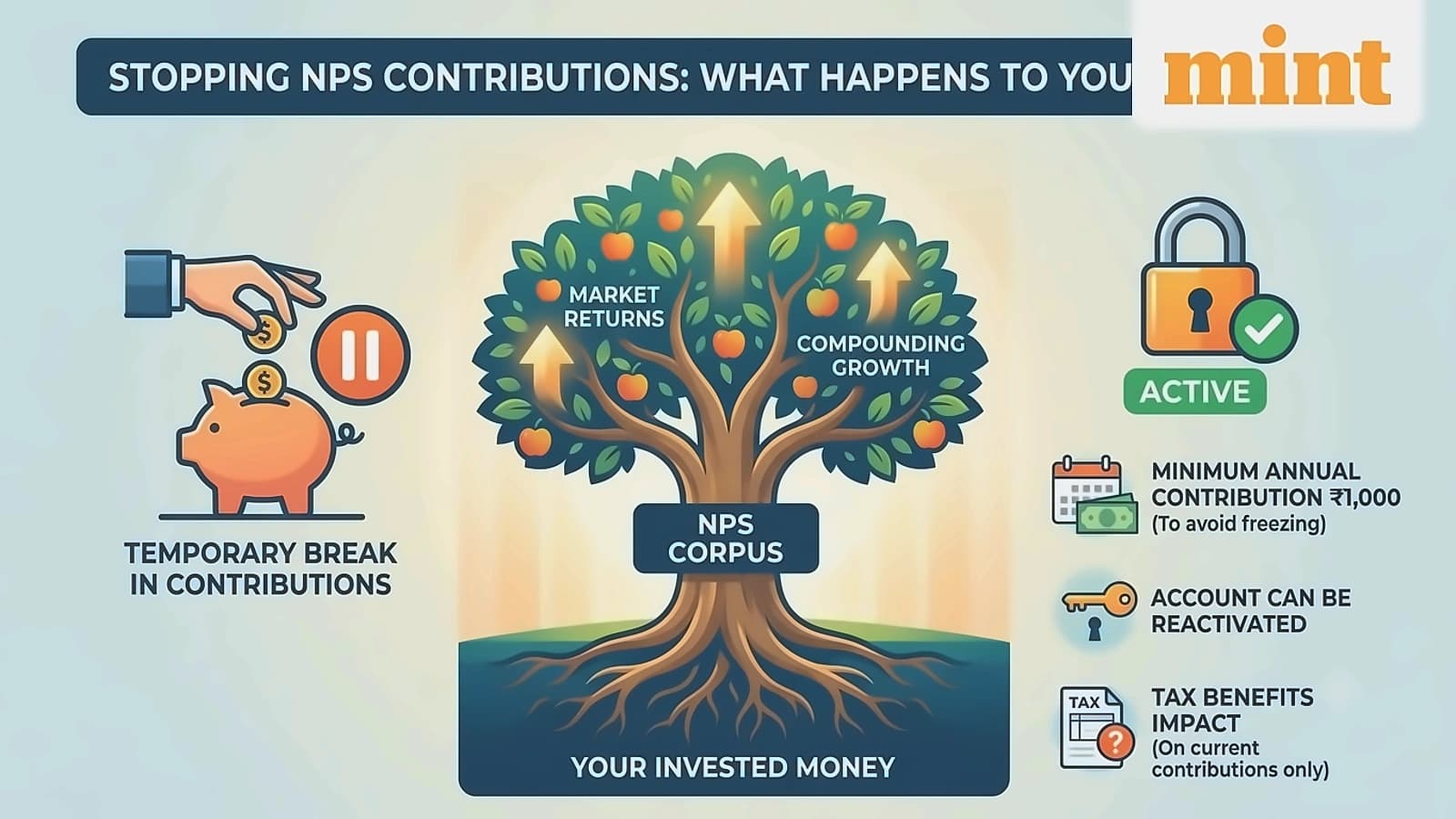
The tax implications depend on the tax regime followed and whether the NPS contribution is made by the individual or employer. As reported by Mint, stopping contributions does not make the existing NPS corpus taxable, nor does it take away deductions that were legitimately claimed in previous years. Under the old tax regime, an individual's own NPS contribution can qualify for a deduction within the overall ₹1.5 lakh limit under Section 123 of the Income-tax Act, 2025, subject to applicable conditions, with an additional deduction of up to ₹50,000 available for NPS contributions under Section 124(3). Under the new tax regime, deductions for individual NPS contributions are not available, but employer contributions continue to receive separate tax treatment, with employer contributions of up to 14% of salary qualifying for deduction even for non-government employees.
Asset allocation matters significantly in retirement planning, with diversified portfolios that gradually become more conservative as retirement approaches being essential. As reported by financial experts, keeping the entire retirement corpus in low-return assets may make it difficult to keep pace with inflation, while excessive equity exposure can create sharp fluctuations close to retirement. A diversified portfolio that gradually becomes more conservative as retirement approaches can balance growth with the need to protect near-term expenses. Healthcare costs should not be underestimated, as a smaller retirement corpus can work only if you have adequate health insurance and a separate medical reserve. One major hospitalisation can force you to withdraw a large amount from investments at precisely the time when your earning income has stopped. Inflation is another critical factor, with RBI's August 2026 outlook projecting CPI inflation for 2026-27 at 5 percent, illustrating why today's expenses cannot be carried unchanged into retirement decades away.
The account does not automatically close merely because contributions have stopped, and it can generally be reactivated by making the required contribution through the applicable Central Recordkeeping Agency (CRA) process. According to Mint, under the current PFRDA framework, an account with no contribution for four consecutive quarters can be classified as dormant. Making a fresh contribution can restore the account to active status, subject to the applicable CRA procedure. Under PFRDA's current All Citizen Model rules, normal exit after age 60 or applicable vesting period allows up to 80% of accumulated pension wealth as lump sum and at least 20% for annuity purchase, subject to corpus thresholds and conditions. Corporate employees can withdraw up to 80% of the accumulated balance as a lump sum, while government employees can withdraw up to 60% of their wealth at exit, with the remaining amount mandatory for annuity purchase.