Under Securities and Exchange Board of India (SEBI) rules, a minor can hold a demat account that must be operated by a guardian until the child turns 18. According to reports from Mint, a demat account is held in the child's name with the parent operating it using the child's own PAN. No separate ITR filing is required for the child - the income is clubbed in the parent's return, with the clubbed income reported in the parent's ITR-2 or ITR-3 if the parent has business income. ITR-1 cannot be used when a minor's income is clubbed because it does not contain Schedule SPI.
The clubbing rules depend on the marital status of the parents. As reported by Mint, for subsisting marriages, the income is included in the total income of the parent whose total income (before including the minor's income) is higher. For example, if the father earns ₹12 lakh and the mother earns ₹8 lakh annually, the minor's income will be clubbed with the father's income. In cases of non-subsisting marriages (separated or ended marriages), the income is clubbed with the parent who maintains the minor child during the year. Once income is included in one parent's income, it continues for subsequent years unless the Assessing Officer agrees to a change.
According to Mint reports, dividends are taxed at the parent's slab rate, while short-term capital gains on equity are taxed at 20%. Long-term capital gains on equity are taxed at 12.5% on gains above ₹1.25 lakh. The ₹1.25 lakh exemption applies to the parent's aggregate eligible LTCG, including the minor's clubbed LTCG, and is not available separately for each minor child. Parents should maintain a clear bank trail showing fund transfers to the child's account, and if their income exceeds ₹1 crore, investments held in the minor's name may need to be disclosed as part of assets.
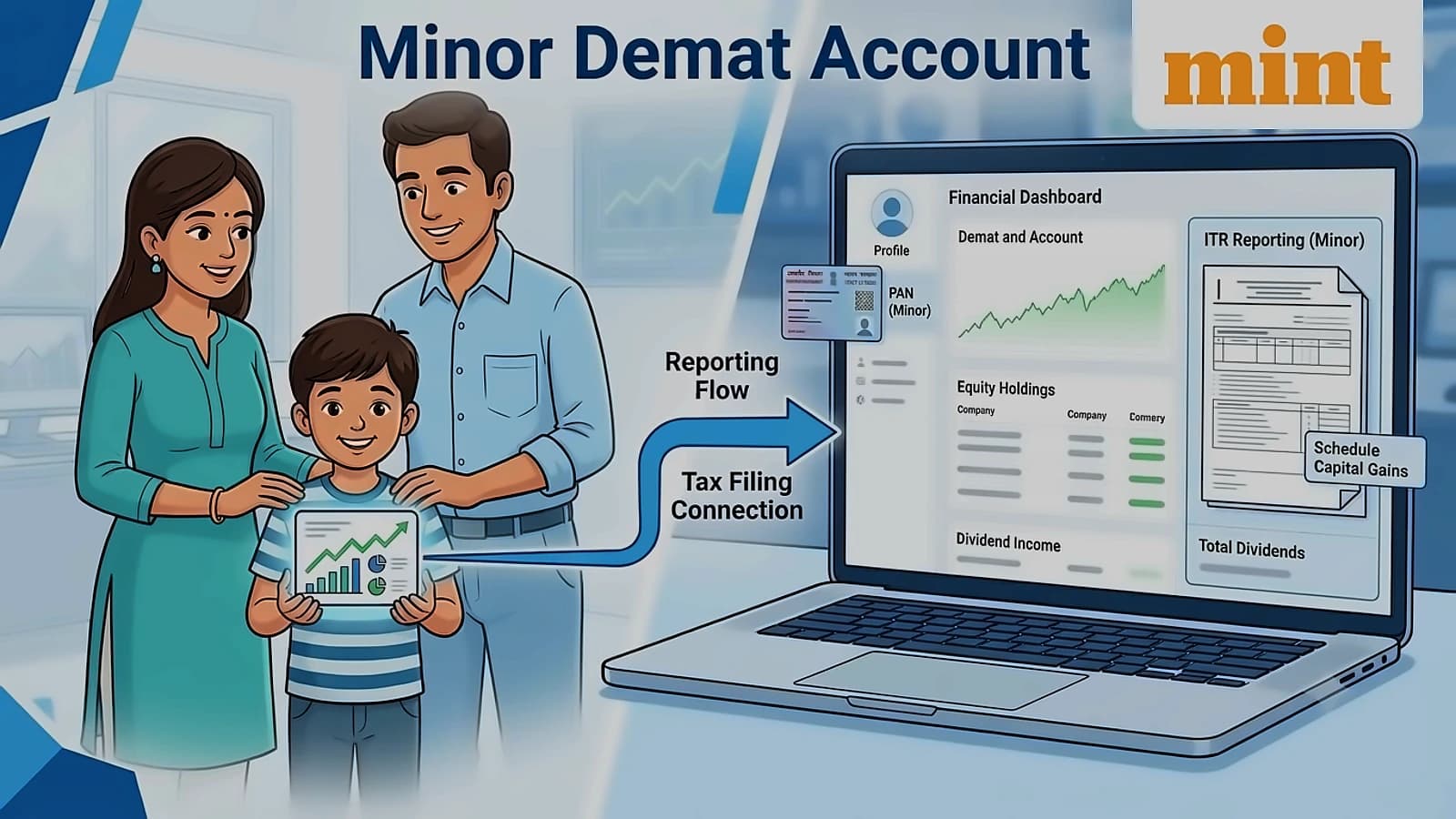
As reported by Mint, parents should check AIS, TIS, and Form 26AS for both child and parent PANs to reconcile investment income with broker's tax statements. Schedule SPI should include the child's name, PAN, relationship, nature of income, and amount. Schedule CG and Schedule 112A should report capital gains with scrip-wise details, while Schedule OS should report dividends with quarter-wise break-up. Schedule EI can claim section 10(32) exemption up to ₹1,500 per minor child or actual clubbed income, whichever is lower. Schedule TDS2 should claim TDS on the child's PAN since the parent is the person in whose hands the income is ultimately taxable.
According to Mint reports, money invested by a parent for a minor is treated as a gift from a relative, which is not taxable with no specific disclosure required in the ITR. For capital gains, the child's cost of acquisition remains the purchase price paid by the parent. If the minor's income results in a loss, the parent can club it and set it off against their own income. If the parent's income exceeds ₹1 crore and Schedule AL is applicable, investments held in the minor's name may need to be disclosed as part of assets.