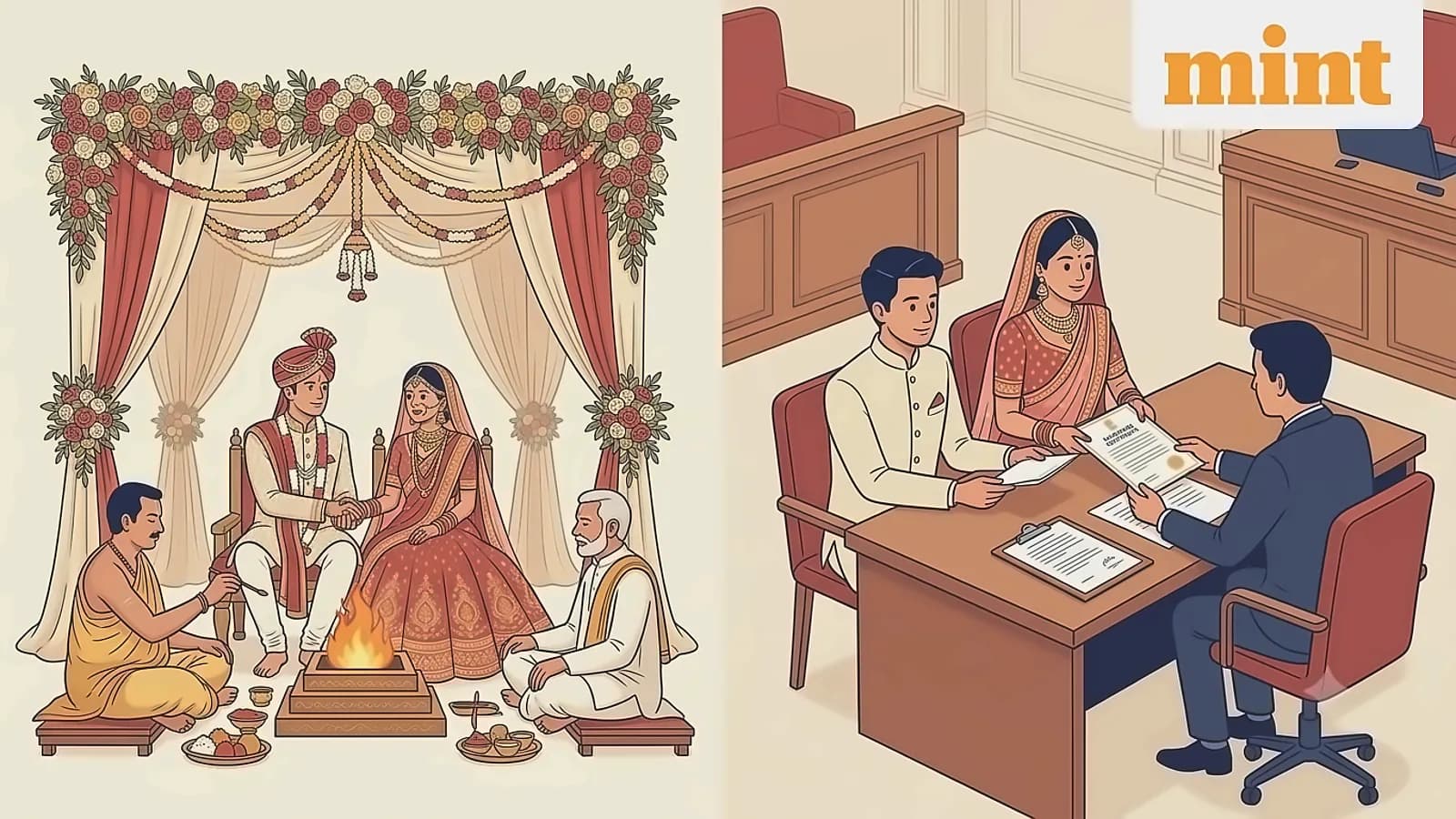
Marriage registration is not mandatory in India, according to legal experts. Amitraj Kaushal, Advocate at the Supreme Court of India, explained that the Hindu Marriage Act, 1955, provides for registration under Section 8, while the Special Marriage Act, 1954, governs other civil marriages. The Supreme Court in Seema v. Ashwani Kumar emphasized compulsory registration of marriages, though state rules differ in procedures, deadlines and penalties. As reported by Mint, Siddharth Maurya, Founder & Managing Director of Vibhavangal Anukulkara, stated that marriage registration serves as an important legal safeguard and must not be considered a formality.
Marriage registration is not necessarily restricted to marriages performed after a particular year, according to Kaushal. Older couples can generally seek registration of an already solemnised marriage, subject to the applicable state law, prescribed procedure and evidentiary requirements. However, Kaushal noted that retrospective registration does not automatically cure a marriage that was legally invalid when performed. The Supreme Court has held that all religious communities must follow the procedure of compulsory registration of marriages, with couples advised to check rules applicable to their place of marriage rather than assuming uniform procedures across India.
Non-registration does not automatically invalidate a marriage, as confirmed by Kaushal under Section 8(5) of the Hindu Marriage Act. Maurya explained that the lack of registration does not necessarily invalidate a marriage, provided all legal requirements including ceremonial requirements for a valid marriage are satisfied. Without registration, a spouse may face greater difficulty proving the marriage in court of law, particularly when records, witnesses, or customary evidence are unavailable. This can complicate maintenance, divorce, inheritance, pension, and immigration claims, according to Kaushal.
Proof of age and identity (Aadhaar/passport etc. as applicable), proof of residence, photographs, wedding card or ceremony proof if relevant, affidavits where local practice asks for them, and prior marriage dissolution papers if applicable are commonly requested documents for marriage registration. As reported by Adhiwakta, the exact process depends on state rules, personal law, and individual circumstances. Notice periods, objections, and fees differ between different routes, with couples hearing of registration under personal/religious marriage laws in some states and civil notice-and-registration themes under the Special Marriage Act for inter-faith or civil marriages. Requirements vary by office and route, with verification required locally.
A marriage certificate provides reliable proof of marital status for spouse visas, immigration, insurance and pension claims, employment benefits, bank or government records, and certain inheritance-related proceedings, as explained by Kaushal. Maurya noted that a marriage certificate supports financial claims, administrative processes and protection of a spouse's legal rights, including visa and immigration applications, insurance and death benefits, employer-provided pensions, banking transactions, employee benefits, and succession and inheritance claims. Courts can consider other admissible evidence including witnesses, photographs, ceremonies, and cohabitation when establishing a marriage, though the absence of an official record may increase time and effort required.